


 Français
 Español
 العربية
 한국어
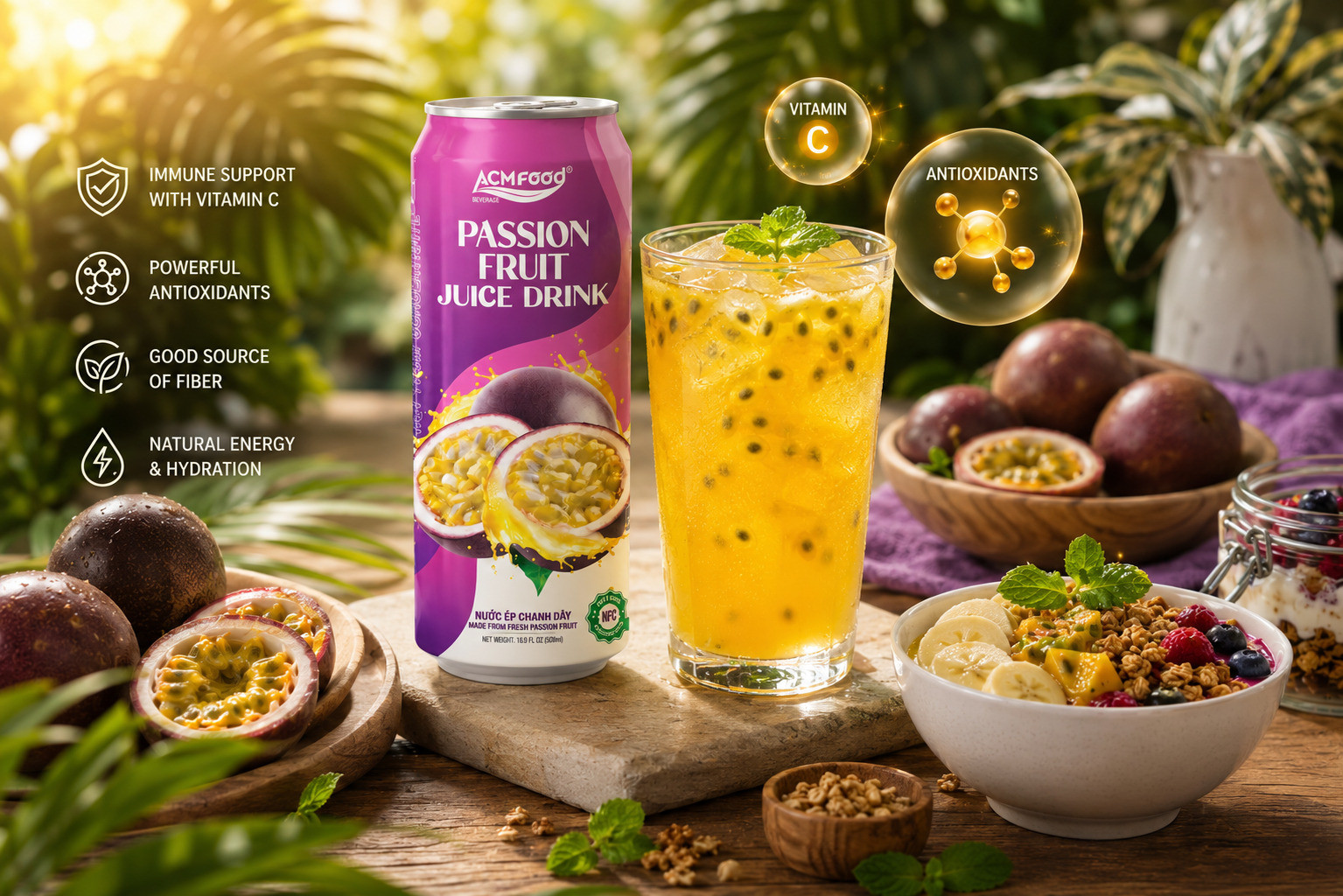
한국어Passion fruit is one of the easier tropical fruits to build a beverage around, for a reason that has nothing to do with marketing: it is intensely aromatic and strongly acidic. The aroma means a small inclusion rate delivers a recognisable flavour, and the acidity means the finished product usually sits well below the pH threshold that complicates processing. Both facts make it a practical starting point for a new brand.
This guide covers what passion fruit brings to a formulation, how OEM and white label production differ, and what a brand should have ready before approaching a manufacturer.
Why passion fruit works well as a beverage product
- High aroma intensity. Passion fruit carries a distinctive tropical aroma at low inclusion rates, so a blend can be recognisably passion fruit without the raw material cost of a single-fruit juice.
- Strong natural acidity. The pulp is markedly acidic, which usually keeps a finished formulation comfortably below pH 4.6 and allows a simpler thermal process.
- Distinctive colour. The golden-orange pulp gives a visual identity that stands apart from the more crowded orange and mango shelf.
- Blends readily. It works with mango, orange, pineapple, guava and coconut without either flavour disappearing.
- Established supply. Passion fruit is a mature commercial crop in Vietnam, so purée and concentrate supply is well developed.
Yellow or purple: which variety matters
Two varieties dominate commercial supply. The yellow type is larger, more acidic and higher yielding, and is the one most used for juice and purée production. The purple type is smaller, sweeter and more aromatic, and is more often sold as fresh fruit or used where aroma matters more than yield.
For a beverage project the distinction usually shows up as a difference in acidity and colour rather than as a naming decision on the label, since most markets do not require the variety to be declared. It is worth asking which your purée supplier uses, because switching between them changes the finished taste.
The forms passion fruit arrives in
| Form | What it contains | Typical use |
|---|---|---|
| Single-strength juice | Pressed juice, seeds removed | Clear or lightly cloudy drinks |
| Purée | Pulp with natural body retained | Nectars and fuller-bodied blends; the most common form |
| Concentrate | Water removed for shipping and storage | Year-round supply at lower freight cost |
| Purée with seeds | Pulp including the edible black seeds | Products where visible seeds are part of the identity |
Seeds are a specific decision rather than a detail. Visible seeds signal authenticity and are a recognisable cue for the fruit, but they need filling equipment that can pass them without blocking, and they settle in the pack. If seeds are wanted, say so at brief stage so the line is configured for it.
Formulating around high acidity
Passion fruit’s acidity is an advantage for processing and a challenge for taste. Undiluted, the pulp is too sharp for most consumers, so commercial products are almost always diluted, sweetened, or blended with a sweeter fruit. Getting that balance right is the main formulation task.
Acidity and sweetness have to be tuned together rather than in sequence, because raising one changes how the other is perceived. A useful sequence is to fix the target juice content first, since that is a label decision, then adjust sweetness against the acidity that the chosen inclusion rate delivers.
Juice content and what the label can say
The single most consequential decision in a passion fruit project is the declared juice content, because it determines whether the product is a juice, a nectar or a juice drink, and each of those has a different permitted composition and a different cost. Passion fruit’s intensity means a nectar or juice drink still tastes distinctly of the fruit, which is why relatively few products in the category are 100% juice.
The minimum content for each category is set by the destination market. See 100% juice vs nectar vs juice drink for how the three compare.
What is OEM in beverage production?
OEM means the manufacturer produces a beverage to your specification and under your brand. You define the recipe direction, the pack format and the artwork; the factory develops the formulation, sources the raw materials, runs production and delivers finished goods labelled as yours. The product is developed for you and is not sold to anyone else.
The trade-off is time and volume. Because the formulation is developed from scratch, an OEM project takes longer to reach first production and generally carries a higher development effort. What you get in return is a product that is genuinely yours rather than a variant of something already on the market. See OEM beverage manufacturing for how the process runs.
What is white label beverage manufacturing?
White label starts from an existing formulation that the manufacturer already produces. You select from products that are ready to run, apply your own branding, and go to market faster and at lower development cost. The recipe itself is not exclusive to you.
For a new brand testing a market, or a distributor filling a gap in a range, this is often the more sensible entry point. See private label beverages for the detail.
OEM or white label: which suits your project?
| OEM | White label | |
|---|---|---|
| Recipe | Developed to your brief | Existing, ready to run |
| Exclusivity | Yours | Shared formulation |
| Time to first production | Longer | Shorter |
| Development effort | Higher | Minimal |
| Best suited to | A differentiated product you intend to own | Fast market entry or filling a range gap |
Packaging formats for passion fruit drinks
- PET bottle — shows the golden colour, lightweight, the most common format in this category.
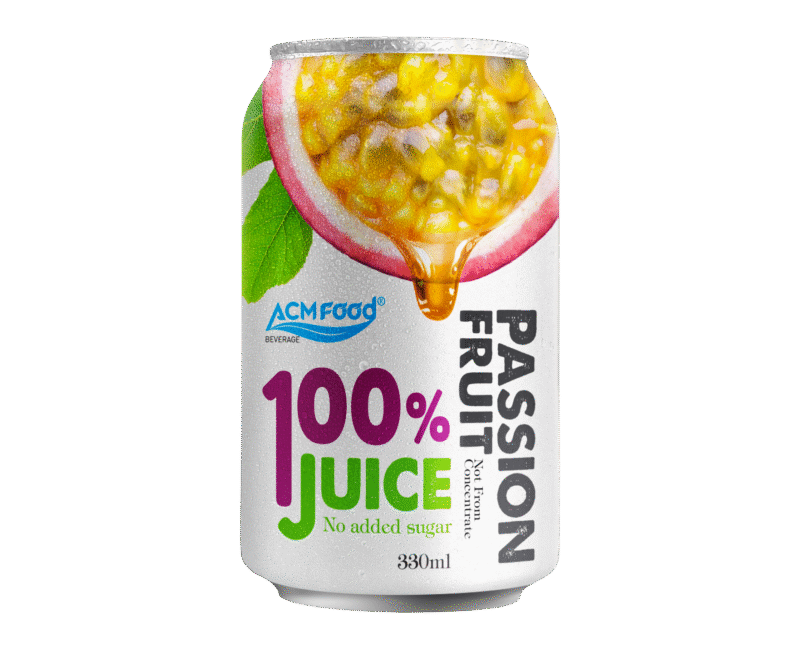
- Aluminium can — full light barrier, protects the colour, suited to single-serve and export.
- Glass bottle — premium presentation at higher freight cost.
- Aseptic carton — ambient stable with a light barrier; suits family and take-home sizes.
What to prepare before contacting a manufacturer
- Target juice content and which product category you intend the item to fall into.
- Destination markets, which decide the label rules and permitted ingredients.
- Pack format and size, and whether seeds are to be visible.
- Target retail price, which sets the ceiling on formulation cost.
- Order volume, and whether the first run is a market test or a full launch.
Frequently asked questions about passion fruit juice OEM
Is passion fruit usually sold as 100% juice?
Rarely. The pulp is sharp and intensely flavoured, so most commercial products are nectars or juice drinks where the fruit is diluted and balanced. The category the product falls into depends on the declared juice content and the destination market’s rules.
Should the drink contain visible seeds?
It is a positioning choice. Seeds reinforce authenticity and are visually distinctive, but they require filling equipment configured to pass them and they settle in the pack. Decide before the format is fixed rather than after.
What is the minimum order quantity?
At ACMFOOD the minimum is 500 cartons per SKU. Custom pack formats or bespoke artwork can raise the practical minimum because of tooling and print lead times.
How long does an OEM passion fruit project take?
It depends on how much formulation work is needed and whether packaging is custom. A white label product using an existing recipe and a standard pack moves considerably faster than a bespoke formulation with new artwork and a new format.
Information for beverage brands
Passion fruit is a good first product for a new beverage brand: the aroma carries at low inclusion rates, the acidity keeps processing straightforward, and the supply base is mature. Bring your target price, your markets and your juice content to the first conversation and most of the technical questions resolve quickly.
Conclusion
The decisions that shape a passion fruit project are the juice content, the sweetness and acidity balance, and whether you build a bespoke recipe or start from an existing one. Settle those three and the fruit itself does much of the work — it is one of the few tropical flavours that stays recognisable even at modest inclusion rates.