


 Français
 Español
 العربية
 한국어
한국어Private label and white label are used interchangeably in most sourcing conversations, and the confusion is expensive. The two models differ in who owns the recipe, who controls the specification, and whether anyone else can sell the same liquid under a different name. This article is a decision framework, not a glossary: the dimensions that actually separate the two, a matrix for choosing between them, the contract clauses that make the distinction real, and how to migrate from one to the other without starting over.
Once you have chosen a model, the practical next steps are covered separately: how a private label programme is structured, what it costs and how the cash flow works, and how to vet the manufacturer.
The one distinction that matters
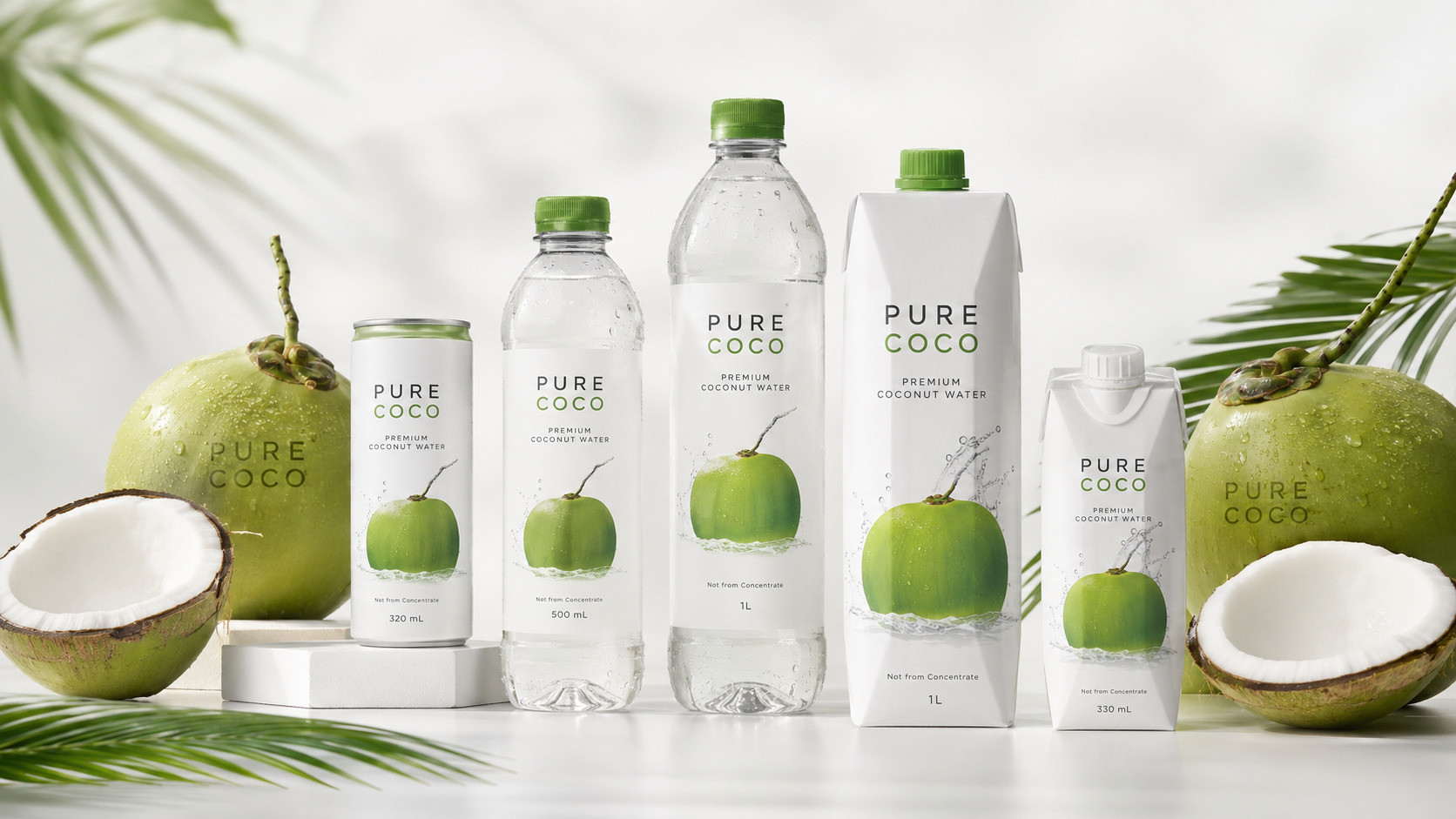
Strip away the marketing language and it comes down to a single question: can the manufacturer sell this exact product to your competitor?
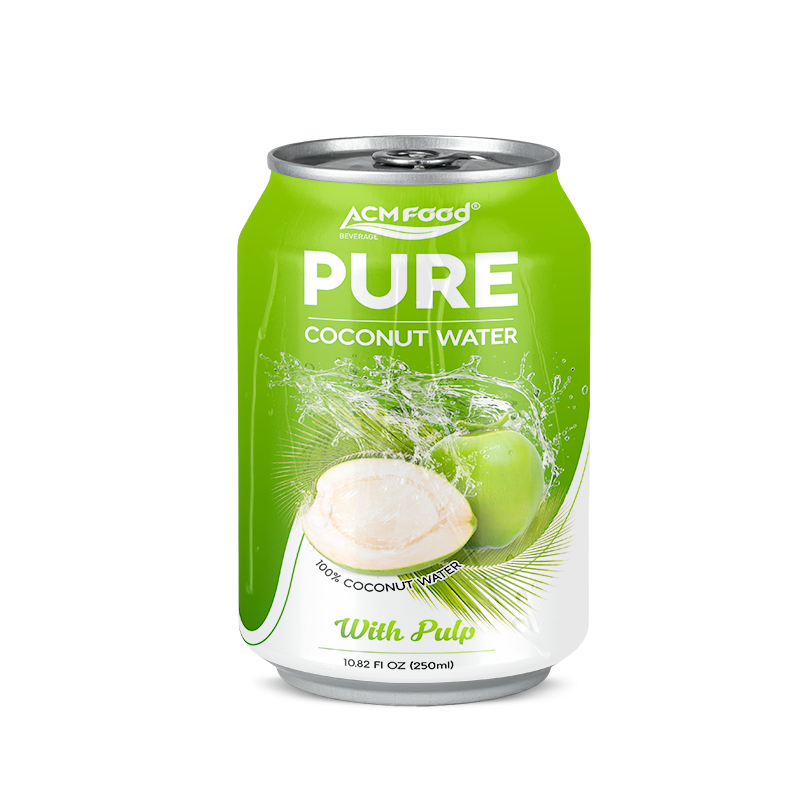
With white label, yes. The manufacturer has developed a standard coconut water SKU and offers it to many buyers. You supply artwork; they supply an existing product. Your differentiation lives entirely in branding and distribution.
With private label, done properly, no — or not for an agreed period. The specification was built for you, and the agreement restricts the manufacturer from producing that configuration for others. Your differentiation lives in the liquid as well as the label.
Everything else — timeline, minimum order quantity, investment — follows from that one difference. And note the phrase “done properly”: private label without an exclusivity clause is white label with extra steps and a higher price.
Where the models diverge in practice
| Dimension | White label | Private label |
|---|---|---|
| Recipe ownership | Manufacturer’s, shared across buyers | Built for you; ownership set by contract |
| Specification control | Fixed — accept it as-is | Brix, sweetness, pulp, blend ratio negotiable |
| Exclusivity | None | Available, usually tied to volume |
| Pack and fill volume | Manufacturer’s existing formats | Selectable within line capability |
| Time to first shipment | Artwork and production only | Add development, samples, stability work |
| Minimum order quantity | Lower — shared production runs | Higher — dedicated runs and materials |
| Up-front spend | Artwork and plates | Artwork, plates, development, sampling, testing |
| Price competition risk | High — an identical product may sit nearby | Lower — no direct like-for-like comparison |
| Supplier switching | Easy — nothing is yours but the label | Harder — the specification travels, the process may not |
Choosing between them
Answer these five questions honestly. Three or more answers in one column usually settles it.
- Is your differentiation in the liquid, or in distribution and brand? If you win because of shelf access, sales relationships or marketing, a distinctive formulation is not what is holding you back. White label.
- Do you have a fixed launch date you cannot move? Development and stability work do not compress. If a seasonal window or a retailer listing date governs, white label.
- Can you fund a dedicated production run plus development, and wait out the cash cycle? If not, white label now and private label from cash flow later.
- Will a competitor selling the identical liquid damage you? In commodity retail, often not. In premium positioning or a retailer’s own brand, seriously. Private label.
- Are you building an asset to sell, or a trading margin? A brand whose product is anyone’s product is worth less than one with its own specification. Private label.
Coconut water specifics that generic advice misses
Three things make this decision different in this category than in, say, snacks or supplements.
Raw material variability limits how “exclusive” a formulation can be. Coconut water is agricultural: sugar content and mineral profile shift with variety, maturity and season. A private label specification is a band with a standardisation method, not a secret recipe. Understand that before paying a premium for exclusivity on pure coconut water, where the room to differentiate is genuinely narrow.
Blends and functional variants are where private label earns its cost. If the liquid is 100% coconut water and nothing else, one manufacturer’s product is close to another’s, and white label is usually the rational choice. A specific fruit blend ratio, a pulp level, a carbonation target or a fortification profile is defensible — that is a formulation worth owning.
Processing route is often not negotiable. A factory runs the thermal process its line is built for. “Private label” rarely means choosing between aseptic and in-container processing; it means choosing a manufacturer whose existing route matches your positioning. Settle that during supplier selection, not during development.
The clauses that make private label real
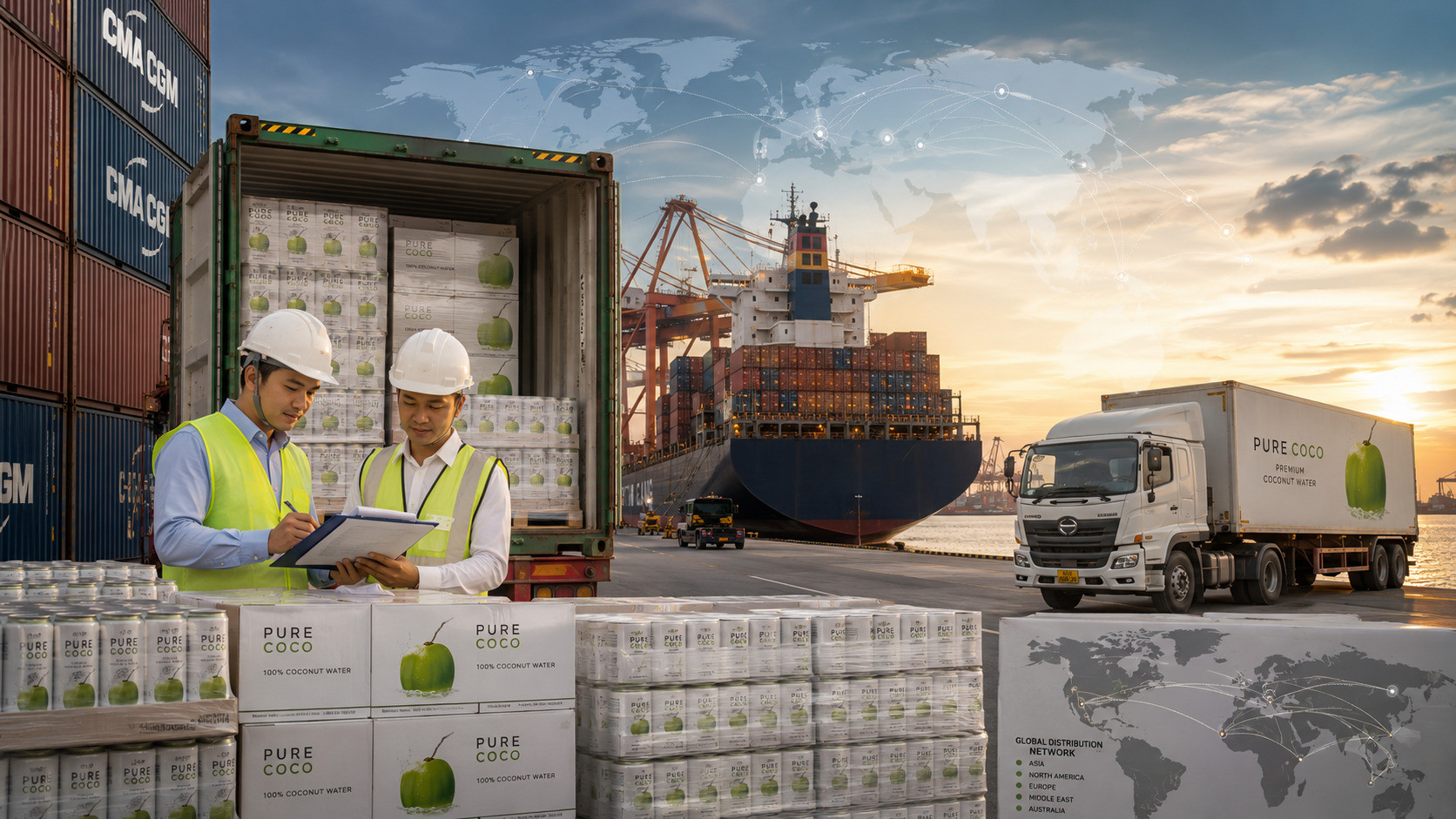
If you are paying for private label, these belong in the agreement. Without them you have bought a white label product at a private label price.
- Recipe ownership stated explicitly — yours, theirs, or jointly held — and what happens to it if the relationship ends.
- Exclusivity scope: which markets, which channels, for how long, and against what volume commitment. Worldwide perpetual exclusivity for a small order is not something any manufacturer will honour.
- The specification as a contractual annex, with Brix, pH, fill weight, sensory description and shelf life named and tolerances stated.
- Artwork and die ownership, including who holds the print plates and what happens to them at termination.
- Change control: the manufacturer may not alter the formulation, supplier or process without written approval. This is what stops slow drift away from the product you approved.
- Non-conformance remedy — what happens, and who pays, when a batch misses specification.
The migration path most brands actually take
Treating this as a permanent either-or decision is the most common mistake. The sequence that works looks like this:
- Launch white label on a standard SKU with your branding. The goal is a rate-of-sale reading and retailer feedback, at the lowest possible capital risk.
- Learn from real sales data which pack size moves, which price point holds, and what customers say about the taste.
- Move to an adapted SKU — an existing base modified toward what the data showed — before committing to full development.
- Commit to private label once volume justifies a dedicated run, and use the sales history as leverage in negotiating both price and exclusivity.
Two things make this migration much smoother if you plan for them at step one: choose a manufacturer capable of all three levels so you are not switching suppliers mid-journey, and keep your artwork and brand assets fully under your own control from the beginning.
Where ACMFOOD fits
ACMFOOD Beverage Co., Ltd. produces canned coconut water and coconut-based blends in Vietnam, and supports all three levels described above — standard SKU with your label, adapted formulation, and full private label development — from the same facility. That matters for the migration path specifically: moving from a white label test to an owned formulation does not require finding a new manufacturer and revalidating everything from the start.
If you are still deciding, the fastest way to settle it is to compare the standard SKU against what you would want changed. Request samples of the standard range, taste them against your target, and list the differences. If the list is short, white label is the sensible starting point. If it is long, you have just written the first draft of a development brief.
Once you have chosen a model
For how a branded programme is structured and priced, see private label beverage manufacturing; if the manufacturer will own the recipe and the run, see contract manufacturing. Minimums per SKU are set out in minimum order quantity. To start, request a quote.
Request a quote