


 Français
 Español
 العربية
 한국어
한국어Functional beverage manufacturing is the production of drinks formulated around added ingredients such as vitamins, minerals, electrolytes, botanical extracts or amino acids, where those additions are intended to be present at a declared level in the finished product. The manufacturing challenge is that the declared level has to survive blending, thermal processing, filling and the whole of shelf life.
This article covers how the main active groups behave in a beverage matrix, what processing does to them, and how the regulatory framework in the EU and the US governs what may be said on the label. It describes the framework rather than making claims for any ingredient.

What is a functional beverage?
A functional beverage is a drink whose formulation includes ingredients added deliberately for a purpose beyond flavour and hydration, and which are usually declared on the label at a stated amount per serving. The term is a market category rather than a legal one, so in regulatory terms the product remains a beverage and is governed by the ordinary food rules of the destination market.
That distinction matters for manufacturing. Because the category is commercial, there is no single technical definition to design against; the specification comes from the brief and from what the destination market permits. What every project shares is the need to prove that the declared amount is actually present at the end of shelf life, not only at the moment of blending.
Which actives are used, and how do they behave?
Different active groups present different formulation problems. Solubility, interaction with acid, sensitivity to heat and light, and effect on taste all vary, and the choice of format and process usually follows from them rather than the other way round.
| Active group | Main formulation consideration | Principal stability risk |
|---|---|---|
| Water-soluble vitamins | Dissolve readily; some carry a distinct taste at higher levels | Degradation from heat, light and dissolved oxygen over shelf life |
| Fat-soluble vitamins | Require an emulsion or a solubilised form | Separation and ringing at the neck; oxidation |
| Minerals and electrolytes | Salt form determines solubility and mouthfeel | Precipitation, haze and a saline or metallic note |
| Botanical extracts | Standardised extracts vary batch to batch | Colour drift, sediment and bitterness |
| Amino acids | Solubility varies widely between them | Interaction with sugars during heating |
| Fibres and hydrocolloids | Affect viscosity and processing behaviour | Viscosity drift and filling line effects |
Several of these interact. A mineral salt can accelerate the loss of a vitamin; a botanical extract can bring colour that masks or exaggerates a colour change elsewhere. This is why a functional formulation is developed as a system rather than as a base plus additions.
How does processing affect active retention?
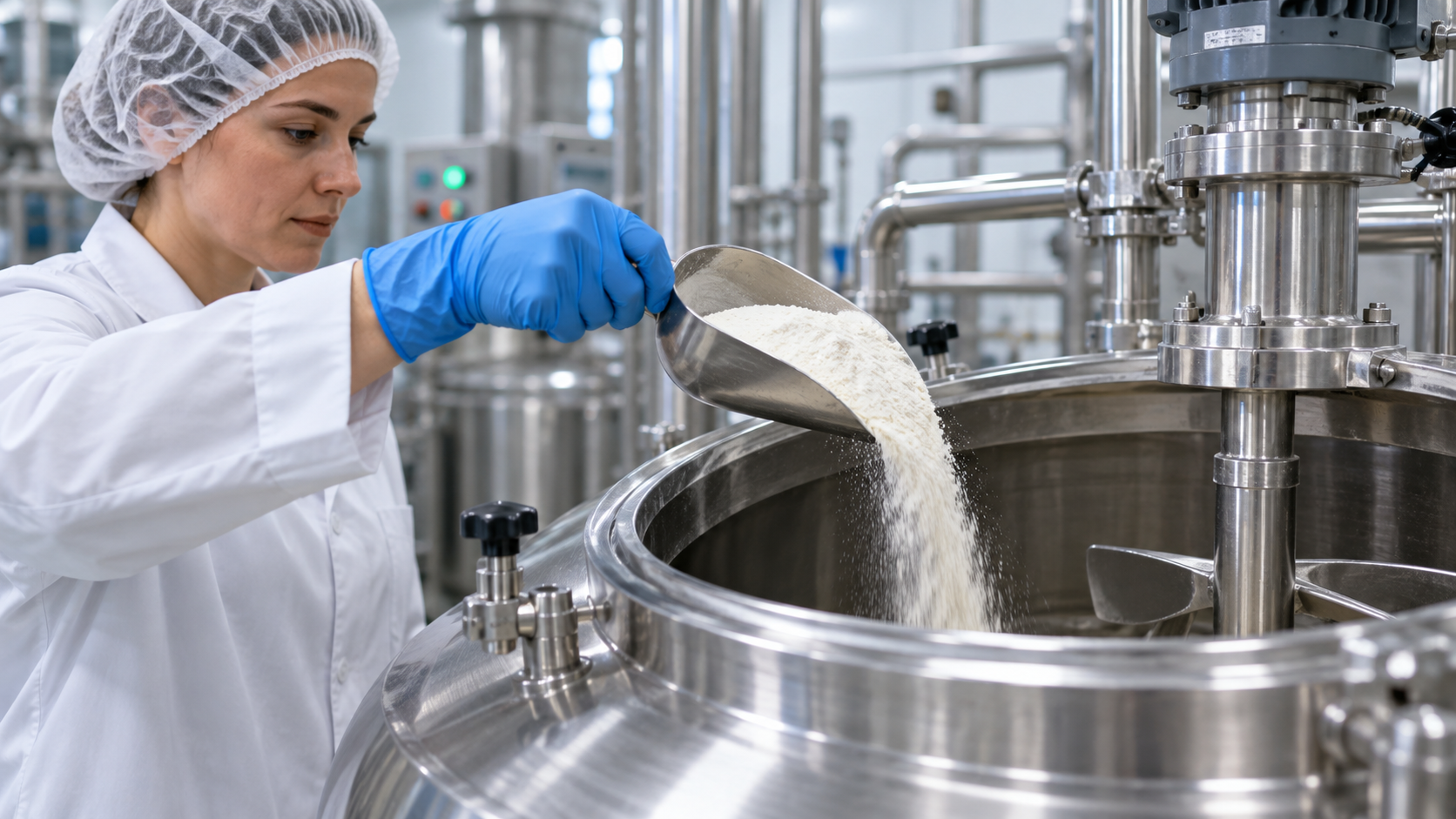
Heat is the main variable. Every thermal step reduces the level of the more sensitive actives, and the reduction depends on the combination of temperature and holding time rather than on temperature alone. A short, high-temperature treatment and a longer, gentler one can achieve the same microbiological result while leaving different amounts of a heat-sensitive ingredient in the finished drink.
Three process decisions carry most of the consequence:
- The thermal profile. The choice between processes, and the specific time and temperature within each, determines how much of a sensitive active survives. The mechanics of one common route are set out in the article on UHT processing for beverages.
- Dissolved oxygen. Oxygen picked up during blending and filling continues to act throughout shelf life, so deaeration and headspace control often matter more than the thermal step for oxidation-sensitive ingredients.
- Pack and light exposure. Light-sensitive actives behave differently in clear PET, in a can and in a carton, which can make the pack decision a formulation decision.
Because the losses are cumulative, retention has to be measured on product that has been through the actual process and stored under the intended conditions, not on a freshly blended bench sample.
Overage, and why more is not a solution
Overage is the practice of adding more of an active than the label declares, so that the declared amount is still present at the end of shelf life. It is a normal and necessary technique, but it is bounded in several directions at once, which is why it cannot simply be increased until the problem disappears.
The constraints are regulatory, sensory and commercial. Maximum permitted levels apply to several nutrients in most markets, and an overage that pushes the product above them is not an option regardless of what the label says. Many actives carry a taste at higher concentrations, so the overage that solves the analytical problem can create a palatability one. And actives are often the most expensive line in the recipe, so a large overage changes the cost structure.
The practical approach is to measure the actual decay curve for the specific formulation, process and pack, then set the overage from that curve with a defined margin. Guessing an overage from a general figure is the usual reason a product either fails an end-of-life test or costs more than it needed to.
What claims survive label review?
This is where functional products most often stall, because the marketing concept is written before the regulatory position is checked. The two major frameworks work differently, and neither permits a manufacturer to describe an effect in its own words.
In the European Union, nutrition and health claims may only be made if they appear on the authorised list, and each authorised claim carries conditions of use. Those conditions typically require the product to contain a specified minimum amount of the nutrient per portion or per 100 ml, and they prescribe wording that may be adapted only within narrow limits. A claim that is not on the list may not be used, however plausible it sounds, and a claim on the list may not be used if the product does not meet its conditions.
In the United States, the framework distinguishes between authorised health claims, which require a specific regulatory basis, and structure or function statements, which carry their own requirements including a disclaimer and a substantiation file held by the company. The practical consequence for an exporter is that the same product may support a statement in one market and not in the other.
Three rules follow from this for any functional project:
- Check the claim before fixing the dose. Where a claim carries a minimum content condition, that minimum becomes the formulation target, and it is cheaper to design to it than to discover it afterwards.
- Design the dose to hold to end of life. A claim depends on the content in the product the consumer buys, not on the content at filling.
- Treat every claim as market-specific. Artwork built around a claim permitted in one destination may need a different front panel elsewhere.
Claims and labelling remain the responsibility of the brand owner and depend on the final formulation, the tested content, the serving size and the rules of each destination market.
Why the analytical method matters as much as the result
A declared level is only as reliable as the method used to measure it. Different laboratories can return different figures for the same sample when they use different extraction steps or different detection techniques, and for some actives the available methods differ in what they actually capture. A botanical marker compound, for example, is not the same measurement as the whole extract it represents.
Two practical consequences follow. The first is that the method should be named in the specification, not just the value and its tolerance, so that a retest anywhere produces a comparable number. The second is that release testing and stability testing should use the same method throughout, since a mid-programme change makes the decay curve uninterpretable.
This matters commercially when a buyer tests independently. A discrepancy between the supplier’s certificate and the buyer’s own result is a difficult conversation if the two used different methods, and an easy one if the specification named the method from the start.
Stability testing for a functional product
A functional product needs more from its stability programme than a conventional one, because two separate questions have to be answered. The first is the ordinary one: does the product remain safe and acceptable through its shelf life. The second is specific to the category: does the declared active remain at or above the declared level for the same period.
That second question requires analytical testing at intervals across the shelf life, on product in the final pack, stored under the conditions the product will actually meet. Export adds a complication, because a container crossing the equator may see temperatures well above a temperate warehouse, and the decay of a heat-sensitive active is not linear with temperature.
What a functional brief should specify
A brief that answers the following removes most of the iteration from a functional development project.
- The actives and the declared level per serving or per 100 ml, and which of them are commercially essential.
- The destination markets, since permitted levels, permitted ingredients and permitted claims all vary.
- The intended claim, if any, so the minimum content condition can be treated as a formulation target.
- The pack format, because light and oxygen barrier properties affect retention.
- The sweetness position, which interacts with the taste of several actives, as discussed in sweetener systems for export beverages.
- The required shelf life, because it sets the end point the overage calculation has to reach.

Frequently asked questions
Can any active be added to a beverage?
No. Each market maintains rules on which substances may be added to food and at what levels, and those lists are not identical. An ingredient routinely used in one region may be restricted or require authorisation in another, so the destination markets have to be known before the formulation is fixed.
Does a functional drink need a different production line?
Usually not a different line, but often different handling. Powder addition, dissolution order, deaeration and sometimes a modified thermal profile are the common changes. Where an emulsion is involved, homogenisation becomes necessary and that does require the equipment to be available.
How is the declared level verified?
By analytical testing of finished product, repeated across the shelf life rather than performed once at production. The release test confirms the starting point and the stability programme confirms that the level holds, which together support the figure printed on the label.
Why do some functional drinks change colour on shelf?
Colour change generally comes from oxidation, light exposure or reactions between ingredients rather than from spoilage. Botanical extracts and certain vitamins are the usual contributors. It is managed through pack choice, oxygen control and formulation rather than by adding more colour.
Building a functional product that holds its specification
Functional beverage manufacturing succeeds or fails on whether the declared level is still there at the end of shelf life. That outcome is decided by the combination of active selection, thermal profile, oxygen control, pack format and a measured overage, and none of those can be settled in isolation from the others.
The efficient sequence is to fix the destination markets and any intended claim first, let the permitted levels and claim conditions set the formulation target, then develop the process and pack around holding that target. ACMFOOD develops functional formulations through its formulation and R&D process and manufactures them under OEM beverage manufacturing, with the same approach applied to the caffeinated products covered in energy drink manufacturing.