


 Français
 Español
 العربية
 한국어
한국어Noni juice concentrate is noni juice with part of its water removed, usually by evaporation, so it can be shipped and stored in smaller volumes and later diluted back to a drinking strength. For a buyer, the concentrate is defined less by taste than by its specification: Brix, acidity, pH, colour, microbiological limits, pack type and shelf life. This guide explains how to read those parameters, how concentrate compares with single-strength juice and what to confirm before a bulk enquiry.
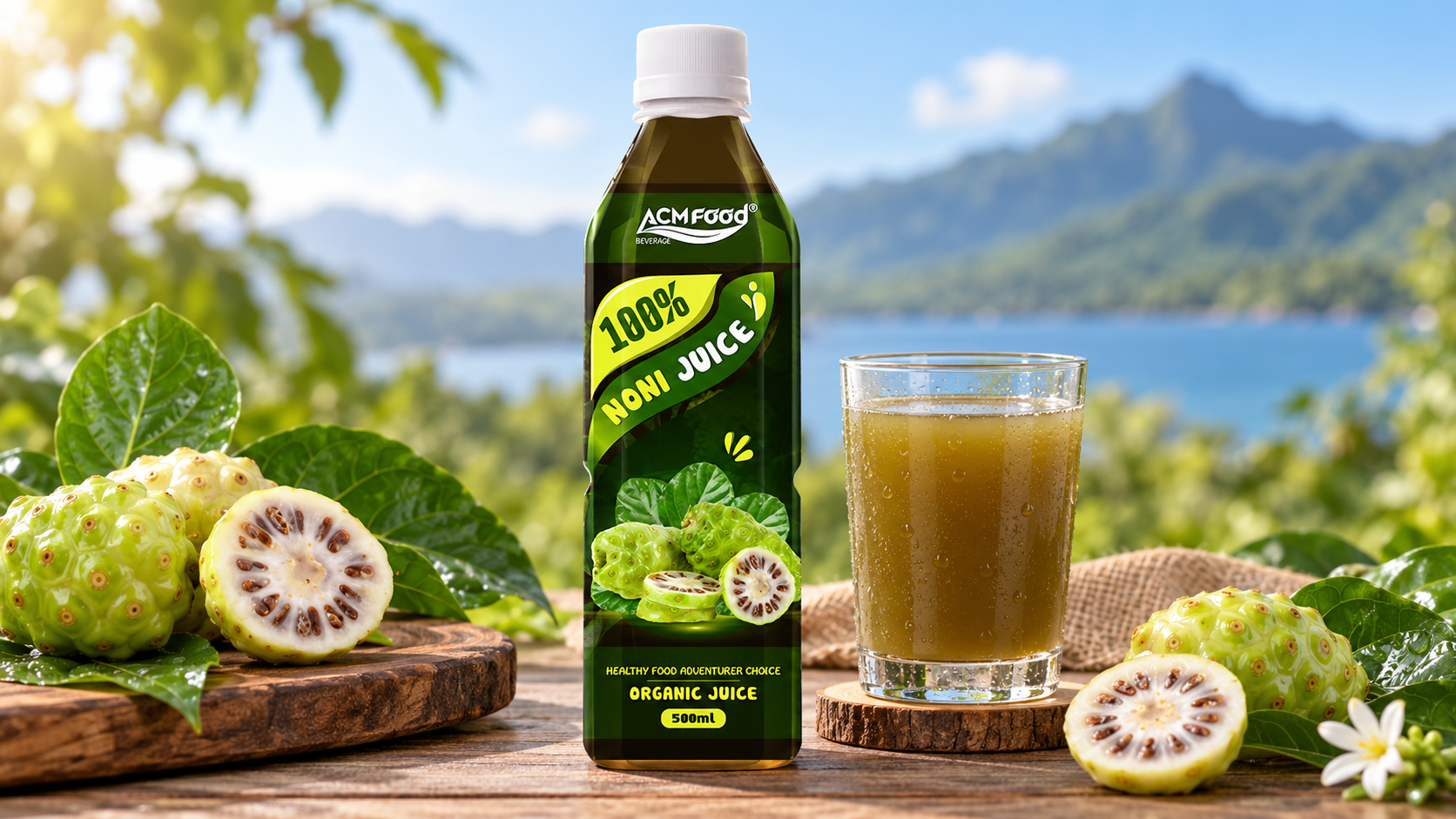
One limit applies from the start. The noni product ACMFOOD currently lists on its site is a finished 500ml PET bottle drink, not a concentrate. Concentrate supply is handled by enquiry, and every figure on a concentrate specification should come from the supplier’s own sheet for the lot you are buying. Where this page describes typical industry practice, it says so.
Key takeaways
- Concentrate is defined by its specification: Brix, pH, acidity, colour, microbiological limits, pack type and shelf life.
- ACMFOOD lists a finished 500ml PET noni juice drink, not a concentrate; concentrate is handled by enquiry.
- Treat any figure not on a signed specification sheet as indicative and ask for the lot’s certificate of analysis.
- Confirm noni’s regulatory status and labelling in your market before ordering.
What is noni juice concentrate?
Noni juice concentrate is juice from the Morinda citrifolia fruit that has had a share of its water removed, raising its soluble solids measured as Brix. It is an ingredient, not a finished drink, and it is normally reconstituted with water or blended with other juices before bottling.
Brands use concentrate for three practical reasons: lower freight volume per litre of finished drink, easier storage and a more consistent base across several production runs. The trade-off is a more demanding specification, because small differences in Brix or acidity change the finished drink after dilution. Our broader guide on fruit juice processing methods explains how concentration, pasteurisation and filling fit together.
Concentrate vs single-strength noni juice: which suits your project?
Concentrate suits buyers who will blend or bottle in their own market and care about freight and storage. Single-strength juice suits buyers who want to ship a ready-to-use ingredient or a finished drink. The choice depends on where the final filling happens and how much control you need over the recipe.
| Factor | Concentrate | Single-strength juice |
|---|---|---|
| Freight volume per litre of drink | Lower, because water has been removed | Higher, because the water is shipped |
| Filling location | Usually near the destination market | Can be at origin or near the market |
| Specification sensitivity | High, since small Brix or acid shifts scale on dilution | Lower |
| Flavour | Depends on concentration method and aroma handling | Closer to the original juice |
| Labelling after dilution | Depends on market rules for reconstituted juice | Depends on whether the juice is a blend or pure |
If the label says “from concentrate”, that wording has market-specific rules. The article on NFC versus from-concentrate juice explains how the two are described.
Which specification parameters matter for noni juice concentrate?
Six parameters carry most of the weight on a concentrate specification sheet: Brix, pH, titratable acidity, colour, microbiological limits and the declared composition. Each should appear as a target with a tolerance, together with the test method used.
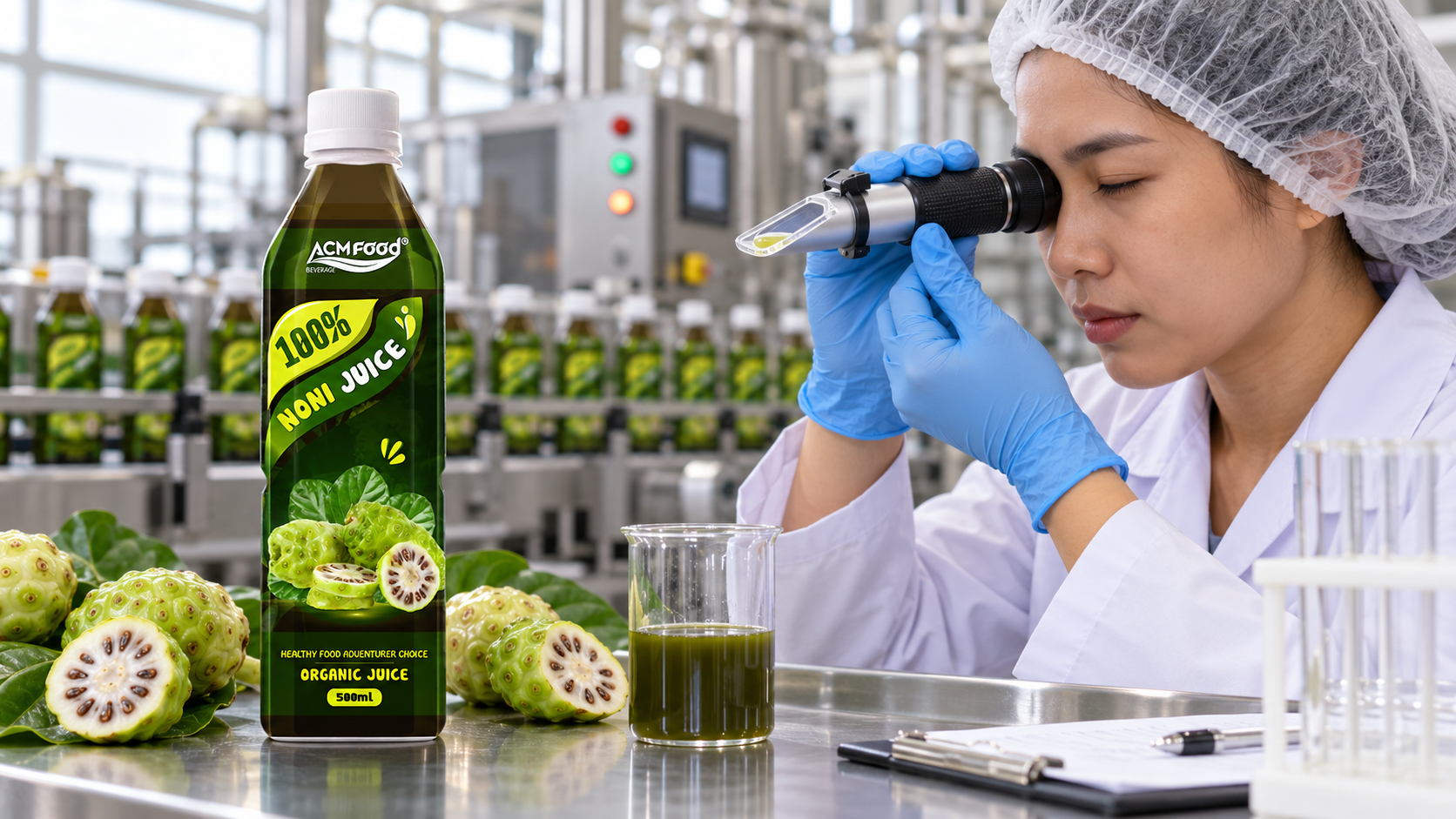
- Brix. Soluble solids, read with a refractometer. It defines how concentrated the product is and is the starting point for any dilution calculation. See our guide to fruit juice Brix for how it is measured and read.
- pH and titratable acidity. Both describe sourness and microbial stability. They also influence which filling technology is suitable, a topic covered in the article on pH and acidity targets in beverage formulation.
- Colour. Noni juice darkens with processing and storage. Agree how colour is measured and what shift is acceptable over shelf life.
- Microbiological limits. Total plate count, yeast and mould limits and the pathogen tests your market expects.
- Composition. Whether the lot is pure noni, a blend, or contains added preservatives or sweeteners, and whether any ingredient requires declaration.
- Physical properties. Viscosity, pulp or sediment content and clarity, all of which affect handling and the finished drink’s appearance.
Specific numeric ranges for these parameters vary between processors and between harvests. Treat any range you see in marketing material as indicative only, and ask for the signed specification sheet and a certificate of analysis for the actual lot.
How is concentrate reconstituted to drinking strength?
Reconstitution means adding water to concentrate until the Brix of the mixture reaches the Brix of the single-strength juice or the target of your finished recipe. The calculation compares the concentrate’s Brix with the target Brix, then sets the water addition accordingly.
The reconstitution ratio is the concentrate Brix divided by the target Brix. As a purely illustrative example, if a concentrate measured twice the target Brix, the ratio would be 2, and one part concentrate would be diluted with one additional part water. The numbers in this example are not noni specifications. For noni, the target Brix is whatever your recipe or the market’s standard for juice requires, so confirm it before you calculate. Because noni is usually blended with other juices or sweeteners, the final Brix often comes from the whole recipe rather than the noni component alone.
What packing options are common for concentrate?
In the juice industry, concentrate is commonly supplied in aseptic bags inside 20 kg cartons, in 220 kg drums and in intermediate bulk containers (IBCs). Availability, liner type and closure depend on the supplier and must be confirmed for noni specifically.
| Pack type | Typical use | What to confirm |
|---|---|---|
| Aseptic bag in 20 kg carton | Trials, small production runs | Bag material, sterility method and handling |
| 220 kg drum | Mid-size batches | Liner, closure and storage temperature |
| IBC | Large volumes and continuous production | Unloading equipment and return or disposal |
These formats are listed as commonly used in the industry, not as a published ACMFOOD range. Confirm any pack type with the supplier before planning a shipment, and match it to the receiving line’s equipment.
How long does noni concentrate last, and how should it be stored?
Shelf life depends on the concentration, the process, the pack and the storage temperature, so only the supplier’s stated figure for the lot applies. Concentrate is normally stored cold or frozen when no preservative is used, and aseptic packs once opened must be handled hygienically.
For finished noni drinks, the published shelf life of ACMFOOD’s 500ml PET noni juice drink is 18 months. That figure belongs to the finished product and should not be assumed for concentrate. Ask for storage conditions, the date-marking system and the recommended use-by after opening. Our article on fruit juice shelf-life testing explains how stability is verified.
What affects noni juice concentrate price?
The price of concentrate is built from several factors, and no single figure is meaningful without them. This page does not publish prices. The factors to ask a supplier about are listed below.
- Fruit sourcing and season. Raw fruit cost and availability change across harvests.
- Processing method. Extraction, clarification, concentration and any aroma recovery.
- Concentration level. Higher Brix means more fruit per kilogram of product.
- Pack type. Aseptic bags, drums and IBCs have different packing and handling costs.
- Quantity and delivery. Order volume, Incoterms, freight and insurance.
- Certification and testing. Audits, analysis and documentation requested by the buyer.
Compare offers on the same specification, pack and delivery terms. Our guide on private label fruit juice cost breaks down how juice pricing is structured.
Are there labelling and regulatory points for noni concentrate?
Yes. Noni is regulated differently from market to market, and the rules for reconstituted juice and for noni products differ again. Confirm whether noni is treated as a conventional food, a supplement or a product that needs prior authorisation in your destination before you place an order.
Keep marketing claims conservative. Noni is naturally high in potassium, and EFSA has re-assessed case reports of acute hepatitis linked to noni juice, finding no convincing evidence of a causal relationship and considering adverse liver effects unlikely at observed intake levels. Even so, wording that implies treatment or remedy should be avoided. Claims on finished products depend on the final formula, tested content, serving size and local rules. A supplier can provide documents, but the responsibility for compliant labelling in your market stays with the brand.
What documents should come with a concentrate lot?
Ask for the documents that let your quality team accept or reject the lot with evidence. At minimum, request a specification sheet, a certificate of analysis for the specific batch, the manufacturing site’s food safety certificates and the safety data you need for storage and handling.
Production for ACMFOOD takes place at facilities holding HACCP, ISO 22000 and FSSC 22000, and certificates, specification sheets and test reports are released on request. Our guide on how to read a beverage certificate of analysis shows which fields to check first.
How do you ask for bulk noni concentrate from Vietnam?
Send a short enquiry that states the target Brix, acidity and pH, the pack type, the quantity in kilograms or litres, the destination port and the delivery terms you prefer. The more precise the specification you attach, the faster the supplier can say whether it can match it.
Shipments from ACMFOOD depart from Ho Chi Minh City Port under T/T payment terms, with documentation prepared in-house. The standard minimum order is 500 cartons per SKU for finished beverages, and concentrate minimums are confirmed per project. You can see how minimums are set on the minimum order quantity page.
How should you run a pilot with noni concentrate?
A pilot proves that a concentrate performs in your own recipe before you buy at volume. Start with a small lot, reconstitute it exactly as the specification describes, and compare the result with your target on appearance, taste, Brix, pH and stability.
- Define the target drink. Write down the finished Brix, acidity, colour and flavour description you want, including any other juices in the blend.
- Request a pilot quantity and the lot’s analysis. Check that the certificate of analysis matches the specification sheet before you open the pack.
- Reconstitute and blend under controlled conditions. Record the water source, temperature and mixing time, because these affect the result.
- Test stability. Hold samples under the storage conditions of your market and look for sediment, colour change and flavour drift.
- Decide on scale-up. Only move to a larger order once the pilot meets the target on repeat tests.
Which quality risks should you watch in noni concentrate?
The main risks are colour darkening, sediment, fermentation or off-flavours from poor handling, and variation between lots. Noni’s strong natural flavour can hide some defects in a blend, so objective measurements matter more than tasting alone.
- Browning and colour drift. Heat and long storage can darken the juice. Ask how colour is measured and what shift is acceptable.
- Sediment and haze. Pulp, pectin and protein can settle after dilution. Confirm whether the concentrate is clarified or cloudy.
- Microbial spoilage. Sugar-rich concentrate can ferment if the cold chain breaks or the pack is compromised.
- Lot-to-lot variation. Fruit varies by season and region, so ask how the supplier standardises Brix and acidity across lots.
Agree in writing which of these defects lead to rejection, and which can be corrected by blending or reprocessing. A clear acceptance procedure protects both sides when a lot arrives slightly outside the target.
Can noni concentrate be blended with other juices?
Yes, and most commercial noni drinks are blends. Because plain noni juice is bitter and pungent, formulators often combine it with sweeter or milder juices or with sweeteners to reach a taste that a mainstream consumer will accept. The proportion of noni in the blend is a recipe and labelling decision.
When you blend, the finished Brix and acidity come from the whole recipe, not from the noni component alone. Record each component’s specification, calculate the blend on paper first, then confirm by measurement. Check how your market treats the proportion of noni in the ingredient list and in any front-of-pack statements, since some regulators set rules on how a juice ingredient may be named or highlighted.
FAQ about noni juice concentrate
Does ACMFOOD sell noni juice concentrate?
The noni product listed on the site is a finished 500ml PET bottle drink. Concentrate supply is handled by enquiry and minimums are confirmed per project.
How is concentrate reconstituted?
Water is added until the Brix of the mixture reaches the target Brix of the single-strength juice or your finished recipe. The ratio is the concentrate Brix divided by the target Brix.
What pack types are common for concentrate?
Aseptic bags in 20 kg cartons, 220 kg drums and IBCs are common in the juice industry. Availability for noni must be confirmed with the supplier.
Does the 18-month shelf life apply to concentrate?
No. The 18-month figure belongs to the finished 500ml noni drink. Concentrate shelf life depends on the lot, pack and storage temperature.
Summary and next step
Noni juice concentrate is a specification-driven ingredient. Read Brix, pH, acidity, colour and microbiological limits as a set, compare concentrate with single-strength juice on freight and filling location, and treat any numbers that are not on a signed sheet as indicative. Confirm noni’s regulatory status and labelling in your market before committing to volume.
To discuss noni juice or a finished noni drink, send your specification, pack and destination through the request a quote page, and ACMFOOD will confirm what it can supply and the minimum for your project.
Sources
- EFSA, re-assessment of the safety of noni juice — the panel found no convincing evidence of a causal link between the reported acute hepatitis cases and noni juice consumption, and considered adverse liver effects unlikely at observed intake levels.
- Codex Alimentarius, General Standard for Fruit Juices and Nectars (CXS 247-2005) — definitions of juice, concentrate and nectar, and minimum Brix values.
- European Commission, EU register of nutrition and health claims — authorised claims and their conditions of use.
Noni is classified differently from market to market. These sources are a starting point, not a substitute for checking the rules that apply to your destination.