Français
 Español
 العربية
 한국어
한국어A tomato juice specification sheet is the document that defines what a batch of tomato juice must be: its Brix, pH, acidity, sodium, sugar, carbohydrate, energy content, shelf life and microbiological limits. For QA and purchasing teams, learning to read it is the fastest way to compare suppliers on equal terms and to catch problems before a container ships.
This guide explains each line of a typical sheet, how to interpret it and which questions to ask. Numeric values are given only where ACMFOOD has published them for its own product. Any other figure should be treated as something to request from the supplier in writing for the specific lot, because tomato juice varies with recipe, salt addition and processing.
Key takeaways
- A useful sheet gives a target, a tolerance and a test method for Brix, pH, sodium, sugar and shelf life.
- Brix is not sugar content: added salt, acids and other solids also raise it.
- ACMFOOD publishes a 24-month shelf life for its 250ml slim can tomato juice; other values come from the specification sheet on request.
- Approve the sheet together with a batch certificate of analysis and keep both with the purchase order.
What does a tomato juice specification sheet contain?
A well-built sheet lists identification data, composition, physical and chemical parameters, nutrition values, microbiological limits, packaging and storage. It also states the test method and tolerance for each measured value, which is what turns a statement into a requirement.
Use this structure when you review a sheet:
- Identification. Product name, product code, fill volume, pack type, flavour or variant and production site.
- Ingredients and additives. Every ingredient in descending order, including added salt, acidity regulators or flavour.
- Physical and chemical parameters. Brix, pH, titratable acidity, viscosity or consistency and colour.
- Nutrition information. Energy, carbohydrate, sugars and sodium per 100ml, plus per serving.
- Microbiology. Limits and methods for the organisms your market tests for.
- Shelf life and storage. Stated shelf life, storage temperature and conditions after opening.
How do you read the Brix value?
Brix is the percentage of soluble solids measured with a refractometer, and in tomato juice it is mostly sugars, acids and salts together. It indicates how concentrated the juice is, but it is not the same as sugar content.
When you review Brix, check three things: the target value, the tolerance and the measurement temperature. A sheet that gives a single number with no tolerance is incomplete. Remember also that added salt raises Brix without adding sugar. Our guide to fruit juice Brix explains how the figure is measured and how to interpret it across products. Minimum Brix values for juices reconstituted from concentrate are set internationally in the Codex General Standard for Fruit Juices and Nectars (CXS 247-2005).
Why does pH matter for tomato juice?
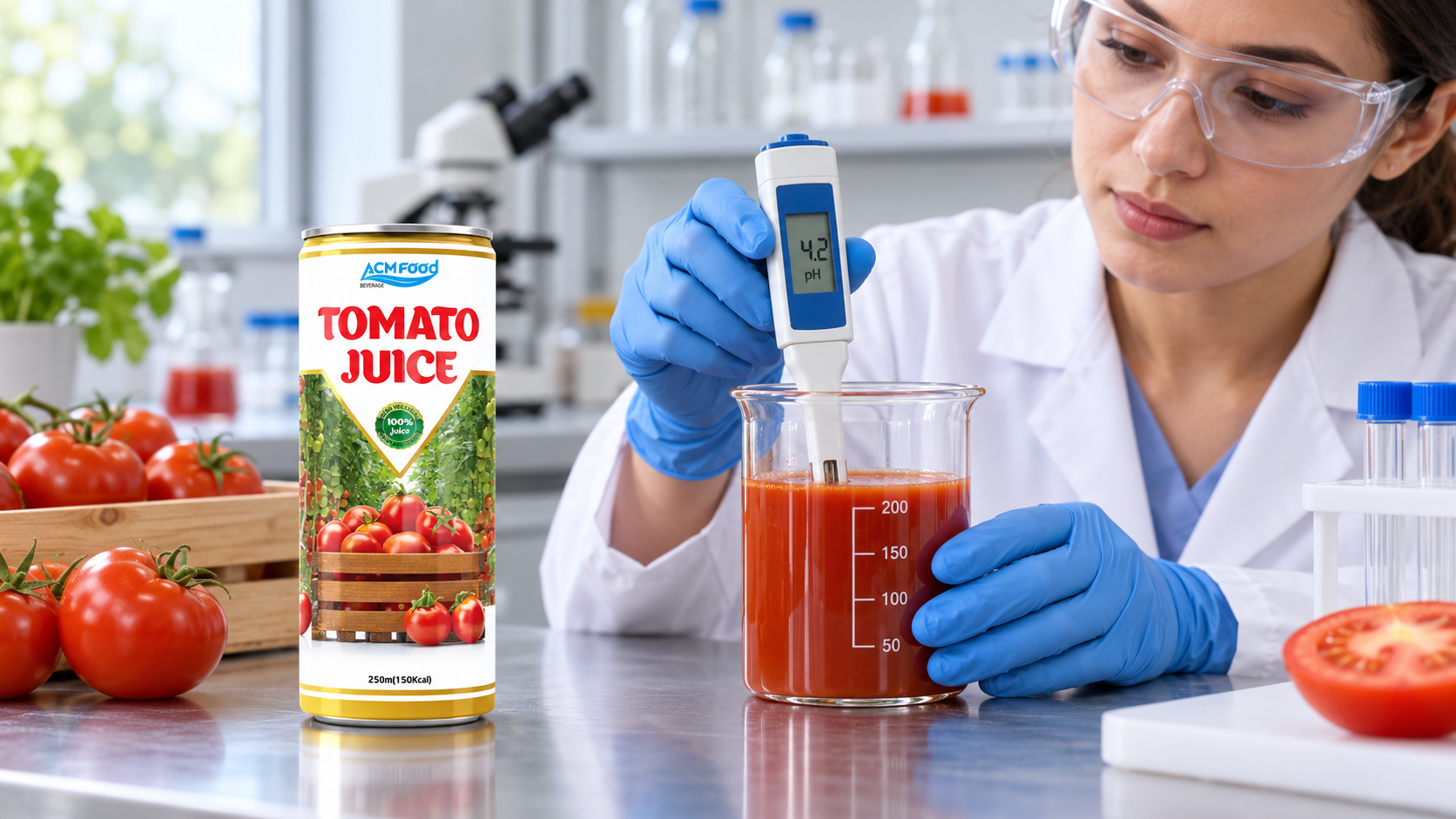
pH measures acidity on a logarithmic scale, and it sets the microbial risk and the filling method. Tomato sits close to the boundary that regulators use to separate acid foods from low-acid foods, which the US FDA sets at pH 4.6 for acidified and low-acid canned foods, so the acidity control on the sheet deserves attention.
Ask for the pH target and the tolerance, and ask whether acidity is adjusted with an added acid. A product on the acid side of the line can usually be hot-filled or pasteurised; a product on the low-acid side needs a different thermal process. Our article on pH and acidity targets in beverage formulation explains the logic, and the guide to choosing a filling technology by beverage pH shows how acidity connects to the process.
How should you interpret sodium and salt on the sheet?
Sodium appears on the sheet in milligrams per 100ml, and salt equals sodium multiplied by roughly 2.5. Tomato juice is sold both unsalted and salted, and some products add salt for taste, so the figure can differ widely between suppliers.
Two points protect a buyer. First, confirm whether salt is added and in what amount, because it changes nutrition labelling and positioning. Second, check the unit and the reference quantity, since a value per 100ml and a value per serving are not interchangeable. If you want to position a product as reduced salt or no added salt, check your market’s rules for those descriptions before writing them on the label.
What do sugar, carbohydrate and energy values tell you?
Carbohydrate is the total of sugars, starches and related compounds, and sugars are the part that tastes sweet. In tomato juice most carbohydrate is natural sugar from the fruit, unless sweetener is added. Energy is calculated from the macronutrient values using conversion factors set by the market.
When a sheet lists these figures, ask whether they are measured, calculated or taken from a database, because that determines how reliable they are for labelling. Terms such as diet, low calorie or no added sugar are regulated claims. Whether a given product qualifies depends on tested content, serving size and local rules, so the sheet should be used as input to a compliance check, not as the check itself.
How is shelf life stated and what does it assume?
Shelf life is the period during which the product keeps its stated quality when stored as instructed. ACMFOOD’s 250ml aluminium slim can tomato juice has a published shelf life of 24 months. That figure applies to that product and pack, and a different pack or recipe needs its own confirmation.
Check the assumptions behind any shelf life. Ask for the storage temperature, whether the product is stored away from direct light, and what is recommended once the can is opened. Long shelf life leaves room for sea freight, but retailers commonly require a minimum remaining life on arrival, as explained in our article on shelf life on arrival for imported beverages.
Which microbiological limits should be listed?
The sheet should list limits and test methods for the indicators your market requires, such as total plate count, yeasts and moulds, and any specific pathogens. For a commercially sterile canned product, sterility is demonstrated by process validation and incubation checks as well as by lab tests.
Ask whether limits apply at release or throughout shelf life, which methods are used and which laboratory carries out the tests. A certificate of analysis for each batch shows the actual results against these limits. The guide on how to read a beverage certificate of analysis explains the fields to check first.
What data has ACMFOOD published for its tomato juice?
The table lists only the values published for the 250ml aluminium slim can tomato juice. Values that are not published, including Brix, pH, sodium, sugar, carbohydrate and energy, are available from the specification sheet on request and should be checked against your own requirements.
| Parameter | Published for the 250ml slim can | Where to confirm anything else |
|---|---|---|
| Volume | 250ml | Product page |
| Packaging | Aluminium can, slim | Product page and packaging options |
| Flavour | Original | Product page |
| Shelf life | 24 months | Specification sheet for storage assumptions |
| Certifications | HACCP, ISO 22000, FSSC 22000 | Certificates on request |
| Brix, pH, sodium, sugar, energy | Not published on the product page | Specification sheet and certificate of analysis |
The current items are listed in the tomato juice category.
Which questions should QA and purchasing ask before approving a supplier?
Ask questions that test whether the supplier controls the process and can prove it with records. A supplier who answers with documents is more reliable than one who answers with adjectives.
- Which values are targets and which are limits? Targets guide production, limits trigger rejection.
- How often is each parameter tested? Per batch, per shift or per line start-up.
- What happens when a batch fails? Hold, rework or reject, and how the buyer is informed.
- Is the nutrition panel measured or calculated? This affects labelling accuracy.
- Which certificates cover the production site? Ask for the scope and the issuing body.
- How is traceability handled? From raw material lot to finished carton.
ACMFOOD produces at facilities holding HACCP, ISO 22000 and FSSC 22000, audited annually, and releases certificates, specification sheets and test reports on request.
How do you turn a specification into an order?
Once the sheet meets your requirements, confirm the pack, the quantity and the destination, then request a pre-production sample and a quotation. For ACMFOOD, the standard minimum is 500 cartons per SKU and the production lead time is 15 to 30 days after order confirmation.
Keep the approved sheet as an attachment to the purchase order, so that any later dispute refers to an agreed document. If you need to compare more than one supplier, line up their sheets on the same parameters, units and tolerances before you compare prices.
How do you compare two tomato juice specification sheets?
Compare sheets line by line, converting everything to the same units and reference quantity first. A sheet that looks better can simply use a different basis, such as per serving instead of per 100ml.
| Check | Why it matters |
|---|---|
| Same unit and reference quantity | Values per 100ml and per serving cannot be compared directly |
| Target and tolerance given | A target without a tolerance cannot be enforced |
| Test method named | Different methods can give different results |
| Measured or calculated | Calculated nutrition values carry more uncertainty |
| Applies at release or through shelf life | Values can drift during storage |
| Date and version | An outdated sheet may no longer match production |
If two suppliers differ sharply on one parameter, ask each for the method and the lot data behind the figure before you decide which is correct.
What mistakes do buyers make when reading a specification?
Most mistakes come from treating a typical value as a guaranteed one, or from ignoring the conditions that surround a number. Avoiding them is mostly a matter of asking one more question.
- Confusing typical with limit. A typical value describes what is usually seen; only a limit or tolerance can be enforced.
- Ignoring the basis. Per 100ml, per serving and per can are different bases.
- Assuming Brix equals sugar. Salt, acids and other solids also contribute to Brix.
- Skipping the shelf life conditions. A stated shelf life assumes a storage temperature and light exposure.
- Using the sheet as a label. Specification values are inputs to compliance, not approved label text.
How should specification changes be handled?
Any change to a recipe, supplier of raw material, process step or pack can alter the specification, so agree a change-control rule in the supply agreement. The supplier should notify you of changes in advance, and you should have the right to approve a new sample before the changed product ships.
Keep a version history of each sheet, tie each version to a date and shipment, and require the supplier to reference the sheet version on the certificate of analysis. If a quality question comes up months later, you can then show exactly which specification applied to which lot.
Who should sign off a tomato juice specification?
Sign-off should involve more than one function, because each reads the sheet for a different risk. Quality assurance checks the measured parameters and limits, purchasing checks that the commercial terms match, and the regulatory or labelling owner checks that the nutrition and ingredient data can support the label.
Record the approval with a name and a date, and attach the approved version to the purchase order. If any function raises a question, resolve it with the supplier before production, since a correction after filling is far more expensive than a clarification before it.
FAQ about tomato juice specification sheets
What is Brix in tomato juice?
Brix is the percentage of soluble solids measured with a refractometer. In tomato juice it is mostly sugars, acids and salts together, so it shows how concentrated the juice is but is not the same as sugar content.
Why does pH matter on a tomato juice specification?
pH sets the microbial risk and the filling method. Tomato sits close to the boundary between acid and low-acid foods, so ask for the pH target, the tolerance and whether acidity is adjusted with an added acid.
Does ACMFOOD publish Brix, pH and sodium for its tomato juice?
No. These values are not published on the product page. They are available from the specification sheet and the certificate of analysis on request.
What is the minimum order and lead time?
The standard minimum is 500 cartons per SKU and the production lead time is 15 to 30 days after order confirmation.
Summary and next step
A tomato juice specification sheet is only as useful as its targets, tolerances and test methods. Read Brix, pH, sodium and shelf life as a set, treat unpublished numbers as questions rather than assumptions and keep the approved sheet with the order.
To request a specification sheet or a quotation for tomato juice, send your format, quantity and destination through the request a quote page, and ACMFOOD will confirm the documents and the minimum for your project.
Sources
- Codex Alimentarius, General Standard for Fruit Juices and Nectars (CXS 247-2005) — definitions of juice, concentrate and nectar, and minimum Brix values.
- US FDA, Acidified and Low-Acid Canned Foods guidance and regulatory information — the pH 4.6 boundary between acid and low-acid foods.
- European Commission, EU register of nutrition and health claims — authorised claims and their conditions of use.
External standards and regulations are cited for orientation. Always check the current text that applies in your destination market.