


 Français
 Español
 العربية
 한국어
한국어UHT beverage processing is a thermal treatment that exposes liquid products to ultra high temperature for a short time to achieve commercial sterility. When paired with aseptic handling and packaging, it enables long ambient shelf life without refrigeration.
This article explains what UHT does, how it differs from aseptic filling, where it excels, and when another process may be a better fit. We focus on the heat treatment itself, not the packaging step. For a broader look at unit operations around heat and packaging, see our overview of processing technology.
What is UHT beverage processing?
UHT (ultra high temperature) processing is a continuous heat treatment that rapidly heats a beverage to a very high temperature for seconds, holds it briefly, then cools it rapidly under hygienic or sterile conditions. The goal is to inactivate spoilage microorganisms and relevant enzymes so the product remains commercially sterile until opened.
Unlike pasteurization, which targets refrigerated shelf life and specific pathogens, UHT aims for a higher level of microbial reduction. This allows compatible products, packages and supply chains to operate at ambient conditions.
How is UHT different from aseptic filling?
UHT is the thermal kill step; aseptic filling is the packaging step performed in a microbiologically controlled environment. You can complete UHT perfectly and still lose sterility if the filler, closures or environment are not aseptic. Conversely, aseptic filling cannot compensate for an under-processed UHT step.
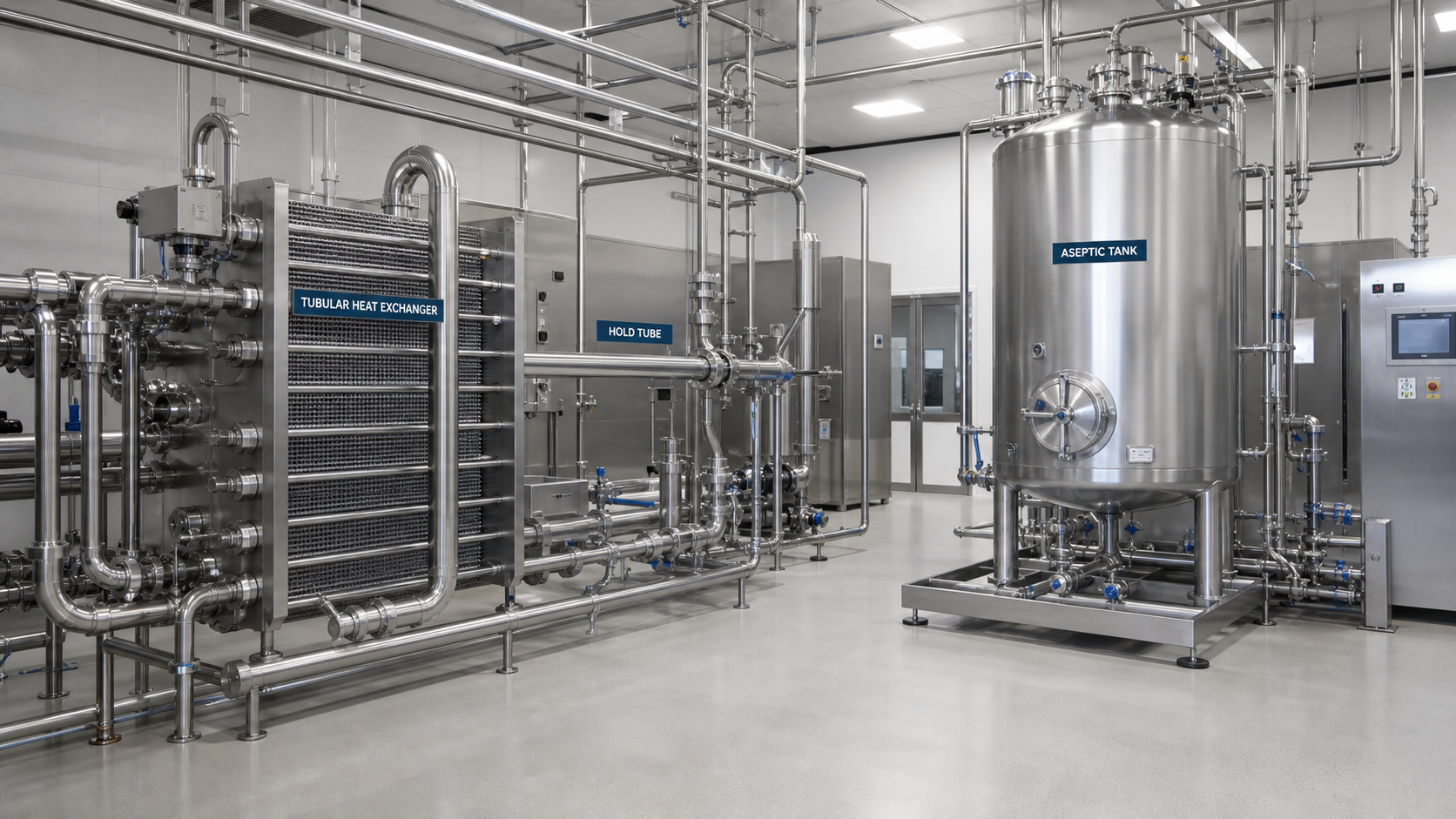
In a typical line, product flows from UHT to an aseptic tank (a sterile buffer) and then to an aseptic filler. Each node must protect sterility to realize the intended ambient shelf life.
What does UHT do to microbes and enzymes?
UHT drastically reduces vegetative cells and inactivates many enzymes responsible for off-flavors and haze. In suitable low-acid products, it also addresses spore-formers of concern for safety when combined with validated processing and aseptic packaging. In acid beverages, UHT primarily improves stability and shelf life by inactivating resistant spoilage flora and enzymes that survive milder heat.
Effectiveness depends on product composition (pH, solids, proteins, fats), the heating method, holding conditions and equipment design. Validation and continuous monitoring are essential.
Key process elements in a UHT line
A modern UHT system is more than a heater. Core elements typically include:
- Product preparation: filtration or screening to remove large particulates; optional deaeration to reduce dissolved oxygen.
- Homogenization: placed upstream or downstream depending on goals (e.g., fat globule size vs. thermal load management).
- Rapid heating: by indirect heat exchange (plate, tubular, scraped-surface) or direct methods (steam injection or infusion) to reach ultra high temperature quickly.
- Holding section: a validated hold tube provides a defined residence time at target temperature.
- Rapid cooling: often via regenerative heat exchange to minimize thermal impact and energy consumption.
- Sterile barriers: sterile product-side piping, steam barriers, and tight control of differential pressures.
- Aseptic tank: a sterilized buffer tank with sterile air overlay to decouple continuous UHT flow from filler stops and starts.
- Aseptic filler: a separate system that sterilizes packaging and fills/closures in a controlled environment.
- CIP/SIP: cleaning-in-place and sterilization-in-place protocols to prepare the system and maintain hygienic integrity.
Direct vs. indirect UHT heating
Both approaches deliver the required thermal load but differ in energy use, fouling, and sensory outcome.
- Indirect UHT (plate, tubular, or scraped-surface) transfers heat through metal surfaces. It is widely used, energy-efficient with regeneration, and suits many juices, teas, and plant-based beverages.
- Direct UHT (steam injection or infusion) contacts product with culinary steam for ultra-rapid heating and flash cooling. It can help protect delicate notes in some products and may reduce fouling, at the cost of added complexity and steam quality control.
Product categories that fit UHT processing
UHT beverage processing fits when you want ambient distribution and the recipe can tolerate high heat and aseptic handling. It is commonly applied to:
- Low-acid beverages such as dairy and many plant-based protein drinks, where commercial sterility is required for safety at ambient conditions.
- Tea, coffee and cocoa beverages with milk or plant milks that target room-temperature logistics and long ambient shelf life.
- Selected fruit or vegetable beverages where UHT plus aseptic packaging is chosen over hot-fill to pursue specific sensory, color or packaging goals.
- Nutritional and meal-replacement drinks formulated for stability through homogenization and suitable stabilizers.
UHT typically favors smooth, pumpable liquids without large particulates. Suspensions of small particles or fibers can be possible with the right equipment and validation, but large chunks are usually incompatible with high-shear, narrow hold tubes and have heat-penetration challenges.
When UHT is not the best choice
UHT is powerful but not universal. Consider alternatives when:
- Chilled distribution is intended: standard pasteurization can be adequate and less intensive for fresh-positioned SKUs.
- Sensitive aroma or color is paramount: some delicate botanicals or cold-brew notes align better with chilled pasteurization or other methods.
- Formulas contain large particulates: retort or specialized particulate processing may be more suitable.
- High sugar and protein together: heat can promote browning and cooked notes; formulation may need adjustment or another process.
- Package choice is hot-fill friendly: for many high-acid juices, hot-fill may meet goals with simpler lines.

UHT vs. pasteurization, hot-fill, retort and HPP
The best-fit process depends on product pH, texture, desired shelf life, sensory targets and packaging strategy. The qualitative comparison below can guide early discussions.
| Process | Typical fit | Ambient shelf life | Packaging | Strengths | Considerations |
|---|---|---|---|---|---|
| UHT + aseptic | Low-acid dairy/plant, some teas/coffees, selected juices | Yes, when paired with aseptic | Aseptic carton, aseptic PET/HDPE, foil-lined pouches | Ambient logistics, smooth textures, wide formats | Thermal impact; aseptic complexity; validation required |
| HTST pasteurization | Milk, smoothies, fresh-positioned juices | Generally no; chilled chain | Refrigerated bottles/cartons | Gentler heat; fresh positioning | Cold chain costs; shorter shelf life |
| Hot-fill | High-acid juices, isotonic, some teas | Yes (product and pack sterilized hot) | Hot-fill PET/HDPE, glass | Simpler than full aseptic; proven | Heat on pack; some flavor impact; paneling control |
| Retort | Soups, beverages with particulates or high viscosity | Yes | Cans, retortable pouches/bottles | Handles particulates; robust lethality | Longer cook; texture/color changes |
| HPP (cold) | Premium chilled juices, smoothies | No; chilled chain | HPP-compatible bottles/pouches | Fresh-like quality; minimal heat | Cold chain; limited formulations; post-pack step |
For deeper context on juice-specific operations, see our guide to fruit juice processing methods. To align process with category strategy, you may also reference popular drink categories.
Formulation and sensory considerations with UHT
High heat interacts with ingredients in ways that can help or hinder quality. Address these points early in development:
- Proteins: denaturation can change viscosity and mouthfeel. Homogenization and stabilizer systems are often tuned to maintain smooth body and prevent sedimentation.
- Fats and emulsions: choose emulsifiers and homogenization pressures to reduce creaming and separation post-UHT.
- Acidity and minerals: pH and ionic strength influence stability and fouling. Slight pH adjustments and chelating/stabilizing agents may be considered within regulatory limits.
- Sweeteners: thermal exposure may shift flavor balance. Bench-top simulations help set expectations.
- Colors and flavors: use heat-stable colors and select flavor systems designed for high-temperature processes.
- Particulates: keep sizes small, uniformly suspended, and compatible with hold tubes and valves, or choose another process for large inclusions.
Equipment and operations that influence outcomes
Several engineering and operational details drive product quality and line reliability:
- Heat exchanger selection: plate vs. tubular vs. scraped-surface changes shear, fouling tendency and cleaning intervals.
- Deaeration: reducing oxygen before heat can help protect color, flavor and nutrients.
- Homogenizer position: upstream improves fat dispersion before heat; downstream can reduce thermal load on the homogenizer and alter texture outcomes.
- Steam quality (for direct UHT): culinary steam standards and condensate management are critical.
- Regeneration: energy recovery lowers utilities and may temper overall thermal impact.
- Fouling management: recipe and surface selection, along with CIP design, extend run times and protect quality.
- Aseptic tank strategy: buffer capacity, sterile air management and instrumentation ensure stable filler supply without compromising sterility.
Packaging choices and ambient shelf life
Ambient shelf life is the combined result of validated UHT processing, sterile handling, and the barrier properties of the package. Common aseptic-friendly formats include multi-layer cartons, aseptic PET/HDPE bottles, and foil-lined pouches. Oxygen and light barriers influence flavor stability and color over time.
Package selection also shapes consumer cues and logistics. To align with market expectations and regulatory nuances, see our summary of packaging options for the Australian market.
Validation, monitoring and quality control
UHT lines must demonstrate that the scheduled process delivers commercial sterility for the intended product and pack. Practical elements include:
- Process development: mapping heating profiles, hold times, and cold spots using the actual formulation.
- Instrumentation: calibrated sensors for temperature, flow and pressures; alarms and flow-diversion logic for deviations.
- Packaging sterilization checks: verification that rinses, sprays or treatments meet requirements without overexposure.
- Aseptic integrity: routine leak tests, environmental monitoring, and aseptic tank integrity checks.
- Records and traceability: batch records, CIP/SIP logs and trending of critical control points.
Independent audits and supplier qualification strengthen confidence. If you plan to work with a co-manufacturer, understand how to audit a beverage factory in Vietnam or your chosen region.
When UHT beverage processing fits your brand strategy
Consider UHT when the following are true:
- Ambient logistics reduce cost or complexity compared with chilled distribution.
- Product and sensory can tolerate high-heat exposure with manageable formulation tweaks.
- Packaging and retail benefit from aseptic formats like cartons or lightweight bottles.
- Route-to-market involves long transit or variable storage where ambient stability is important.
Conversely, choose a chilled or alternative process if you depend on fresh-like aromatics that do not survive high heat, want large particulates, or plan a short, premium-chilled shelf life. For Australia-focused buyers, our MOQ guide for Australian buyers and notes on manufacturing for Australian brands can help frame commercial decisions.
Development workflow tips
Early, structured trials save time later. A typical path is:
- Bench screening: simulate heat impact (e.g., brief high-heat exposures) to assess flavor and color resilience.
- Pilot UHT runs: test several heating methods (indirect vs. direct, different hold conditions) to tune the sensory/processing balance.
- Stability studies: confirm physical stability (creaming, sediment), color retention, and package interaction over time.
- Regulatory and labeling: align ingredient choices and claims with the target market’s rules.
- Scale-up and validation: lock specifications, critical limits and monitoring plans.
If you are planning a multi-category portfolio, align process and positioning early using our types of beverages guide.

FAQ about UHT beverage processing
Does UHT guarantee ambient shelf life on its own?
No. UHT must be paired with aseptic handling and packaging to protect the sterile product. Package barrier (oxygen, light) and closures also influence how quality holds during storage.
Is UHT the same as pasteurization?
No. Pasteurization is a milder heat treatment often intended for refrigerated products and specific pathogens. UHT is more intense, targeting commercial sterility for compatible products at ambient conditions.
Can UHT handle beverages with pulp or particulates?
It depends on particle size, distribution and viscosity. Small, uniform particulates can be possible with the right equipment and validation. Large chunks typically require processes designed for particulates, such as retort.
Do I always need an aseptic tank?
Continuous UHT lines commonly use an aseptic tank as a sterile buffer between the UHT unit and filler. It stabilizes line flow during filler stops and helps protect sterility when correctly managed.
What happens to vitamins and aromas during UHT?
High heat can reduce some heat-sensitive compounds and alter certain aroma notes. Rapid heating and cooling, careful formulation and flavor selection help maintain the intended profile.
Conclusion
UHT beverage processing provides the thermal backbone for ambient, shelf-stable products when the recipe, equipment and aseptic packaging are aligned. It delivers commercial sterility and unlocks logistic flexibility, but it brings thermal trade-offs that must be addressed through formulation, equipment choice and validation.
Map your goals first: category, sensory targets, package, route-to-market and regulatory needs. Then select a process path—UHT, pasteurization, hot-fill, retort or HPP—that best serves those goals. For manufacturing planning, see our overview of processing technology and resources on manufacturing for Australian brands. If you plan to export or source internationally, logistics and partner capability matter—consider supplier audits and commercial terms alongside the process choice.