


 Français
 Español
 العربية
 한국어
한국어HPP beverages are drinks treated by high-pressure processing (also called cold pressure) after packaging to inactivate many spoilage and pathogenic microorganisms while aiming to preserve fresh-like taste, color, and aroma. Unlike heat, HPP uses very high isostatic pressure applied in water to sealed, water-resistant packages.
This guide explains exactly what cold pressure can and cannot do for beverage brands. We cover safety, sensory, shelf-life expectations, packaging, formulation, validation, and commercial fit. Importantly, HPP requires strict refrigeration through the entire cold chain, delivers a refrigerated—not ambient—shelf life, involves higher costs, and access to tolling capacity can be limited, especially in Vietnam.
What is HPP for beverages?
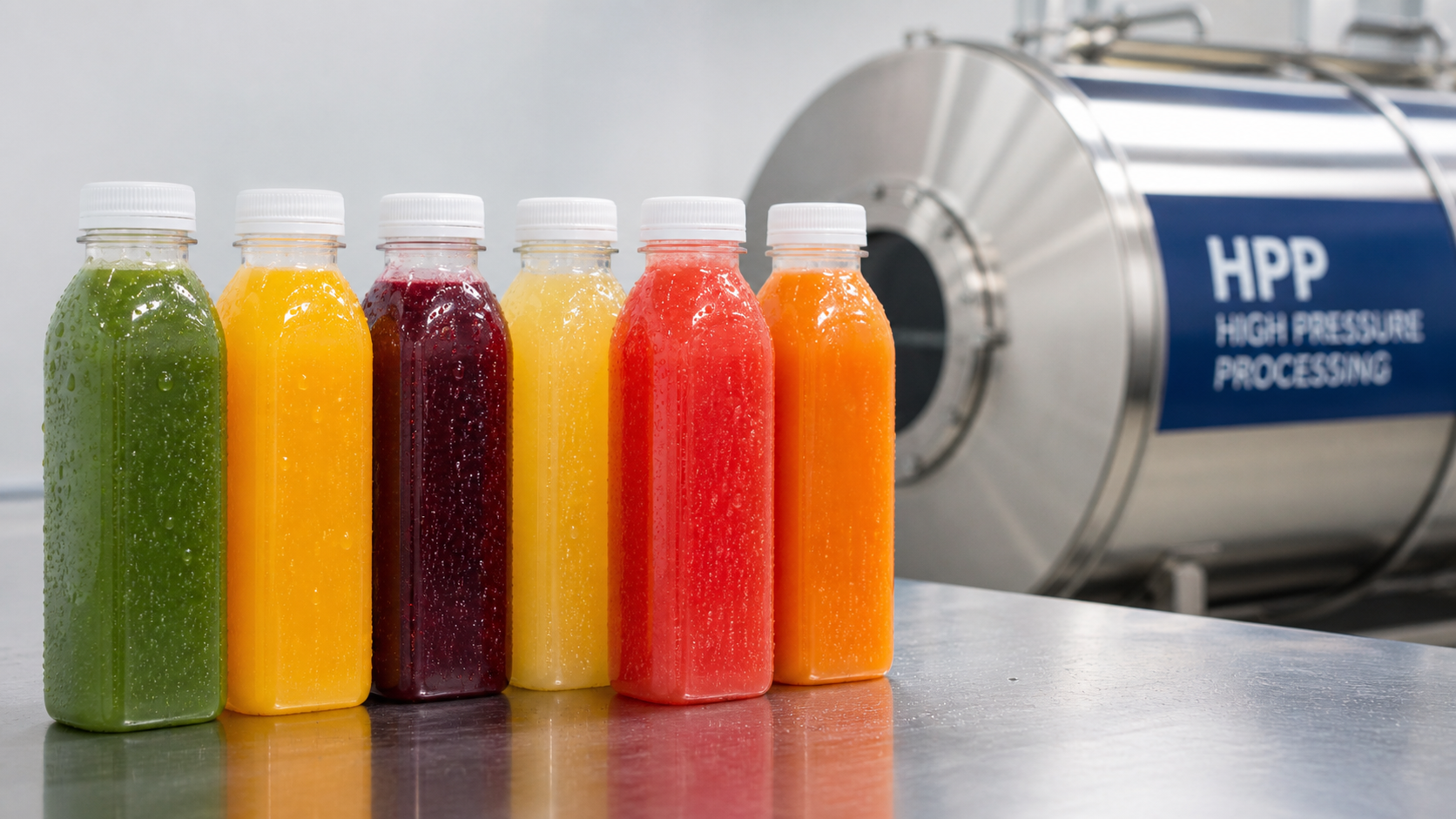
High-pressure processing (HPP) is a non-thermal post-packaging step in which sealed beverage containers are submerged in water and exposed to uniform high pressure for a defined hold time. The pressure disrupts many vegetative microorganisms that affect safety and quality, while typically retaining more fresh-like attributes than traditional thermal pasteurization. HPP is a kill step, not merely a filtration or physical separation stage.
What can cold pressure actually do?
HPP can inactivate many vegetative pathogens and spoilage organisms in appropriately formulated beverages, often enabling a refrigerated shelf life with fresher sensory compared with many heat treatments. It is especially compatible with acidic juices and blends when validated by proper testing.
- Microbial inactivation of vegetative cells: Many yeasts, molds, and vegetative bacteria are pressure-sensitive, helping improve product safety and quality when the process is validated for the specific beverage.
- Fresh-like sensory retention: Because there is no cooking step, color, aroma, and volatile notes can be closer to fresh-pressed compared with many thermal methods.
- Clean-label positioning: HPP can support formulas without added preservatives in markets where regulations and claims align with validated process performance.
- Post-packaging treatment: Product is processed in its final, sealed package, reducing post-process contamination risk when packaging is compatible.
- Acidic beverages are typically more suitable: Lower pH products generally pair well with HPP from a microbial perspective; actual suitability must be confirmed by validation.
- Enzyme impact varies: Certain quality-related enzymes may be only partially inactivated, so formulation strategies may still be needed to manage browning or separation.
What HPP cannot do (and the non‑negotiables)
HPP does not sterilize beverages and does not create months‑long ambient shelf stability. It generally requires strict refrigeration from end-to-end, and the resulting shelf life is still refrigerated and limited. Not all packages, product types, or channels are compatible, and costs are higher than many heat-based methods.
- No sterilization: HPP does not reliably inactivate bacterial spores, so it is not a substitute for thermal sterilization or aseptic processing when ambient shelf life is required.
- Cold chain is mandatory: HPP beverages must remain refrigerated throughout distribution and retail. Breaks in cold chain compromise safety and quality.
- Not for every package: Glass, cans, and rigid or fragile formats are typically unsuitable; packages must withstand compression in water without leaking or deforming excessively.
- Carbonation challenges: Highly carbonated formats are generally poor fits due to pressure and gas management issues.
- Does not fix poor hygiene: HPP complements, but does not replace, sanitation, good manufacturing practice, or ingredient quality.
- Higher cost and capacity limits: Capital and per‑unit tolling costs are higher than many thermal options. Access to toll HPP can be limited in some regions and is currently uncommon in Vietnam.
- Process sensitivity: Large particulates, high viscosity extremes, and air pockets can reduce effectiveness; headspace and closure integrity matter.
HPP capabilities at a glance
Use this decision snapshot to align technology limits with your brand’s product brief and route-to-market.
| What HPP can do | What HPP cannot do | Implications for brands |
|---|---|---|
| Inactivate many vegetative microbes in suitable formulas | Sterilize or inactivate spores | Position as refrigerated; validate the target micro reduction for your product |
| Preserve fresh-like color, aroma, and taste | Guarantee unchanged flavor over time | Build sensory shelf life with formulation, oxygen control, and storage trials |
| Enable refrigerated shelf life when validated | Create ambient, months-long stability | Plan strict cold chain, inventory turns, and shorter code dates |
| Process sealed, water-resistant packages | Work with glass, cans, or fragile shapes | Select HPP-suitable PET/HDPE/PP bottles, tight closures, and robust labels |
| Support clean-label positioning | Replace GMP, sanitation, or good ingredient quality | Maintain disciplined pre-HPP hygiene and quality systems |
| Fit acidic juices and some blends | Universally suit every matrix or particulate size | Screen pH, viscosity, and particulates; confirm with validation studies |
HPP vs. thermal pasteurization and aseptic processing
HPP aims to deliver fresh-forward sensory at refrigerated shelf life, whereas thermal pasteurization and aseptic technologies target robust microbial lethality and ambient distribution. If your brief demands months at room temperature, thermal technologies are the more appropriate direction. For an overview of thermal options and decision trade-offs, see our guide to fruit juice processing methods.
Because HPP products are refrigerated, commercial success hinges on strong cold-chain execution, retail placement, logistics, and velocity. If your strategy prioritizes export and long routes-to-market, review shelf-stable juice manufacturing to compare formats that travel without refrigeration.
Where HPP beverages fit in your portfolio
HPP beverages are best suited to premium refrigerated channels and consumers who value fresh-like taste and short-ingredient lists. They can complement a broader portfolio by anchoring the fresh tier while shelf-stable products cover mainstream or export needs.
- Premium refrigerated juice, smoothie, or juice-shot ranges with short ingredient lists.
- Seasonal or limited‑run flavors that benefit from fresh aroma and color.
- Local or regional distribution where cold chain is reliable end-to-end.
- Foodservice or hospitality programs that can manage refrigerated inventory and faster turns.
Cold-pressed vs. HPP: what the terms mean
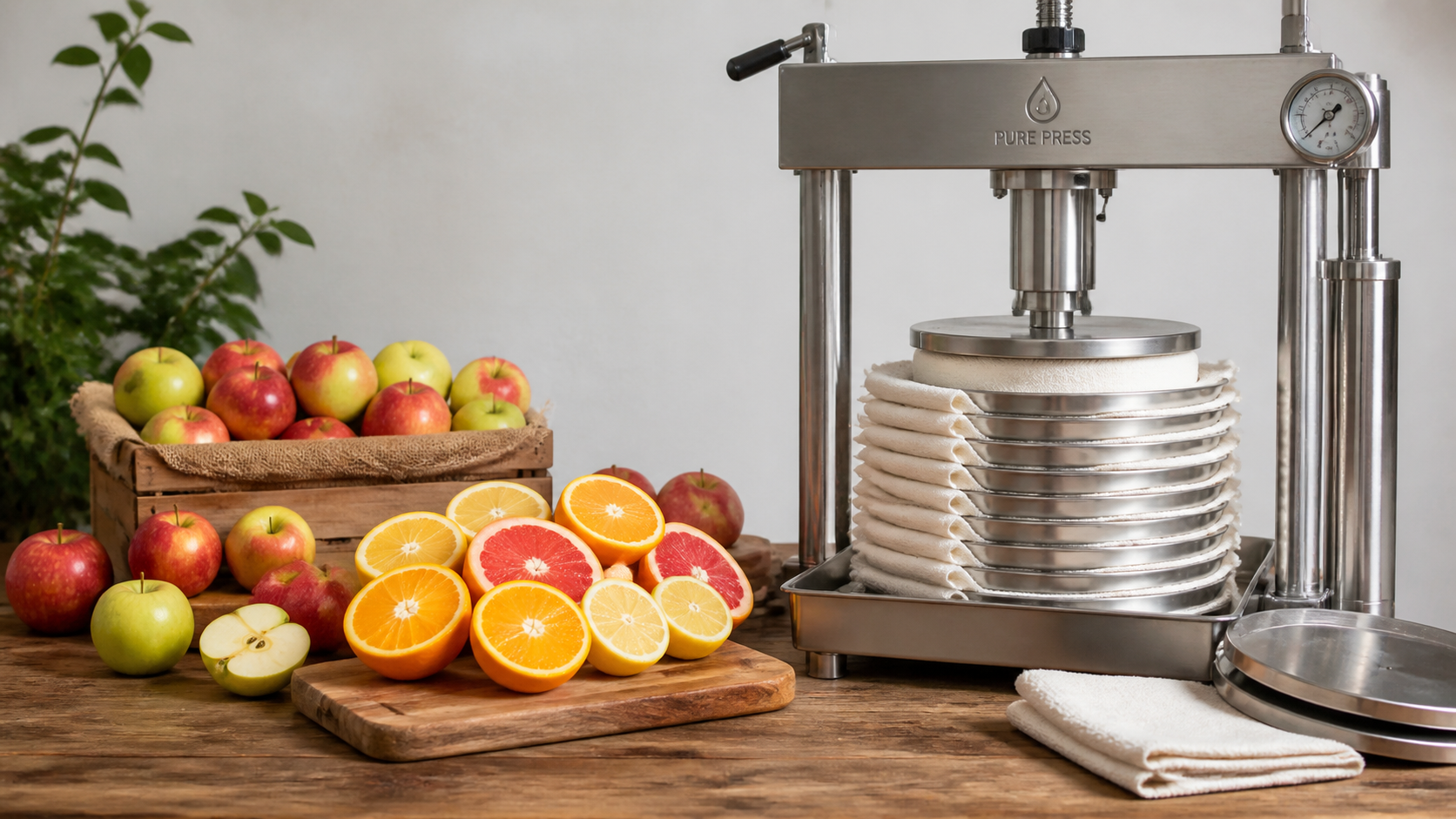
“Cold-pressed” describes how juice is extracted (typically a hydraulic press with minimal heat). “HPP” describes how the packaged beverage is preserved (high pressure in water). A drink can be cold-pressed but not HPP (sold raw), or cold-pressed and HPP (fresh-like, refrigerated). The terms are not interchangeable.
To explore broader process options beyond HPP, including blending and thermal routes, start with our overview of processing technology.
Packaging choices for HPP beverages
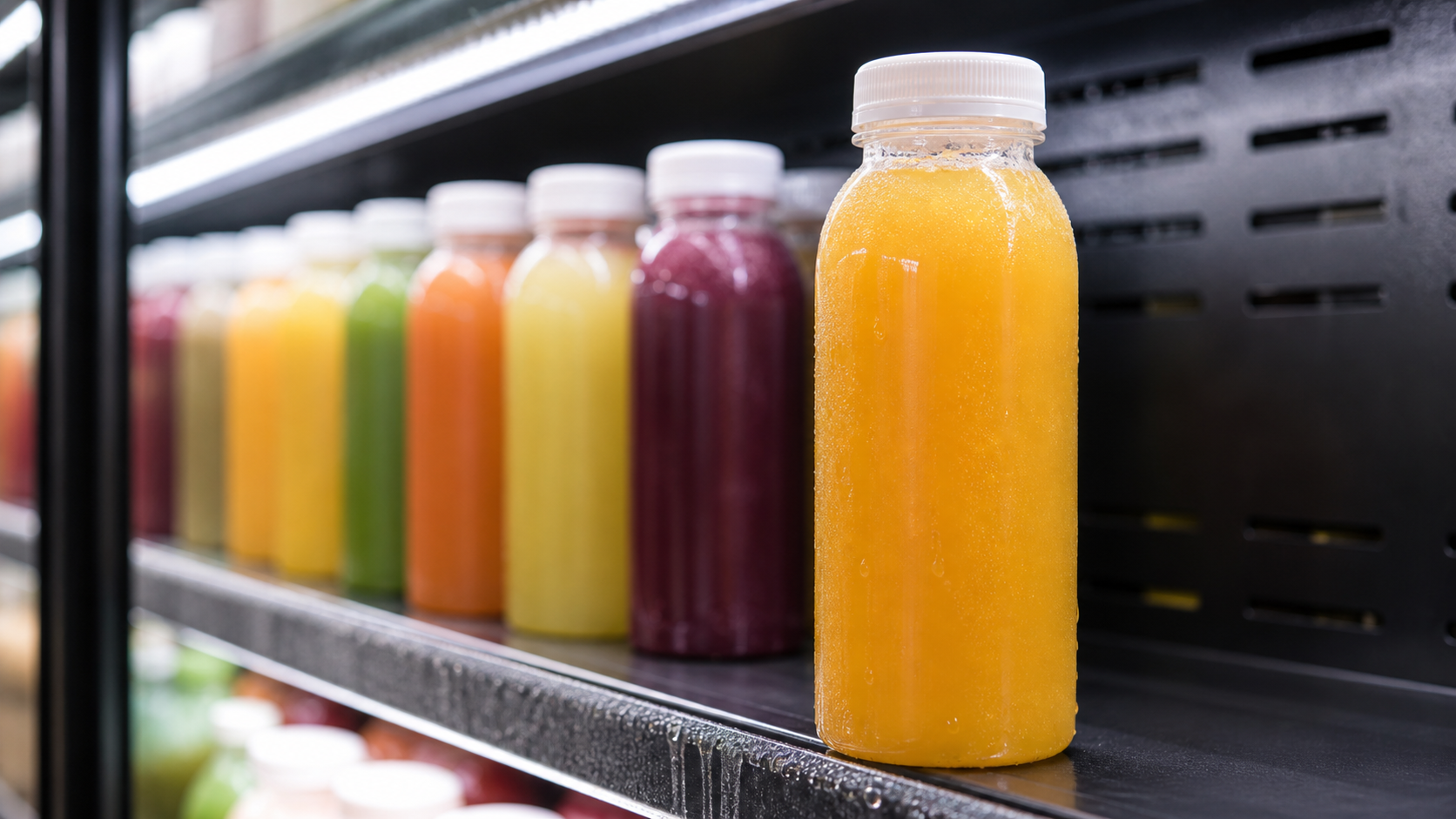
Packaging must tolerate compression in water, maintain seal integrity, and emerge retail-ready. Glass and cans are generally incompatible. Work closely with your HPP service provider to screen candidates before committing tooling or artwork.
- Materials: PET, HDPE, or PP bottles and flexible pouches are common. Confirm wall thickness, shape, and closures perform under pressure without leaking or paneling.
- Closures & headspace: Choose robust caps and liners; manage headspace to limit trapped air. Excess air can reduce process efficacy.
- Labels and inks: Use water-resistant adhesives, inks, and films. Shrink sleeves or durable pressure-sensitive labels that withstand immersion are typical.
- Geometry: Avoid sharp corners and fragile designs that may crease or distort. Test any embossed features or deep paneling.
- Oxygen control: Consider barrier choices or scavengers as appropriate. HPP is not an oxygen-removal step.
- Barcodes and coding: Ensure printing is legible after processing and drying. Plan drainage to avoid trapped water under sleeves.
- Carbonation: Highly carbonated products are poor fits; trapped gas and pressure interplay raise risk of deformation or leakage.
Formulation considerations for HPP success
Product chemistry drives HPP outcomes. Acidic beverages typically validate more readily, while large particulates, high viscosity extremes, and residual oxygen can undermine results. Design the matrix for pressure robustness and sensory stability.
- pH strategy: Acidic bases (e.g., citrus, many fruit blends) are usually more compatible. If using low-acid components, consider acidification strategies consistent with regulations and flavor targets.
- Particulate size: Keep particulates small and uniform. Large, dense pieces can shield microbes, leading to uneven inactivation.
- Viscosity and stabilizers: Extremely thick systems can challenge pressure transfer; where allowed, use stabilizers to manage separation while protecting fresh-like mouthfeel.
- Oxygen and browning: Manage oxygen pickup at pressing and blending; consider antioxidants where permitted to support color and flavor.
- Flavor planning: Expect evolution over refrigerated life; run sensory time-course to set realistic code dates.
Quality validation & shelf-life work
Every HPP beverage requires product-specific validation and shelf-life studies. That typically includes microbiological validation of the target organisms for your matrix, plus refrigerated storage trials for sensory, color, and physical stability. Learn how to plan protocols in shelf-life testing for private label.
For brands targeting the U.S. market, process controls and claims must align with applicable rules and process validation expectations. See our overview of certifications and FDA compliance for the U.S. to coordinate QA documentation and labeling with your process authority.
HPP in Vietnam: availability and cost realities
Commercial HPP tolling is currently uncommon in Vietnam. Even in mature markets, HPP involves significant capital and per-unit tolling costs, plus slower cycle times than many thermal lines. Build a pricing model that reflects premium positioning, smaller batch economics, and strict refrigerated logistics. If your route-to-market depends on long export lanes or ambient storage, consider alternatives outlined in shelf-stable fruit juice manufacturing and in our broader fruit juice processing methods guide.
Buyer checklist: is HPP right for your brief?
Use these prompts to stress-test product’s commercial and technical fit before committing to HPP.
- Is your target channel truly refrigerated end-to-end, with reliable cold chain?
- Will consumers pay a premium for fresh-like sensory and clean-label cues?
- Does your formula sit in an HPP-friendly pH range, viscosity, and particulate size?
- Do you have access to qualified HPP capacity at the right location and scale?
- Can your package withstand the process, and have labels/inks been wet-tested?
- Have you planned validation, challenge work (as applicable), and real-time shelf-life?
- Is your pricing and margin model resilient to HPP tolling and refrigerated logistics?
FAQ
Does HPP make juice shelf-stable at room temperature?
No. HPP does not sterilize and does not inactivate spores. HPP beverages are intended for refrigerated distribution and storage, with cold chain maintained throughout.
How long is the shelf life of HPP beverages?
There is no one-size-fits-all answer. Shelf life depends on formulation, pH, oxygen control, initial load, packaging, and storage temperature. Set code dates only after product-specific validation and refrigerated shelf-life testing.
Is HPP the same as cold-pressed?
No. “Cold-pressed” describes juice extraction; “HPP” describes the preservation step after packaging. A product can be both cold-pressed and HPP, or cold-pressed and raw.
Can I use glass or cans with HPP?
Generally no. Packages must compress uniformly in water and maintain seal integrity. Glass and cans are typically unsuitable for HPP.
Which beverages are most compatible with HPP?
Acidic juices and blends are often more compatible from a microbial perspective. Always confirm with validation tailored to your exact formulation and package.
Conclusion
HPP beverages can deliver fresh-forward flavor and clean-label positioning with validated microbial safety, but they remain refrigerated products with shorter code dates, strict cold-chain demands, and higher costs. If your brief requires ambient stability or long export lanes, explore thermal options alongside HPP. For deeper background on technology choices, see our overview of processing technology and compare fruit juice processing methods and shelf-stable juice manufacturing. Build decisions on real validation and shelf-life data rather than assumptions.