


 Français
 Español
 العربية
 한국어
한국어Fruit juice processing methods are the sequence of unit operations used to turn fresh fruit into safe, stable juices at commercial scale, from washing and extraction to stabilization and packaging. The exact route depends on juice style (clear, cloudy, with pulp), target shelf life, distribution, and packaging.
This guide maps the major options and trade-offs so technical, procurement, and brand teams can choose a robust process flow, align quality with positioning, and plan for manufacturing at scale.
What are fruit juice processing methods for commercial production?
They are modular steps—raw material handling, extraction, clarification or cloud retention, standardization, deaeration, pasteurization or alternative stabilization, filling, and packaging—selected and sequenced to meet safety, sensory, and shelf-life goals. Final choices vary by fruit variety, pulp level, product type (NFC or from concentrate), and ambient vs chilled distribution.
A typical high-level flow for many juices:
- Receiving, sorting, washing, and sanitizing
- Size reduction and seed/stone removal where applicable
- Extraction (pressing or decanter/centrifugal methods)
- Optional enzymatic treatment and clarification/filtration
- Standardization: Brix, acidity, color, aroma balance
- Deaeration/oxygen control
- Thermal pasteurization or non-thermal stabilization
- Filling (hot-fill, tunnel-pasteurized, aseptic, or chilled)
- Secondary packaging, storage, and distribution
How do raw materials and pretreatment influence juice quality?
Fruit variety, maturity, and handling set your sensory ceiling. Gentle pretreatment preserves aroma, color, and yield, while inadequate sorting or sanitation raises defects and spoilage risk.
- Selection & maturity: Align cultivar and ripeness with intended profile (acid/sugar balance, aroma, color).
- Sorting & trimming: Remove damaged fruit to limit enzymatic browning and microbial load.
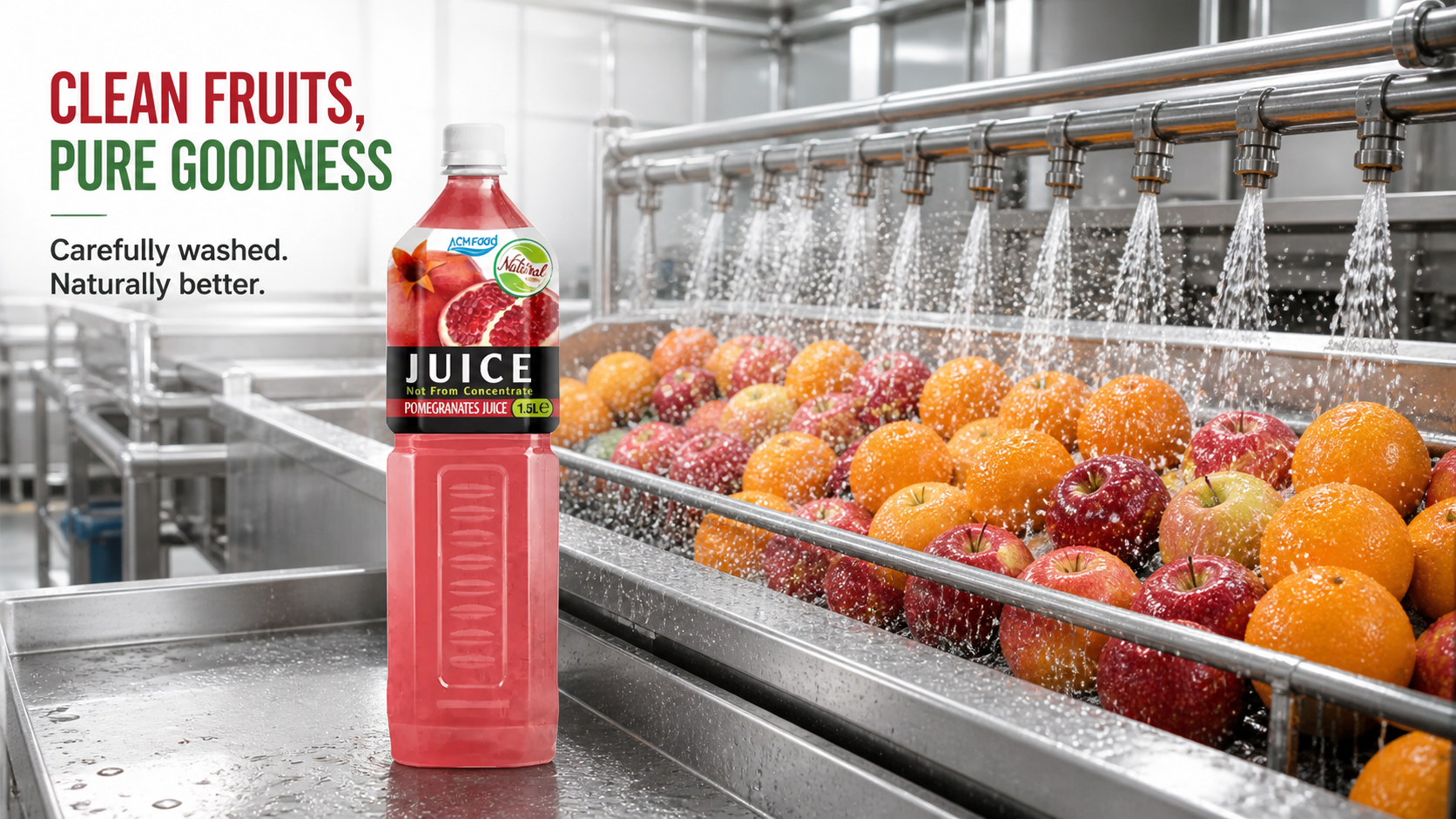
- Washing & sanitation: Multistage wash with potable water and an approved sanitizer (e.g., peracetic acid or ozone where permitted) to reduce surface contaminants.
- Destoning/peeling/coring: For mango, peach, lychee, pineapple, etc., mechanical removal prevents bitterness and equipment wear.
- Size reduction: Controlled crushing or maceration improves extraction; avoid excessive shear that releases undesirable phenolics.
Which juice extraction technologies are used?
Commercial plants commonly use belt presses, screw presses, hydraulic presses, or decanter/centrifugal systems. Choice depends on fruit structure, desired yield, clarity, and CAPEX/OPEX profile.
- Belt press: Continuous, high-throughput for apples, grapes, and similar; good clarity after downstream treatment.
- Screw or hydraulic press: Versatile for many fruits; pressure profiles influence yield vs turbidity.
- Decanter/centrifugal extraction: Efficient phase separation, useful for pulpy fruits and when targeting cloudy styles.
- Cold-press positioning: In industry, “cold-press” typically refers to mechanical pressing with minimal heat pickup; the marketing term varies by market rules.
Enzymatic treatment, clarification & filtration
Pectinolytic enzymes can break down pectins, reducing viscosity and improving juice release and filterability. After enzymation, processors may clarify to a bright juice or retain cloud depending on product style.
- Clarification options: Settling, flotation, fining aids, centrifugation, and crossflow microfiltration/ultrafiltration for stable clarity.
- Cloud retention: For cloudy juice, manage pulp size distribution and colloidal stability; minimize over-clarification.
- Filtration strategy: From coarse screens to polishing filters, design the train to protect downstream heat exchangers and fillers.
NFC vs concentrate: evaporation and aroma recovery
Not-from-concentrate (NFC) juice is stabilized and packed near its natural solids. Concentrated juice is water-removed under vacuum and later reconstituted to sale strength (single-strength) with recovered aromas.
- Vacuum evaporation: Lowers boiling conditions to reduce thermal impact while concentrating soluble solids.
- Aroma recovery: Strips and captures volatiles before/within the evaporator to dose back into concentrate or during reconstitution.
- Reconstitution: Mix concentrate with treated water to target Brix, acidity, and flavor; then proceed to stabilization and filling.
If you are aligning product type with market norms across juice, nectar, or juice drinks, see our overview of popular beverage categories for context.
Standardization: Brix, acidity, color, and flavor
Standardization ensures batch-to-batch consistency. This includes adjusting soluble solids (Brix), titratable acidity, color, and aroma to target specs defined in the product brief and relevant standards for the destination market.
- Blend design: Combine lots, single-strength and concentrate, or different cultivars to hit sensory and analytical targets.
- Acidity balance: Natural acids (e.g., citric, malic) and flavor balance are adjusted within market rules.
- Sweetness strategy: Options range from fruit-only to permitted sweeteners in nectar/juice drinks; labeling depends on formulation and local law. Compare approaches in no added sugar vs reduced sugar formulations.
- Antioxidants: Ascorbic acid is often added to manage color and oxidative notes; rates depend on product and regulations.
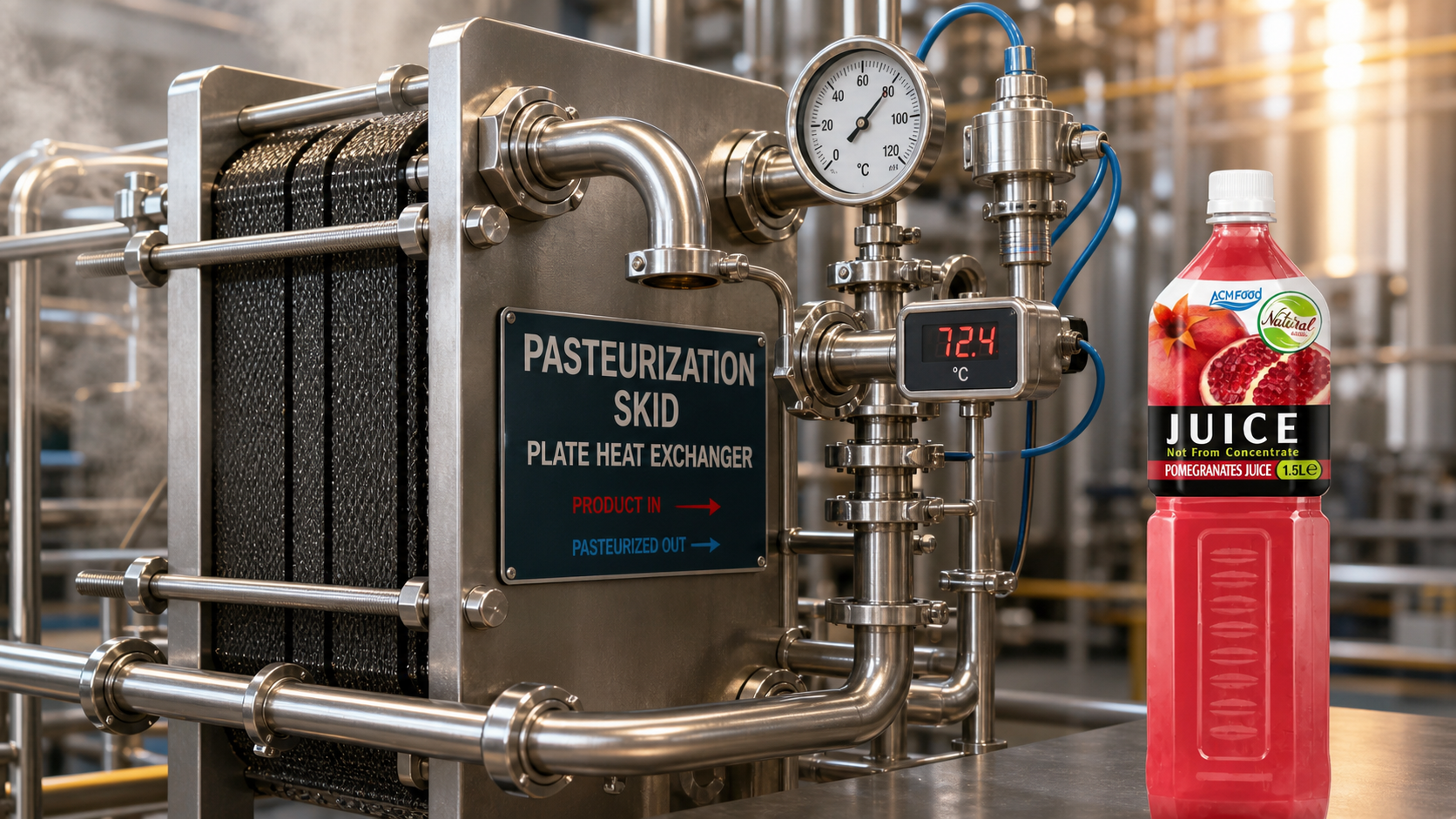
What pasteurization and stabilization options are available?
Most high-acid fruit juices use thermal pasteurization to reduce spoilage organisms and enzymes. Common routes include HTST via plate heat exchangers, hot-fill-hold in PET/glass, tunnel pasteurization for filled glass/cans, ultra-high-temperature aseptic filling, or non-thermal high-pressure processing (HPP) for premium chilled lines.
| Method | Heat severity | Shelf-life & distribution | Compatible packaging | Positioning & notes |
|---|---|---|---|---|
| HTST pasteurization | Moderate heat, short time | Chilled chain; weeks to months depending on process | PET/glass (filled cold), bag-in-box, totes | Preserves freshness; often paired with deaeration and rapid cooling |
| Hot-fill-hold | Higher heat with in-bottle hold | Ambient; months if sealed integrity holds | PET or glass rated for hot-fill | Common for clear/cloudy juices; requires cap/closure and bottle design suitable for heat |
| UHT + aseptic filling | Very high heat, seconds | Ambient; extended shelf life | Aseptic carton, PET, or glass | Low microbial risk when asepsis is maintained; premium or family packs |
| Tunnel pasteurization | Mild-to-moderate post-fill | Ambient; depends on target lethality | Glass and cans | Post-pack thermal stabilization; suits clear juices and blends |
| High-pressure processing (HPP) | Non-thermal, pressure-based | Chilled chain; limited but premium shelf life | HPP-compatible PET or HDPE | Fresh-like flavor; batch process with higher unit cost |
Choice hinges on desired flavor retention, budget, shelf life, and packaging. All routes must be validated for safety and legal compliance in the destination market.
Deaeration and oxidation control
Oxygen ingress accelerates aroma loss and browning. In-line deaeration before heat treatment reduces dissolved oxygen, improving flavor retention and color stability. Coupled with inert gas blanketing and low-turbulence transfers, it helps protect sensitive volatiles.
- Deaeration: Vacuum or membrane systems upstream of pasteurization.
- Inerting: Nitrogen or CO2 headspace flushing where suitable.
- Low-oxygen design: Short holds, closed loops, and minimized splashing during blending.
Homogenization and stabilization of pulpy juices and nectars
Pulp- or purée-rich beverages tend to settle. Homogenization can reduce particle size and improve suspension, while hydrocolloid systems (e.g., pectin) help maintain a stable cloud without gritty mouthfeel.
- Homogenization: Applied before or after pasteurization depending on viscosity and equipment; validate impact on flavor and cloud.
- Stabilizers: Choose types and levels consistent with local regulations and desired label positioning.
- Shear sensitivity: Over-processing may dull flavor; run design-of-experiments for optimal texture vs stability.
Filling & packaging formats for commercial juice
Packaging must align with the stabilization method and brand positioning. Glass conveys premium clarity and heat resistance; hot-fill PET balances weight and cost; aseptic cartons suit ambient family packs; chilled HPP prefers robust plastic bottles.
- Hot-fill PET or glass: Heat-stable bottles and closures; vacuum panels for PET manage internal pressure during cooling.
- Aseptic PET/glass/carton: Sterile zones and validated sterilants; tight control of packaging materials and seaming/capping.
- Tunnel-pasteurized glass/cans: Post-fill lethality with controlled spray zones and temperature ramps.
- Chilled distribution: Emphasize barrier properties, cap liner integrity, and secondary packaging for cold chain.
Quality control checkpoints across the line
Build QA into every stage—from incoming fruit to finished goods—to ensure safety, consistency, and label compliance.
- Incoming: Visual quality, maturity, defects, pesticide documentation where required.
- In-process: Brix, pH/acidity trends, turbidity, color, dissolved oxygen, temperature-time records, homogenization pressure.
- Microbiological: Environmental swabs, in-line sampling post-pasteurization, finished product testing per plan.
- Sensory: Attribute tracking vs reference; monitor aroma fade and sweetness/acid balance.
- Packaging integrity: Torque, seam checks, vacuum, headspace gas, leak tests.
- Traceability & HACCP: Lot tracking, critical control points, and deviation handling.
For governance and supplier verification, see the supplier audit checklist for juice plants.
Common defects and troubleshooting
Early detection helps preserve shelf life and minimize rework. Typical issues include:
- Haze loss or sediment: Rebalance enzyme treatment, filtration cutoffs, and homogenization pressure; review stabilizer selection.
- Oxidative browning: Improve deaeration, antioxidant dosing, and oxygen control at fillers; tighten cap torque.
- Flavor fade: Shorten hold times, improve aroma recovery, and reduce thermal load where possible.
- Swelling or leaks: Check thermal process delivery, packaging integrity, and hygienic design at critical junctions.
- Color shift: Review fruit maturity mixing, light exposure, and heat impact during pasteurization.
Sanitation, CIP, and hygienic design
Clean-in-place (CIP) programs and hygienic design minimize contamination risk and downtime. Focus on validated cycles, correct chemical concentrations per supplier guidance, effective rinsing, and inspection of gaskets, seals, and dead-legs. Design transfer lines and valves to avoid product traps and ensure full drainability.
Process economics and sustainability levers
Process choices affect yield, energy, labor, and waste. Opportunities include:
- Yield optimization: Enzyme-assisted extraction and proper press settings.
- Heat recovery: Regenerative plate heat exchangers and optimized CIP heating.
- Water stewardship: Counter-current washing and rinse recovery where allowed.
- By-product utilization: Pomace to feed or valorized ingredients (where feasible).
Product development notes for buyers and brand teams
Lock the process route early in your brief, aligned to shelf life and channel strategy. Cross-functional clarity prevents late changes to packaging, logistics, and claims.
- Define product type: 100% juice (NFC or reconstituted), nectar, or juice drink—each with different solids and labeling norms.
- State sensory targets: Color window, pulp level, key aroma notes, sweetness/acid balance.
- Pick stabilization + pack: HTST chilled, hot-fill ambient, aseptic, or HPP chilled; match to glass, PET, or carton.
- Confirm analytics: Brix range, acidity, viscosity for nectars, oxygen limits.
- Validate claims & labeling: Dependent on final formula, tested levels, serving size, and local regulation.
Plan milestones with this development timeline from concept to shipment, and use this guide to choose a fruit juice manufacturer that fits your route to market.
FAQs
Is pasteurization always required for fruit juice?
Commercial fruit juices generally use a validated stabilization step—most often thermal pasteurization for high-acid juices—to manage spoilage organisms and enzymes. Specific requirements and process targets depend on juice composition, packaging, and the regulations of the destination market.
What is the difference between NFC juice and juice from concentrate?
NFC is stabilized near its natural solids and packed for sale, while concentrate is water-removed under vacuum and later reconstituted to single-strength with recovered aromas. Both can deliver high quality when processed and standardized correctly.
Does HPP replace heat?
High-pressure processing is a non-thermal method that inactivates many spoilage organisms while preserving fresh-like flavor. It usually requires chilled distribution and compatible packaging and is often positioned as a premium, shorter-shelf-life option compared with ambient-stable heat-processed juices.
Which packaging is best for my juice?
Match packaging to stabilization and channel: hot-fill PET or glass for ambient lines, aseptic carton or PET for extended ambient shelf life, and robust plastic bottles for chilled HPP. Consider brand cues, barrier needs, logistics, and recycling infrastructure in target markets.
For formulation choices around sweetness and positioning, compare options in no added sugar vs reduced sugar fruit juice formulations. To mitigate supply risk, use a structured supplier audit checklist for juice plants, and review broader context in popular beverage categories.
Key takeaways: map your stabilization method to shelf life and packaging; control oxygen to protect color and aroma; standardize Brix and acidity for consistency; validate CIP and QA plans. If you are preparing a product brief or planning trials, align stakeholders early and sequence decisions alongside your development timeline from concept to shipment.
Turning this into a product
For the formats, ingredients and processing routes the factory actually runs, see beverage product capabilities. For how a recipe moves into production, see contract beverage manufacturing; for launching under your own label, see private label beverages. The processing routes available are set out in processing technology. To discuss a specification, request a quote.
Request a quote