


 Français
 Español
 العربية
 한국어
한국어LCL vs FCL beverage import is the decision between shipping a partial load consolidated with other cargo (LCL) or booking an entire container for your goods (FCL). For a first beverage order, the right choice depends on volume, shelf life, packaging, risk tolerance, and how quickly you need market feedback.
This guide explains the trade-offs in plain language, shows how cost and risk behave at low volumes, and gives a practical framework to choose confidently for trial orders without compromising quality or compliance.
What does LCL vs FCL mean in beverage import?
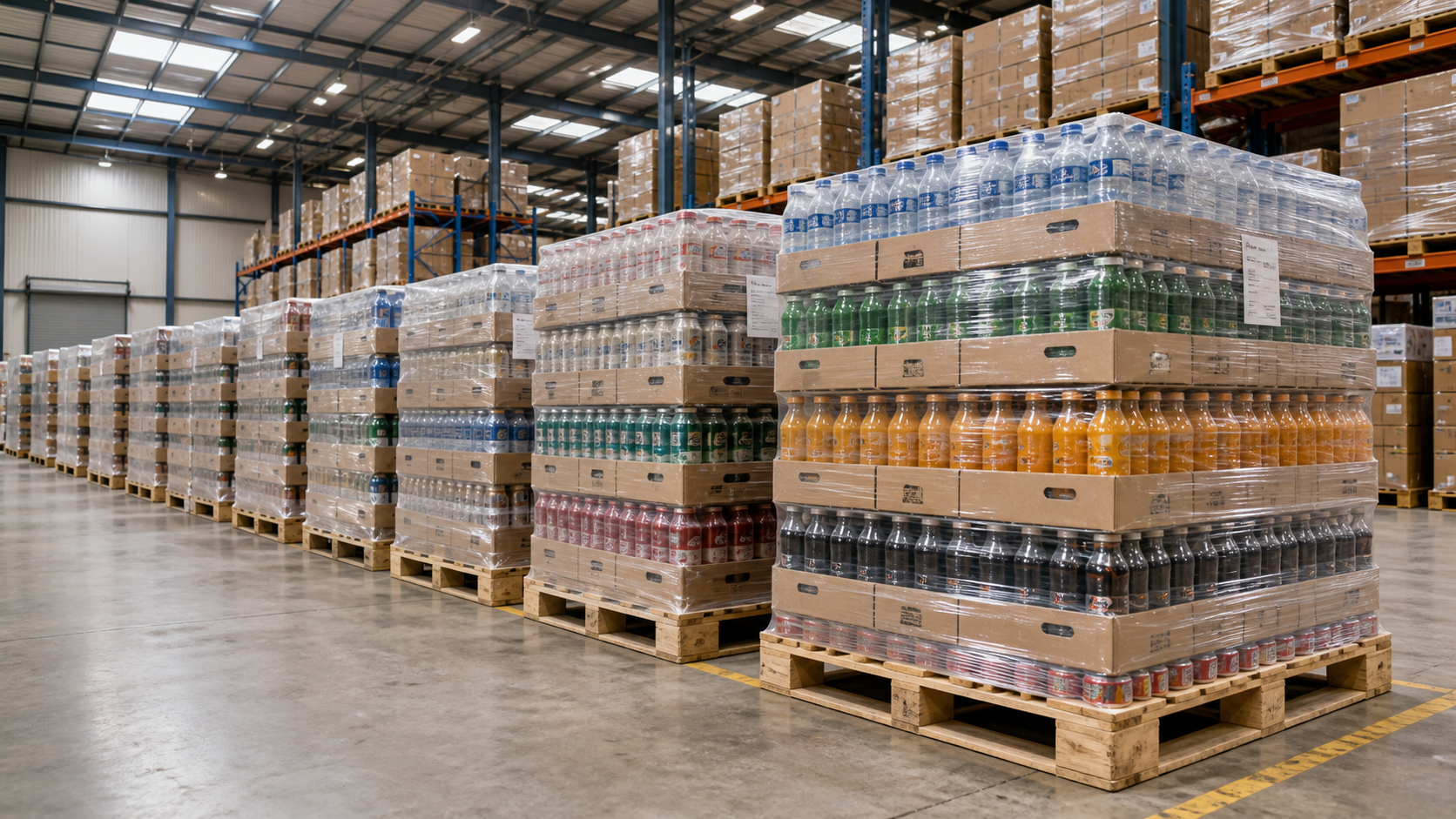
LCL (Less than Container Load) combines your cartons or pallets with other shippers’ cargo inside a container, while FCL (Full Container Load) dedicates a whole container to your shipment. LCL is flexible for small volumes; FCL usually offers tighter control, lower unit logistics cost at scale, and simpler handling.
In beverages, this choice also affects product integrity. Handling frequency, consolidation time, stacking patterns, and temperature control differ between LCL and FCL, which can influence leak rates, label scuffing, and potential flavor impacts if heat exposure is not well managed.
LCL vs FCL at a glance (buyer’s comparison)
| Criteria | LCL (Less than Container Load) | FCL (Full Container Load) | Positioning & notes |
|---|---|---|---|
| Volume fit | Best for trial or small runs | Best for scaled or launch volumes | Match order size to realistic market test |
| Cost structure | Pay by CBM/weight + CFS fees | Pay per container + port charges | LCL attractive at very low volume; FCL scales better |
| Handling frequency | Higher: more touches, more transfers | Lower: factory load to consignee | Fewer touches = lower damage risk |
| Lead time reliability | More variable (consolidation/deconsolidation) | Generally more predictable | Important for dated promos or retail resets |
| Temperature control | Reefer LCL exists but less common | Dry or reefer widely available | Choose by product stability & route |
| Quality risk | Higher scuffing/leak risk if under-packed | Lower with proper blocking & bracing | Packing spec matters more in LCL |
| Customs & docs | House B/L; CFS deconsolidation | Master B/L; direct to terminal | Broker flow can be simpler with FCL |
| Fees exposure | CFS, deconsolidation, per-pallet fees | Demurrage/detention risk on full box | Know local free-time rules |
| SKU flexibility | Easy to trial many SKUs in small qty | Large qty per SKU more efficient | Useful when testing assortment |
| Damage/shortage claims | More parties; can be slower | Clearer custody chain | Photo evidence & tally sheets help |
When is LCL better for a first beverage order?
LCL is a strong choice when your objective is market validation with limited capital at risk. It suits low volumes, multi-SKU trials, targeted channel tests, and shipments where speed to learn outweighs small per-unit cost disadvantages.
- Market test first: Send only what you reasonably expect to sell before best-before dates, then scale.
- SKU breadth over depth: Place multiple flavors or formats in smaller quantities to assess pull-through.
- Cash flow discipline: Avoid over-committing to packaging inventory or warehouse space before demand is proven.
- Complex routes: If you’re testing a secondary market or new distributor, LCL can reduce sunk cost if plans shift.
Use LCL more confidently when your beverage is shelf-stable, well-packed, and tolerant of standard ambient shipping. If the product is heat-sensitive or packaged in fragile formats without robust cartons, either upgrade packaging or consider reefer solutions.
When does FCL make more sense from the start?
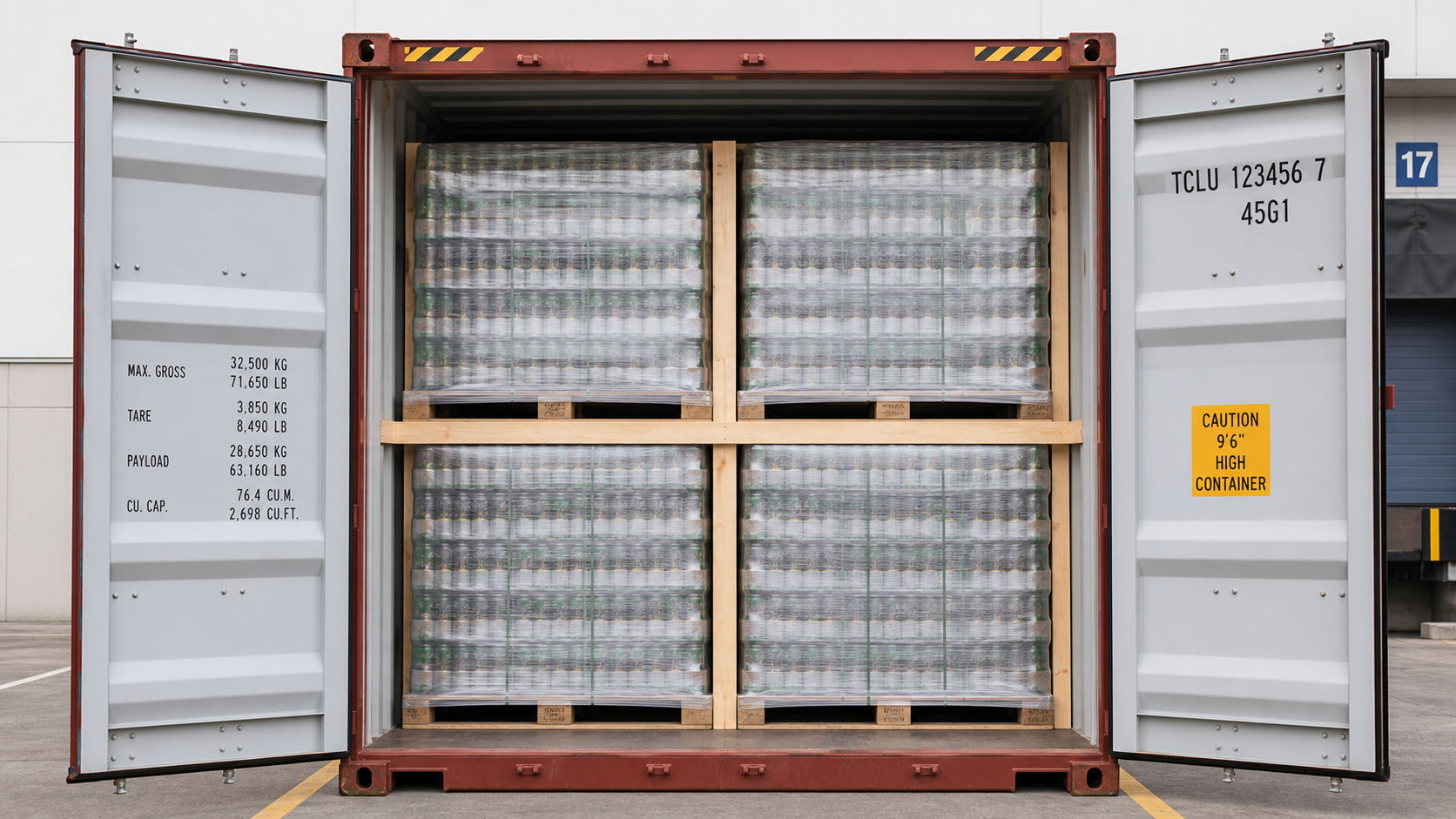
Choose FCL when total landed cost per unit and quality control are critical and you have enough demand to fill a meaningful portion of a container within shelf-life. FCL typically reduces handling touches, clarifies custody, and gives you more control over temperature and stowage.
- Confirmed demand: Retail POs, e-commerce forecasts, or distributor commitments justify container-level volume.
- Temperature or stowage control: Better access to reefer equipment and dedicated blocking & bracing.
- Heavy or bulky packaging: Glass, large PET, or can multipacks benefit from fewer transfers.
- Promotional timing: More predictable schedules for seasonal sets or marketing windows.
How do LCL and FCL cost structures actually differ?
While rates vary by lane and season, the core mechanics are consistent. LCL charges are primarily volume/weight based plus origin/destination CFS handling and documentation; FCL is a per-container ocean rate plus terminal, drayage, and local charges. The crossover point depends on your CBM, packaging density, and all-in local fees.
- LCL cost drivers: Chargeable volume (CBM), minimum charges, CFS in/out, deconsolidation, documentation, potential per-pallet fees.
- FCL cost drivers: Container type (20’/40’/HC/reefer), ocean base rate, origin/destination terminal handling, chassis/drayage, demurrage/detention exposure.
- Packaging density matters: Heavier beverages in compact cases reach FCL break-even sooner than light, airy packs.
Ask your forwarder to quote both scenarios using the same packing list. Clarify inclusions (fuel surcharges, peak season factors, terminal fees) so the comparison is apples-to-apples.
Quality & compliance considerations for beverages
Regardless of mode, protect product integrity and labeling compliance from factory to shelf. The following controls reduce risk, especially in LCL.
- Temperature profile: Match product stability to the route. Ambient-stable items generally go dry; sensitive SKUs may require reefer or protective packing.
- Carton strength: Use moisture-resistant corrugate and fit-for-purpose partitions for glass; verify stacking strength over expected transit duration.
- Palletization: Choose pallet type compatible with destination handling. Secure with corner boards, top sheets, and adequate wrap tension.
- Blocking & bracing: In FCL, specify load plans, slip sheets, airbags/dunnage as needed to prevent shifting.
- Label durability: Scuff-resistant labels and shrink bundles reduce abrasion during LCL transfers.
- Traceability: Clear lot/batch coding and carton markings aid first-expiry-first-out (FEFO) and claims handling.
Packaging & palletization: does LCL change the spec?
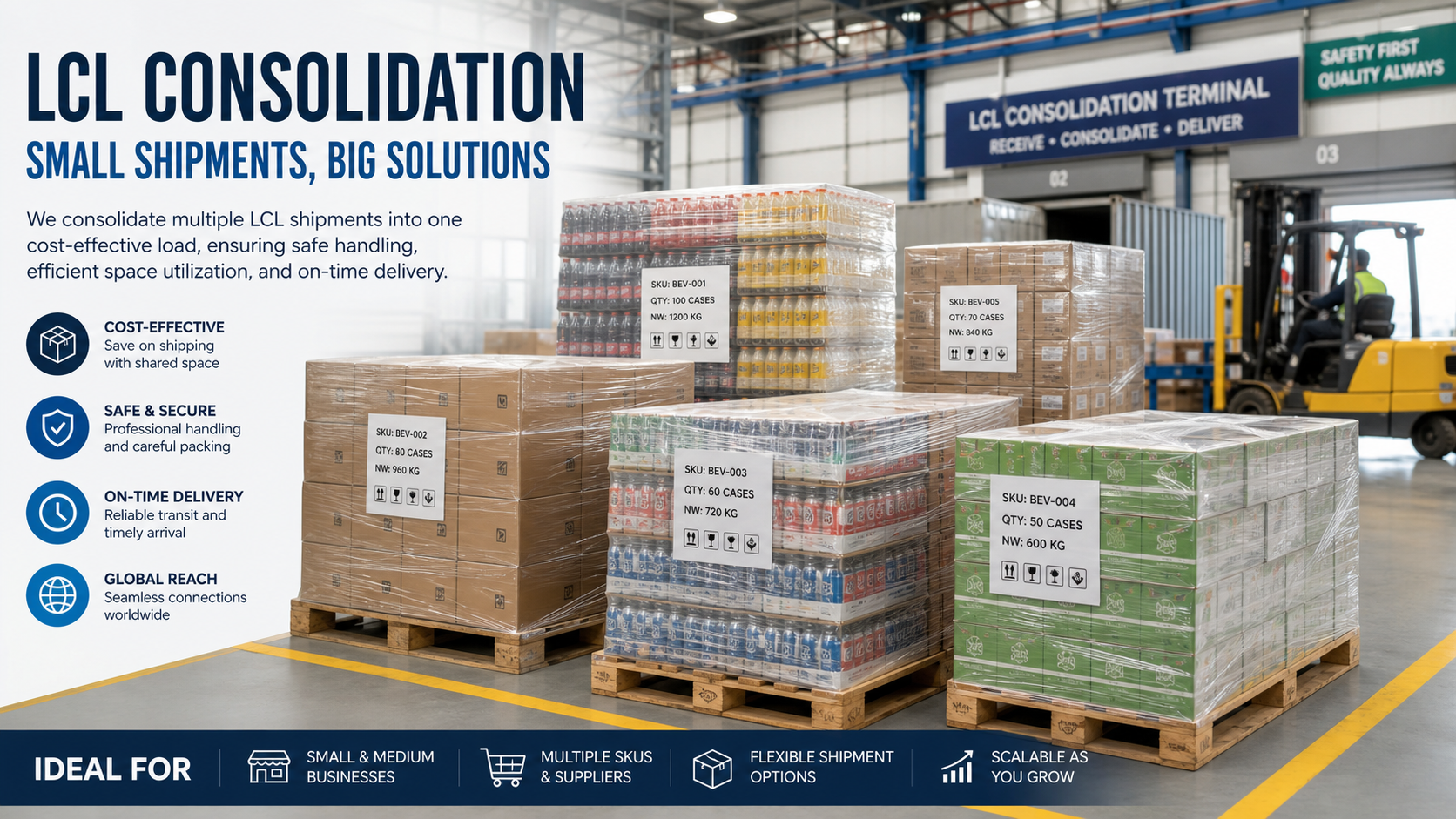
Often, yes. LCL introduces more touches and mixed-cargo environments. Up-spec the shipper carton and unitization when shipping trial orders via LCL.
- Carton design: Add internal dividers, reinforce corners, and avoid case headspace that invites crushing.
- Unitization: Tight shrink wrap with top/bottom sheets; consider strapping for tall pallet loads.
- Pallet standard: Align with receiver’s standard (e.g., 1200×1000 mm EU or 48×40 in US) to avoid re-palletization.
- Load height: Keep within terminal and truck gate limits; shorter stacks can reduce top-layer damage in LCL.
- Moisture control: Desiccants or liners can help on humid routes, particularly for cartons with paper labels.
If you are exploring PET formats or light-weighting to improve cube efficiency, see this related overview of coconut juice in PET bottles OEM for packaging considerations that also apply beyond coconut beverages.
Lead time & reliability: what should first-time importers expect?
FCL generally offers more predictable schedules because your cargo is not waiting for consolidation or affected by other shippers’ readiness. LCL can be perfectly workable, but factor in potential extra days at origin CFS and destination deconsolidation.
- Cutoffs & rollovers: LCL relies on consolidation windows; missing cutoffs can push to the next sailing.
- Free time: Understand free-time at terminals/CFS to avoid storage fees; have your broker and drayage lined up in advance.
- Delivery cadence: FCL supports full-container deliveries; LCL may deliver as loose cartons or pallets from a CFS.
For lane-specific planning to the U.S., including documentation flow and port choices, review Shipping beverages from Vietnam to the United States.
Risk management, insurance, and claims
Protecting your downside is especially important for first shipments. Small, well-documented trials build confidence for FCL scale-up.
- Cargo insurance: Arrange proper coverage (often institute clauses for beverages); confirm valuation basis and deductibles.
- Inspection & evidence: Photograph pallet builds, seal numbers (FCL), and loading; keep packing lists and weight tickets.
- Environmental data: Temperature/humidity loggers provide objective records for quality investigations.
- Receiver readiness: Ensure the warehouse can handle appointment windows and has the right equipment for your pallet type.
Documentation & customs flow differences
In LCL, you’ll typically receive a House Bill of Lading from the consolidator, with deconsolidation at a CFS before final delivery. In FCL, you hold a Master Bill of Lading tied to a specific container and seal, moving directly to a terminal for pickup after customs release.
- Broker coordination: Share commercial invoice, packing list, product classifications, and any required market-specific registrations early.
- Timeline discipline: Pre-file as much as possible to minimize storage charges and keep product within shelf-life objectives.
- Traceability on docs: Align lot codes on documents and carton marks to speed QA checks at destination.
A practical roadmap for a first beverage shipment
Use this step-by-step outline to move from concept to delivered trial with minimal surprises:
- Define test scope: Channels, number of stores, and realistic sales velocity by SKU.
- Select format & pack-out: Bottle/can size, case count, pallet height, and labeling durability.
- Run a packing test: Simulate compression and vibration; set carton and wrap specs.
- Get parallel LCL and FCL quotes: Same SKUs, same packing list; compare true all-in costs and free-time assumptions.
- Choose mode: If uncertain demand—lean LCL; if committed purchase orders—lean FCL.
- Book production & inspection: Align factory dates with consolidation or container cutoff.
- Prepare documents early: Invoice, packing list, product registrations as required by the destination market.
- Arrange insurance and tracking: Policy in place; decide on temperature/humidity loggers for sensitive SKUs.
- Align receiving: Appointments, unloading equipment, and FEFO procedures at warehouse.
- Review results fast: Sell-through, feedback, any handling issues; update packing spec and reorder plan.
If your trial involves fruit juices and you’re weighing volume versus cost, this primer on Private Label Fruit Juice MOQ guide helps frame minimums before you decide LCL or FCL. For brands exploring coconut-based lines, see private label coconut water options that can be tailored to your route and packaging choices.
How to decide: a simple decision framework
Use these questions to reach a confident first-order decision on lcl vs fcl beverage import within minutes:
- Demand clarity: Do you have confirmed POs or only market tests? (Tests → LCL; POs → FCL.)
- Shelf-life headroom: Will product be sold well before best-before dates after transit and receiving? (Tight → FCL/reefer.)
- Packaging robustness: Are cartons and unitization proven through handling? (Unproven → LCL with up-spec.)
- Cost tolerance: Is a slightly higher unit freight cost acceptable to reduce capital risk? (Yes → LCL.)
- Temperature needs: Is ambient acceptable on this lane/season? (No → consider reefer, often FCL.)
- Operational control: Do you need control over stowage, seals, and schedule? (Yes → FCL.)
If the answers split, start with a tightly specified LCL, collect data, and shift to FCL on the immediate follow-up order. This reduces overall program risk while building a defensible landed-cost model.
FAQ
Can beverages ship as LCL under temperature control?
Yes, but availability varies by lane and season. Reefer LCL services exist in some markets; capacity can be limited. If temperature control is critical or capacity is tight, a dedicated reefer FCL usually offers more reliable protection and scheduling.
How many SKUs can I mix in an LCL trial?
As many as your consolidator and importer of record can handle efficiently. Keep the assortment simple for clean documentation and receiving: clear carton marks, separate pallets per SKU if possible, and precise packing lists to avoid check-in delays.
Is FCL always cheaper per unit?
Often at moderate-to-high volumes, yes, because fixed container costs are spread over more units. At very low volumes, LCL can be more cost-effective overall, even if unit freight is higher, because you’re not carrying excess inventory or paying to move empty air.
Do glass bottles force me into FCL?
No, but glass increases the importance of carton design, dividers, and careful unitization in LCL. Many importers still start with LCL to validate demand, then shift to FCL as volumes and confidence grow.
Where can I learn about a Vietnam-to-U.S. shipping plan?
For lane-specific context, documentation flow, and port options, see Shipping beverages from Vietnam to the United States.
Conclusion
For a first beverage order, LCL prioritizes flexibility and learning at lower capital risk, while FCL prioritizes control, predictability, and unit cost once demand is clearer. Protect quality with fit-for-purpose packaging, align documents and receiving early, and compare quotes on a like-for-like basis. Make your lcl vs fcl beverage import decision with a test-and-scale mindset: validate with a tightly managed LCL if uncertain, then graduate to FCL as soon as the sales signal is strong.
Compliance and shipping at ACMFOOD
For the certificates and food safety systems buyers and customs ask us to produce, see certifications and food safety systems. For shipping terms, the document pack and container planning, see export and logistics. To discuss a specific market, request a quote.
Request a quote