


 Français
 Español
 العربية
 한국어
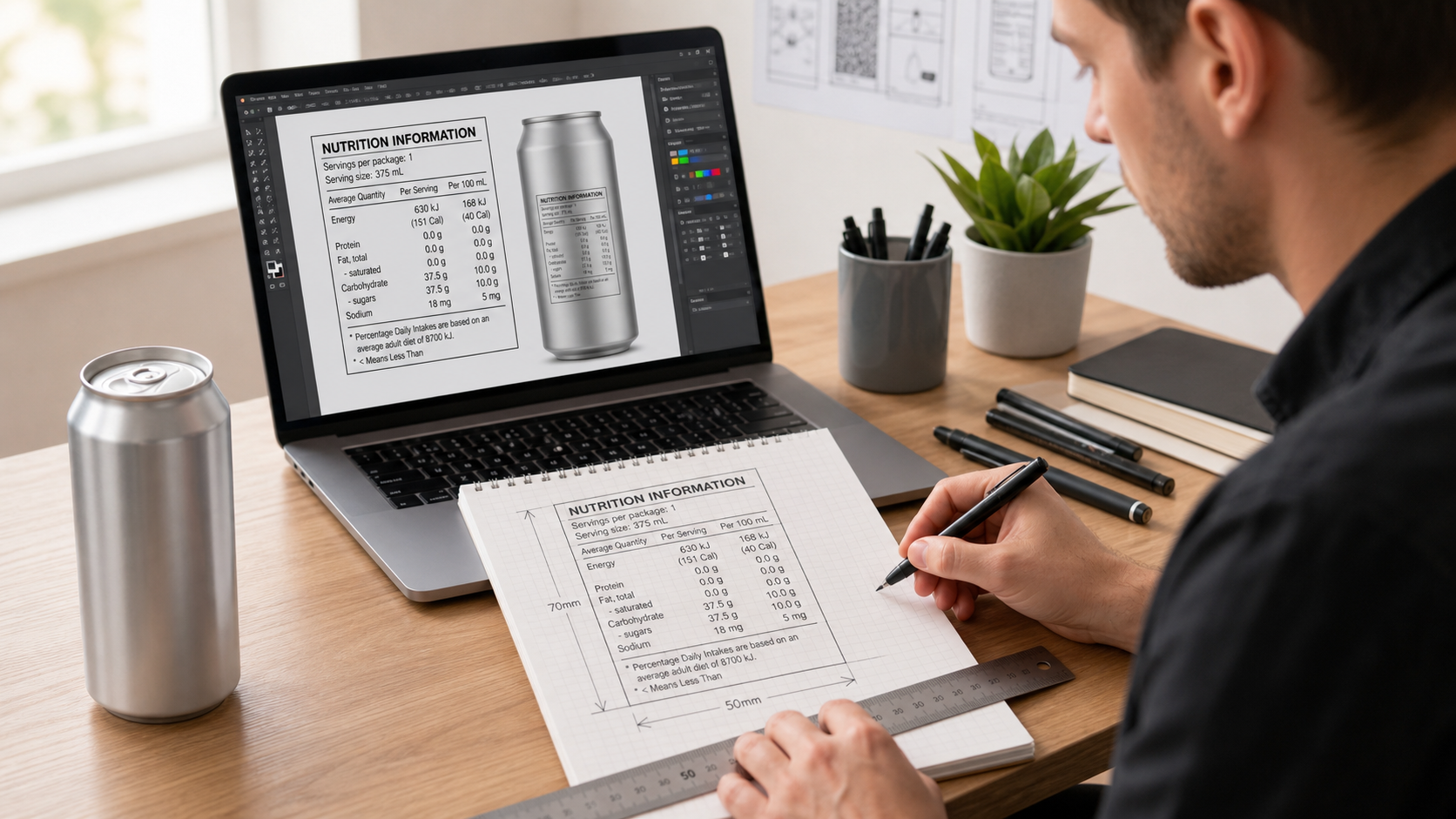
한국어An Australian Nutrition Information Panel (NIP) for beverages is the standardized table that lists core nutrients per serving and per 100 mL so buyers can compare products and make informed choices. This guide shows how to prepare a compliant panel from formulation to print-ready artwork.
If you are developing or importing drinks for the Australian market, you must present the NIP according to FSANZ rules for beverages. Put simply, this article explains how to prepare the nutrition information panel Australia beverages require, including what goes in, how to calculate values, how to format the panel, and common pitfalls to avoid.
What is an Australian Nutrition Information Panel (NIP) for beverages?
An Australian NIP is a mandatory nutrition table that declares specific nutrients in a prescribed order, expressed per serving and per 100 mL for beverages. It helps consumers compare products across brands and formats, and it provides a consistent basis for claims evaluation and regulatory checks.
For most non-alcoholic beverages, the NIP is required unless an exemption applies under FSANZ standards. If a nutrition content or health-related claim is made, an NIP becomes necessary even for some otherwise exempt foods. In practice, almost all retail beverages display an NIP because it is central to transparency and market acceptance.
FSANZ (Food Standards Australia New Zealand) sets the format, the nutrient order, the units, and the way values must be calculated, averaged and rounded. Your panel must be consistent with the final, market-ready product—formula, serving directions, and packaging included.
Which nutrients must be declared for beverages?
For beverages, the NIP typically includes the following core items in a standard sequence and units set by FSANZ:
- Energy (in kilojoules)
- Protein
- Total fat
- Saturated fat
- Carbohydrate
- Sugars
- Sodium
Additional nutrients become mandatory if they are present as added vitamins or minerals, or if you make a relevant nutrition content claim (for example, a claim related to dietary fibre or a specific vitamin). When any such nutrient is declared, it must be shown in the units and format specified by FSANZ for the NIP.
Key points for beverages:
- Values must be shown both per serving and per 100 mL.
- If a product is a powder or concentrate, values are typically shown for the product as prepared according to the on-pack directions, alongside the form sold where relevant, in line with FSANZ rules.
- Do not add or omit nutrients arbitrarily; the panel content is prescribed by the standard and by any claims you choose to make.
Do juices, nectars and juice drinks follow the same NIP rules?
Yes. All retail beverage types that require an NIP follow the same FSANZ framework for core nutrients, units, and expression. However, product definitions, characterising ingredients and claims can change what else must be shown or how you describe the product elsewhere on the label. The NIP is one piece of a broader compliance picture.
| Beverage type | NIP expectation | Positioning & notes |
|---|---|---|
| 100% juice | Standard NIP per serving & per 100 mL; sugars reflect fruit sugars | May declare % juice elsewhere; claims can trigger extra nutrients |
| Nectar | Standard NIP; includes added sugars if present | Recipe and sweeteners influence carbohydrate & sugars |
| Juice drink / beverage | Standard NIP; may include added flavours or sweeteners | Claims or fortification determine extra declarations |
| Flavoured water | Standard NIP; often low energy | Check sweetener & flavour declarations outside the NIP |
| Plant-based milk-style drink | Standard NIP; fortification adds nutrients | Stability and processing affect values over shelf life |
While the core NIP structure is consistent, your formulation, serving directions, and claims determine the final set of nutrients declared. Always align the panel with the finished product, not a pilot sample.
Step-by-step: how to build the NIP for a beverage
The fastest way to a compliant NIP is a structured, documented workflow. Below is a practical, audit-ready sequence you can adopt.
- Define the finished product clearly. Lock the formula, processing steps (e.g., pasteurisation, filtration), dilution directions, and packaging size(s). The NIP must match what consumers actually buy and prepare.
- Confirm that an NIP is required. Most retail beverages need one. If any nutrition content or health-related claim is made, an NIP is typically required. Check for any exemptions that may apply to your category and pack, then proceed accordingly.
- Set the serving size. Select a realistic serve that aligns with how the drink is consumed. For single-serve packs, a full container serve is common. Multi-serve packs often use a household-meaningful measure (e.g., a glass). State the serving size clearly on-pack; your NIP will show per serving and per 100 mL.
- Choose your data source. You can use laboratory analysis, a calculation approach (from supplier specifications and recognised databases), or a hybrid. For consistent beverages, calculations are practical; for complex or variable raws (e.g., seasonal juices), lab analysis improves accuracy.
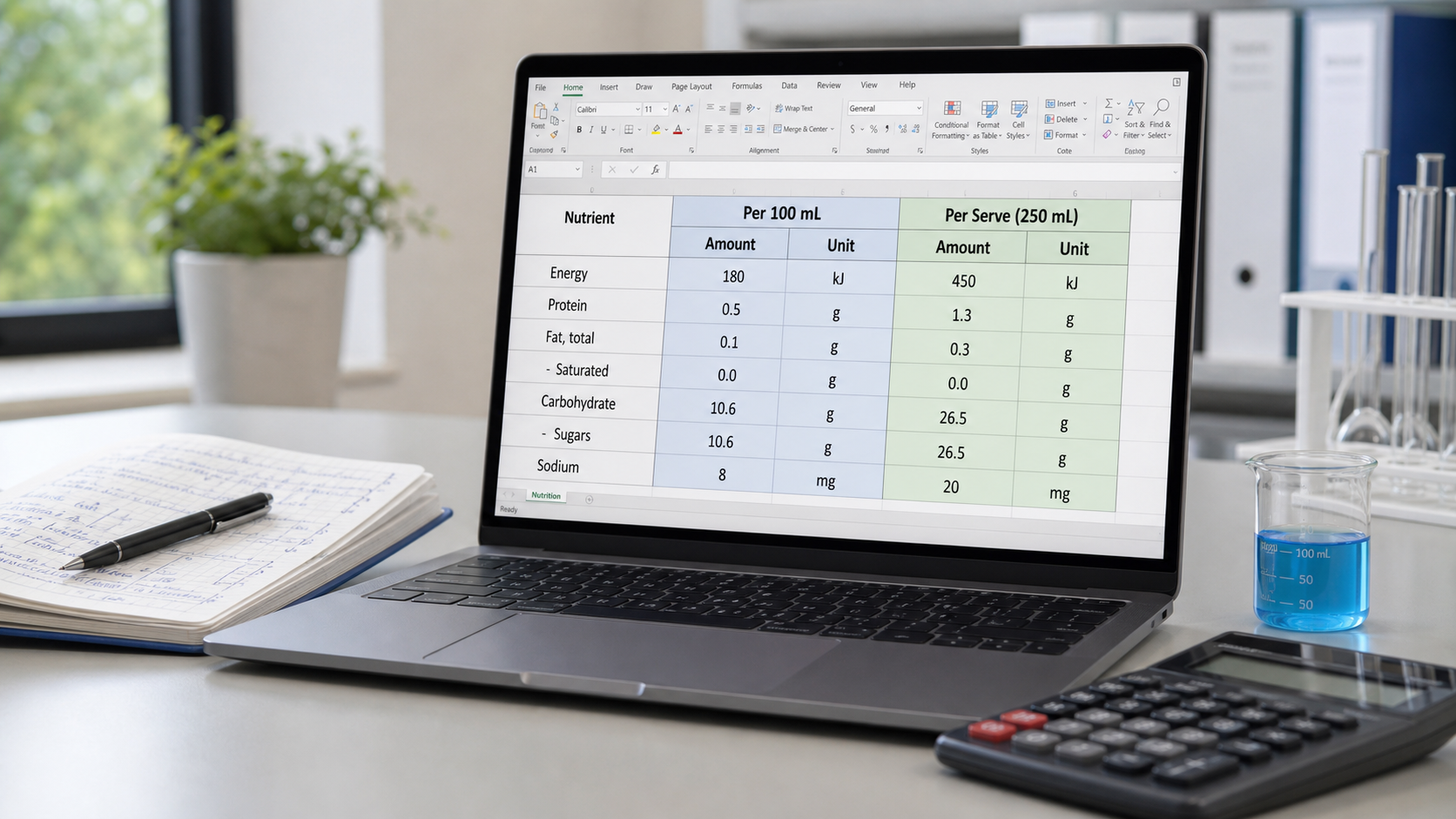
- Calculate per 100 mL values first. Use validated data, account for processing yields and solids, and follow FSANZ conversion factors and methods. Maintain calculation sheets that show ingredients, batch yields, and moisture/solid balances.
- Convert to per serving. Multiply by the serving volume and apply FSANZ rounding conventions. Ensure per serving data ties mathematically to per 100 mL within rounding tolerances.
- Apply FSANZ rounding & averaging rules. FSANZ prescribes how many decimal places and thresholds may be used for each nutrient. Use those conventions consistently across SKUs; do not apply ad hoc rounding.
- Consider “as prepared” products. For concentrates and powders intended to be diluted, calculate values based on the on-pack directions. If both “as sold” and “as prepared” must be displayed, present them distinctly as FSANZ permits.
- Include any claimed nutrients. If you add vitamins/minerals or make a nutrition content claim (e.g., about fibre), you must declare those nutrients in the NIP using FSANZ units and format.
- Lay out the panel correctly. Use the correct heading, nutrient order, units, and the two columns “per serving” and “per 100 mL.” Align figures for easy comparison. Keep typography clear and high-contrast.
- Cross-check with the rest of the label. Ensure ingredients, percentage of characterising ingredients, allergen statements, storage & preparation directions, and any claims do not contradict the NIP.
- Quality assure and version-control. Review by regulatory, nutrition, and design stakeholders. Keep signed calculation records and lab certificates (if any). Update the NIP after reformulation, pack size change, or process change.
Laboratory analysis vs calculation: which should you choose?
Both are acceptable pathways when done correctly. Your choice depends on formula complexity, variability of raw materials, budget, timelines, and claim strategy.
- Laboratory analysis is well-suited to beverages with natural variability (e.g., seasonal juices or kombucha) and when you will rely on tight claim thresholds. It provides empirical data but requires representative sampling and budget.
- Calculation uses supplier specifications, recognised food composition data, and processing yields to compute values. It is efficient for stable recipes, and it aligns well with change control. Use a reliable nutrition panel calculator for beverages that follows FSANZ methods and units.
- Hybrid approaches are common: calculate the baseline, then verify with targeted lab tests for high-risk nutrients (e.g., sugars or sodium) or when claims are sensitive to rounding.
Whichever route you take, document your assumptions, maintain traceable records, and ensure the final numbers satisfy FSANZ formatting and rounding rules.
Serving size for beverages: practical selection
FSANZ allows manufacturers to set a realistic serving size; it must be declared on-pack and used to generate the NIP’s “per serving” column. For beverages, common practice varies by pack type:
- Single-serve bottles/cans: one container often equals one serve.
- Multi-serve packs: choose a household-relevant volume (for example, a typical glass) and show the number of servings per package.
- Concentrates & powders: base the serve on the “as prepared” directions so the panel reflects what consumers actually drink.
The “per 100 mL” column is critical because it enables direct comparisons across brands and pack sizes. Always verify that per serving figures are mathematically consistent with per 100 mL values after rounding.
Special cases: beverages that need extra care
Certain beverage formats require additional attention so the NIP reflects the true, ready-to-consume state:
- Concentrates and syrups: Calculate values for the prepared dilution specified on label. If FSANZ permits or requires, distinguish “as sold” from “as prepared.”
- Powdered drink mixes: Base the NIP on prepared directions; ensure the serving scoop size and the prepared volume are consistent across the label.
- Fermented drinks (e.g., kombucha): Manage variability over shelf life; build buffers so values remain valid through end of shelf life.
- Fortified beverages: Declaring added vitamins/minerals in the NIP may be required; also ensure your formulation meets the compositional rules for any claims.
- Low- or reduced-sugar drinks: Claims must conform to FSANZ rules; ensure the NIP and claim criteria are aligned.
Formatting and placement: making the NIP clear and compliant
FSANZ sets expectations for the NIP’s structure and readability. While graphic design can vary, your panel should follow these fundamentals:
- Heading and columns: Use the correct NIP heading and present two columns—Average Quantity per Serving and Average Quantity per 100 mL.
- Order and units: Keep the prescribed nutrient order and FSANZ units. Do not invent categories or change units.
- Typography: Use legible type, adequate spacing, and clear alignment so numbers are comparable at a glance.
- Contrast and background: Ensure strong contrast between text and background for print and for digital pack shots.
- Location: Place the NIP in a consistent, unobstructed area of the label. Do not break the table across curves or folds that impair readability.
Before final print, check the panel at actual pack size. Many readability issues emerge only at full scale.
Example structure: what an Australian beverage NIP typically shows
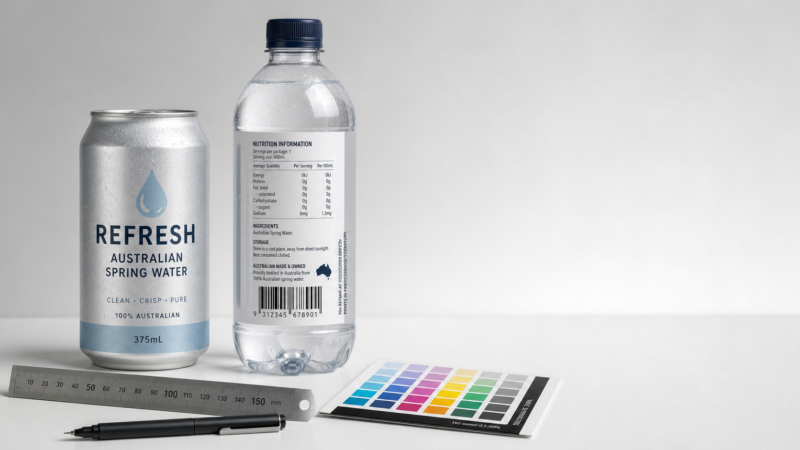
Below is a text-only, structural example to illustrate the order and labelling conventions for beverages. It is not a template for exact numbers or rounding—it simply shows what information appears and where.
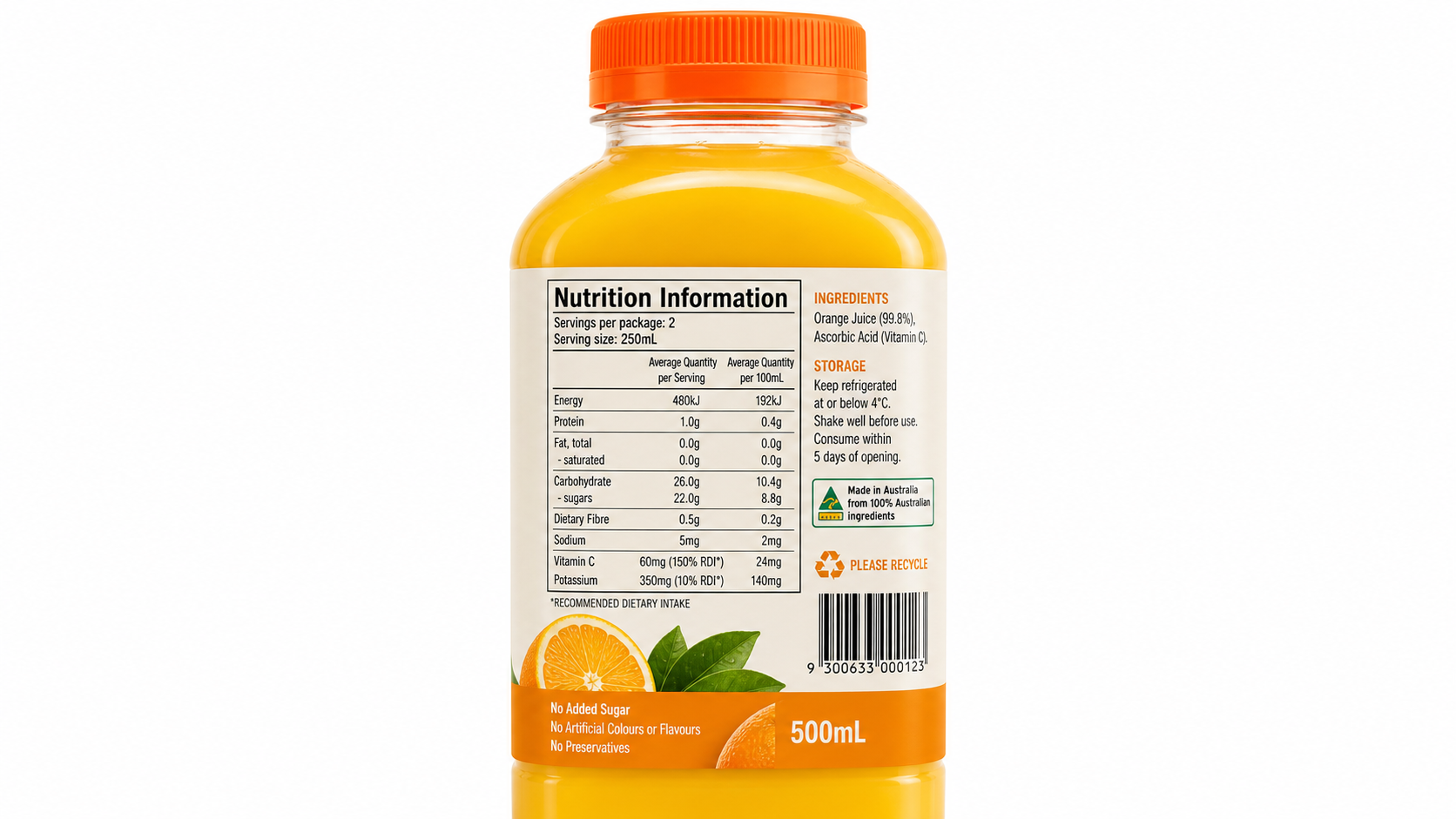
- Nutrition Information
- Servings per package: X
- Serving size: Y mL
- Average Quantity per Serving | Average Quantity per 100 mL
- Energy
- Protein
- Fat, total
- – saturated
- Carbohydrate
- – sugars
- Sodium
- Any additional declared nutrients (e.g., dietary fibre, vitamin C, calcium) where permitted/required
Designers often use a simple grid so decimal places align vertically. Keep wording and order consistent across SKUs to reduce errors and speed up approvals.
Quality assurance: rounding, verification and stability
Accurate NIPs rely on sound ingredient data, good maths, and correct rounding. To keep numbers stable and compliant over time:
- Use FSANZ rounding rules consistently across nutrients and SKUs. Lock these rules into your nutrition panel calculator or SOPs.
- Build in variability buffers for ingredients known to fluctuate (e.g., fruit sugars). This reduces the risk of out-of-spec panels later.
- Verify high-risk nutrients with targeted lab tests when claims are borderline or when supplier data has wide tolerances.
- Re-check after changes to formula, supplier specs, yields, or process conditions. A small change can shift sugars, sodium or energy.
Frequent mistakes to avoid
Small formatting or calculation errors can force reprints. Watch out for these common issues:
- Using per 100 g instead of per 100 mL for beverages.
- Mixing units (e.g., mg vs g) within the same panel line.
- Relying on database values that do not reflect your actual formulation or yield.
- Rounding inconsistently so per serving does not reconcile with per 100 mL.
- Forgetting to add nutrients when making a nutrition content claim.
- Allowing design embellishments to reduce readability or alter the prescribed order.
Where a nutrition panel calculator fits into your workflow
A purpose-built nutrition panel calculator for beverages can standardise FSANZ units, nutrient order, and rounding logic while keeping your ingredient specs in a central library. It is especially helpful when you manage many SKUs, seasonal juices, or frequent reformulations.
- Import supplier COAs and composition data with version control.
- Calculate per 100 mL values from solids and yields, then auto-convert to per serving.
- Lock approved rounding rules and export a panel-ready table to hand off to design.
- Generate audit trails so your regulatory or retail partners can review the basis of numbers.
For a broader labelling view beyond the NIP, see the Australian food label checklist and the advanced beverage label checklist, which can sit alongside your nutrition workflow.
Juice vs nectar vs drink: NIP considerations at a glance
Although the NIP structure is the same, your formulation choices shape the numbers and any claims you may consider. Use this qualitative table to review likely pressure points before you lock a recipe.
| Aspect | 100% juice | Nectar | Juice drink |
|---|---|---|---|
| Core sugars source | Natural fruit sugars | Fruit plus any added sugars | May include added sugars or sweeteners |
| Energy drivers | Fruit carbohydrate | Carbohydrate & any added sugars | Recipe-dependent (water, flavours, sweeteners) |
| Claim sensitivity | Fibre/vitamin claims depend on variety & process | Watch sugars-related claims | Check all claims against FSANZ criteria |
| Data variability | Seasonal & varietal swings | Moderate, depending on fruit content | Generally stable if flavour-driven |
Decide early if you will pursue claims; this determines whether extra nutrients must appear in the NIP and whether additional validation is needed.
Cross-functional checks before print
Your last mile is a coordinated review so the NIP matches the label and the product on shelf:
- Regulatory: Confirms nutrient order, units, rounding, and any extra nutrient declarations are correct.
- R&D/Nutrition: Validates calculations against formulation, yields, and any lab results.
- Design: Ensures readability, spacing, and consistent typography at actual size.
- Supply/Quality: Confirms the panel remains valid across expected ingredient tolerances and shelf life.
If you are launching a new brand or entering a new channel, align the NIP and broader label with category norms and retailer requirements. For context on broader obligations, refer to the Australian beverage regulations guide.
Packaging implications for the NIP
Different packs change what you can practically fit and how consumers read the NIP. Consider these implications during packaging selection, not after design is locked:
- Small containers: Reserve clear flat areas for the table; test legibility early.
- Shrink sleeves & curved bottles: Avoid placing the panel over tight curves or seams that distort numbers.
- Multi-language formats: Keep the Australian NIP intact; do not mix structures intended for other markets.
Explore early-stage options in beverage packaging options to secure adequate space and contrast for your panel.
Documentation and retailer readiness
Major retailers often request a nutrition data sheet, ingredient list, allergen information, and the NIP data file. Keep your calculation workbook and any lab certificates on hand to speed up onboarding and product updates. If you also manage market entry, see how NIP preparation fits within broader compliance in import beverages into Australia and beverage certifications for Australia.
Audit trail: what to keep on file
In addition to the final artwork, keep these records:
- Signed-off formulation and processing steps (version-controlled).
- Ingredient specifications and certificates, including tolerance ranges.
- Calculation sheets showing per 100 mL and per serving derivations and rounding.
- Lab analysis reports (if used), sampling plan, and test methods.
- Internal approvals and dates for every revision of the NIP and full label.
Troubleshooting unusual scenarios
Use a structured approach when something does not add up in your NIP:
- If sugars look unexpectedly high: Re-check juice concentrates, added sugar sources, and fruit solids assumptions. Verify supplier specs and yields.
- If sodium is inconsistent: Confirm mineral content of water, flavour bases, and any added salts. Check unit conversions.
- If energy does not reconcile: Review calculation factors and ensure every macronutrient line is accounted for using FSANZ methods.
- If per serving and per 100 mL do not tie: Inspect rounding and serving size inputs; lock decimals per FSANZ conventions.
FAQ
Do all beverages in Australia need a Nutrition Information Panel?
Most retail beverages display an NIP under FSANZ rules. Some foods and small packages can be exempt, but if you make a nutrition content or health-related claim, an NIP is generally required. In practice, drinks in the retail channel almost always carry one.
What must be shown per 100 mL vs per serving?
For beverages, FSANZ expects both expressions: per 100 mL (for direct comparison between products) and per serving (based on your declared serving size). The same list of nutrients appears in both columns, using FSANZ units and order.
Can I calculate the NIP without lab tests?
Yes, when based on reliable supplier specifications, recognised composition data, and FSANZ-compliant methods. Many brands calculate first, then verify selected nutrients by laboratory analysis when variability or claims sensitivity warrants it.
How do I choose a serving size for a drink?
Pick a realistic amount that reflects typical consumption. Single-serve packs often use the full container; multi-serve packs choose a household-relevant volume. State it clearly and ensure your NIP math matches per 100 mL values after rounding.
What if my beverage is a concentrate or powder?
Base the NIP on the prepared beverage according to the on-pack directions. Where appropriate under FSANZ rules, you may also show “as sold” values, provided the presentation is clear and consistent.
Do I need to show added sugars separately?
FSANZ prescribes what must appear in the NIP. Sugars are typically declared as “sugars” within carbohydrate; whether and how added sugars are shown depends on current FSANZ requirements and any claims you make. Check the latest standard before finalising artwork.
Can I reuse a US or EU panel design?
No. Each market has different nutrient order, units, and formatting rules. Build an Australian NIP to FSANZ specifications rather than adapting a foreign panel.
Conclusion
Preparing an Australian Nutrition Information Panel for beverages is a disciplined process: define the finished product, calculate per 100 mL and per serving using FSANZ methods, apply the prescribed order, units and rounding, and proof the design at actual size. The more variable your ingredients or the tighter your claims, the more you should consider lab verification and conservative buffers.
Treat the NIP as part of a complete label system, aligned with ingredients, claims, packaging and market requirements. For a structured start-to-finish approach, pair this guide with the Australian food label checklist and the Australian beverage regulations guide. Build once, document thoroughly, and update promptly when formulas or pack sizes change—the foundation of a compliant, retailer-ready beverage label in Australia.
Manufacturing for Australian brands
If you are sourcing for the Australian market, start with OEM beverage production for how a recipe moves into production, certifications and food safety systems for the evidence importers and retailers require, and export and logistics for shipping terms and documentation. To price a programme, request a quote.
Sources
Nutrition Information Panel format and values are set by the Food Standards Code. FSANZ publishes a free calculator that produces a compliant panel from your recipe.
- Food Standards Australia New Zealand — Nutrition Panel Calculator
- FSANZ — Australia New Zealand Food Standards Code
Where to go next
Planning an Australian launch? The Australia beverage market page covers the full OEM and private label programme for Australian brands and importers: MOQ 500 cartons per SKU, 15-30 day production, HACCP / ISO 22000 / FSSC 22000, and shipping from Ho Chi Minh City. Request a quote and we reply within 24 hours.