


 Français
 Español
 العربية
 한국어
한국어This checklist explains Australian food label requirements for beverages in clear, practical steps so your drink can move from artwork to shelf with fewer surprises. It covers the mandatory elements most beverage labels need in Australia, where they typically belong on pack, and common pitfalls to avoid.
Rules can vary by product type, ingredients, packaging, and claims, and they update over time. Treat this as a working checklist and verify each point against current FSANZ standards and the relevant information standards before final sign-off.
What are the core Australian food label requirements for beverages?
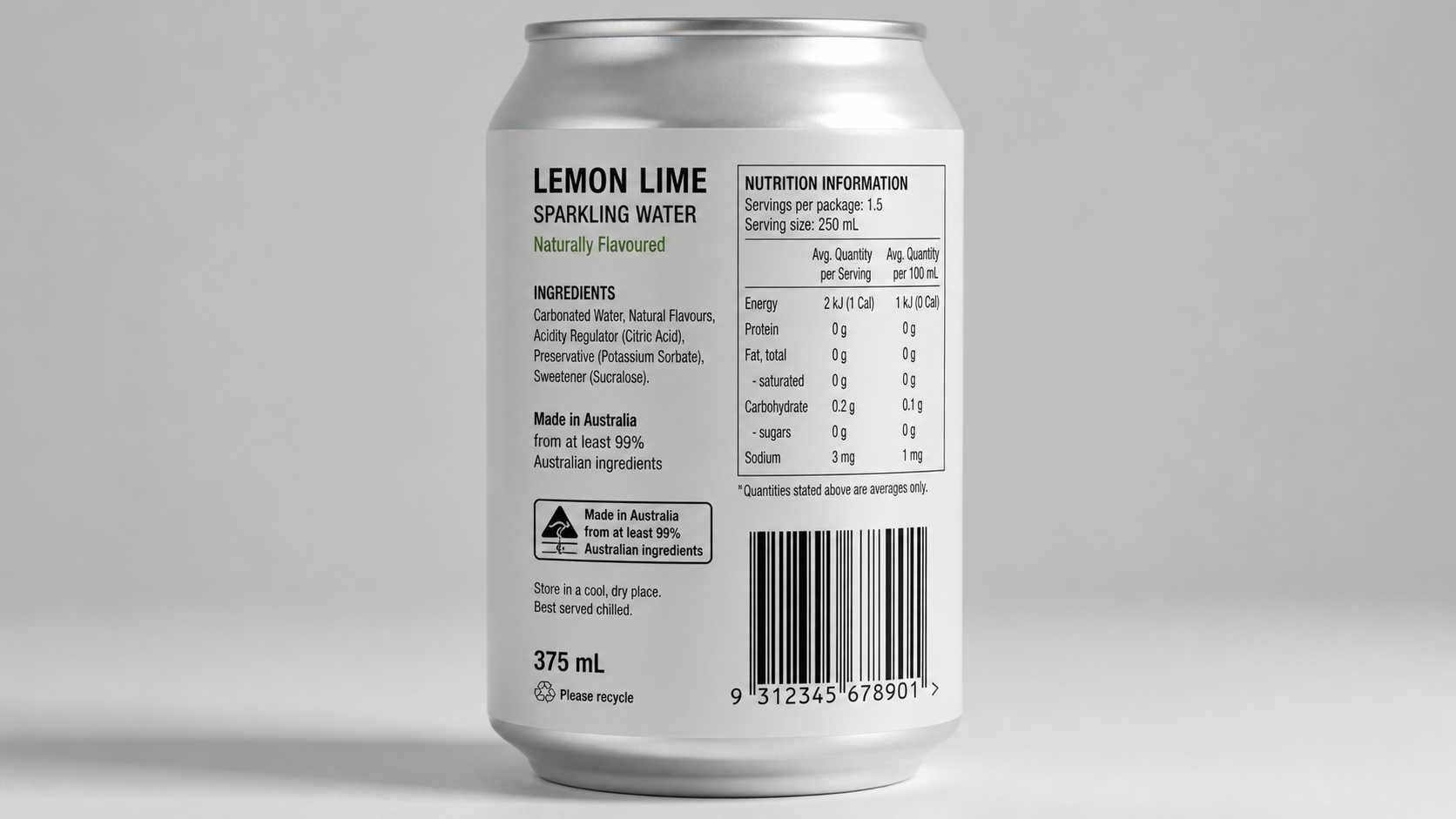
Most drinks in Australia must display a clear name or description, ingredient list, allergen declarations, a Nutrition Information Panel (NIP), net quantity, date mark, storage or use directions where relevant, country of origin statement, and supplier details for traceability.
While details can differ by category, a robust beverage label typically includes:
- Name or description of the food that distinguishes it from similar products.
- Ingredients list in descending order by ingoing weight, including compound ingredients and permitted processing aids where required.
- Allergen declarations using plain English names, clearly visible and consistent with current FSANZ terminology.
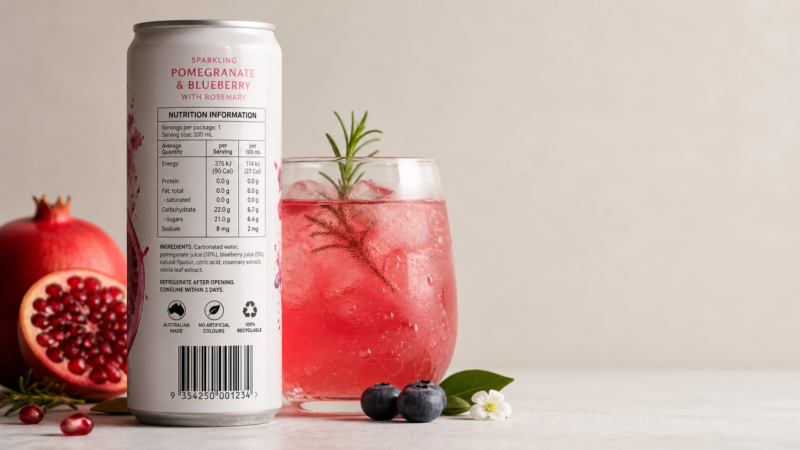
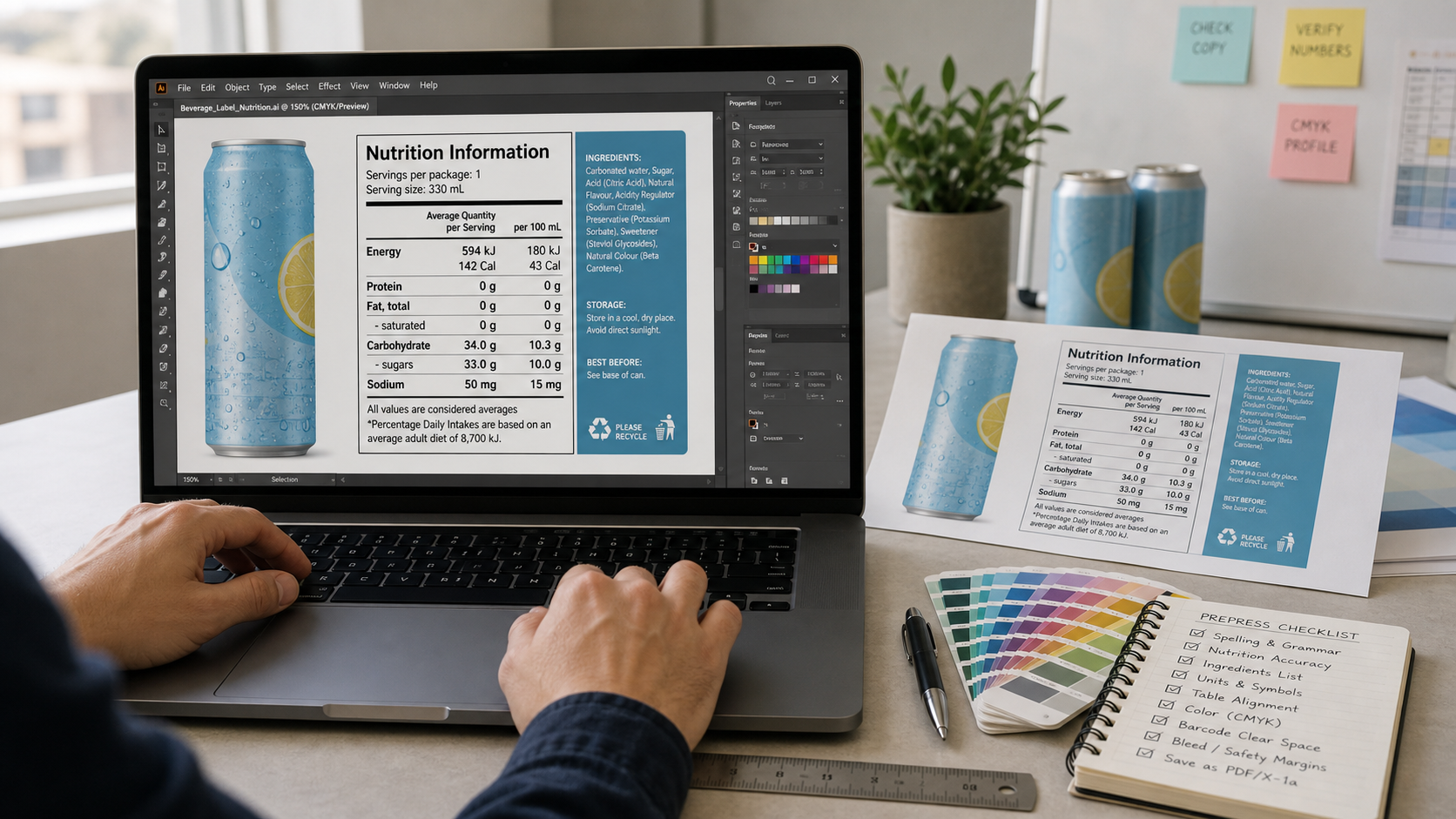
- Nutrition Information Panel (generally per serving and per 100 mL), including energy in kJ.
- Characterising ingredient percentage where applicable (e.g., fruit content in a mango drink).
- Net contents in metric units (mL or L).
- Date mark (best before or use by) and storage directions if the date depends on them.
- Country of origin statement appropriate to where the food was made or produced.
- Supplier details for recall and consumer contact (name and physical business address).
- Lot or batch identification to support traceability.
- Advisory statements and warnings if ingredients such as caffeine or intense sweeteners require them.
For a broader regulatory orientation before label drafting, see our Australian beverage regulations guide.
Ingredient list and allergen declaration: what must appear?
List ingredients in descending order by ingoing weight and declare allergens with the required plain English names and formatting under current FSANZ rules. Use consistent, consumer-friendly naming and include compound ingredients/sub-ingredients where required.
Good practice for beverages:
- Clear naming: Use familiar names for ingredients consumers expect (e.g., sugar, water, mango puree).
- Compound ingredients: Where used (e.g., flavours, bases), disclose sub-ingredients according to the code.
- Allergens: Declare allergens using the exact terms required and in a way that stands out on the label. Many teams also add a concise summary line like “Contains: [allergen]” to improve visibility, subject to FSANZ formatting expectations.
- Processing aids: Include where required by the code.
- Consistency: Ingredient naming in the list should align with any front-of-pack messages.
Be careful with allergen carry-over from flavourings or concentrates, sulphites at levels that require declaration, and cereal-based ingredients that introduce gluten. If in doubt, verify against raw material specs and certificates.
Nutrition Information Panel for drinks: when and how?
Most beverages need a Nutrition Information Panel showing energy (kJ), protein, fat, saturated fat, carbohydrates, sugars, sodium, and any other nutrients you claim. Panels generally present values per serving and per 100 mL with metric units.
Key checks for beverage NIPs:
- Dual columns: Provide per serving and per 100 mL where required; serving size must be realistic for how the product is consumed.
- Units: Energy in kJ; volumes in mL or L; other nutrients in metric units as required.
- Rounding: Follow FSANZ rounding and significant figure guidance rather than ad-hoc rounding.
- Added nutrients: If you fortify or add vitamins/minerals, label per code and consider claim implications.
- Format: Use a clear grid layout with legible type, adequate contrast, and spacing.
Reconcile NIP values back to lab data, formulation sheets, and worst-case ingredient specifications. If the recipe varies by season (e.g., fruit solids), set conservative values so you remain compliant across batches.
Percentage labelling and characterising ingredients
When an ingredient is highlighted (by words, images, or implication), Australian rules typically require you to show the percentage of that characterising ingredient at the time of manufacture.
For beverages, common triggers include fruit images or product names like “Mango Sparkling” or “Lime Soda.” If “mango” or “lime” is a characterising ingredient, state the percentage (e.g., mango puree (12%)). Ensure the percentage matches the ingoing formulation and remains true across production tolerances.
Country of origin statements for beverages
Most drinks sold in Australia require a country of origin statement. The style of statement depends on where the food was grown, produced, or made. Imported products must state their origin and should not use the Australian kangaroo logo unless they meet the eligibility rules.
General guidance:
- Imported beverages: Use a legible origin statement indicating the country. Do not present Australian origin graphics unless fully eligible.
- Beverages made in Australia: If eligible, use the correct statement format and, where applicable, the prescribed origin mark for priority foods under the relevant information standard.
- Multi-country supply chains: Choose accurate wording (e.g., made in X from imported ingredients) instead of over-simplifying origin.
Net quantity, measurement units and serving size
Declare net contents in metric units (e.g., 330 mL, 1 L) on the principal display panel. Serving size informs the NIP and should reflect typical consumption for your pack format.
Practical tips:
- Placement: Put net contents where consumers expect to see it, prominently on the front of pack.
- Units: Use mL for small packs and L for larger; avoid mixed unit systems.
- Verification: Align the net contents with your fill control program and legal metrology checks.
Date marking, storage and preparation instructions
Use a “best before” or “use by” date as appropriate for safety and quality. If a product’s shelf life depends on conditions, include storage or handling instructions necessary to achieve the date.
For many non-perishable or shelf-stable drinks, “best before” is common. Refrigerated or short-life beverages often need “use by.” If required, include instructions such as “refrigerate after opening” or “consume within X days of opening,” and specify any dilution directions for concentrates.
Advisory statements and warnings often needed on drinks
Some formulations trigger mandatory advisory statements or warnings. This commonly affects higher caffeine beverages, products containing certain sweeteners, or specific botanical extracts.
Examples to consider (verify applicability to your formula):
- Caffeine: Formulated caffeinated beverages and high-caffeine products generally have specific advisory statements and quantity labelling requirements.
- Sweeteners: Some intense sweeteners (e.g., those that contain phenylalanine) can require statements.
- Quinine or guarana: May require ingredient-specific advisory statements.
- Plant extracts: If a known stimulant effect or compositional limit applies, check the code for required warnings.
Document the exact wording in your pack copy master and ensure it is not obscured by design elements or secondary labels.
Front-of-pack claims, marketing language and visuals
Nutrition content and health-related claims in Australia are tightly controlled. You can only make a claim if your product meets the exact conditions for that claim, and some claims require stronger substantiation than others.
Checklist for claims hygiene:
- Nutrition content claims (e.g., about sugars or sodium) must meet specific conditions and use permitted wording.
- Health-related claims require higher substantiation and must comply with the code’s requirements for eligibility and wording.
- Imagery can imply a claim; for instance, sports or medical themes might suggest performance or health associations. Avoid unintended implications.
- Front vs back: Keep concise claims on front; explain context on back without exaggeration.
- Substantiation file: Maintain a dossier with formulation data, certificates, and any claim support.
Legibility, language and layout rules
Labels must be in English, legible, and durable for their intended life. Use sufficient contrast, readable typography, and an uncluttered layout so mandatory information is easy to find.
Design best practices:
- Contrast: Dark text on light background (or vice versa) for ingredient list, allergens, and NIP.
- Hierarchy: Reserve the principal display panel for the name/description and net contents; group regulatory text on the information panel.
- Consistent styles: Use one typeface family with clear weights; avoid decorative scripts in mandatory text.
- Durability: Select inks and varnishes suitable for condensation, abrasion, and cold-chain handling.
| Label element | Typical location | Positioning & notes |
|---|---|---|
| Name/description | Front of pack | Clear product identity; avoid implying unpermitted claims. |
| Net contents | Front of pack | Metric units (mL or L); prominent and easy to read. |
| Ingredients & allergens | Back/side panel | Descending order by weight; plain English allergen terms. |
| Nutrition Information Panel | Back/side panel | Per serving and per 100 mL; energy in kJ. |
| Origin statement | Back/side panel | Use format appropriate to origin; keep legible. |
| Advisory statements | Back/side panel | Use exact required wording; do not obscure. |
| Supplier address | Back/side panel | Name and physical business address for traceability. |
| Lot/batch & date | Anywhere legible | Inkjet/laser code must remain readable through supply chain. |
Special cases: 100% juice, nectar and juice drinks
Names like “100% juice,” “nectar,” and “juice drink” suggest different compositions and can trigger different labelling expectations. Align the product name, characterising ingredient percentage, and ingredient list so they tell a consistent story.
| Product style | Typical composition signal | Positioning & notes |
|---|---|---|
| 100% juice | Made entirely from fruit juice (may include reconstituted juice) | Do not imply added sugars; declare fruit sources; characterising ingredient % often expected. |
| Juice nectar | Juice blended with water and possibly sugars/sweeteners | Use a name that does not overstate fruit content; ensure % fruit is shown. |
| Juice drink / beverage | Lower juice content, more water and flavouring | Make % juice clear; avoid images or names that overstate fruit. |
Consistency check: if front-of-pack shows a prominent fruit, ensure the back label discloses an accurate fruit percentage and the ingredient list places fruit in the right order.
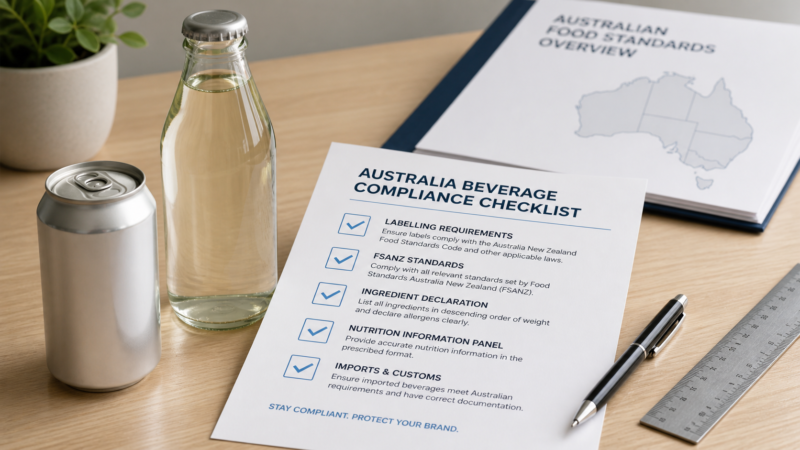
Imported drink label Australia: what to check before clearance?
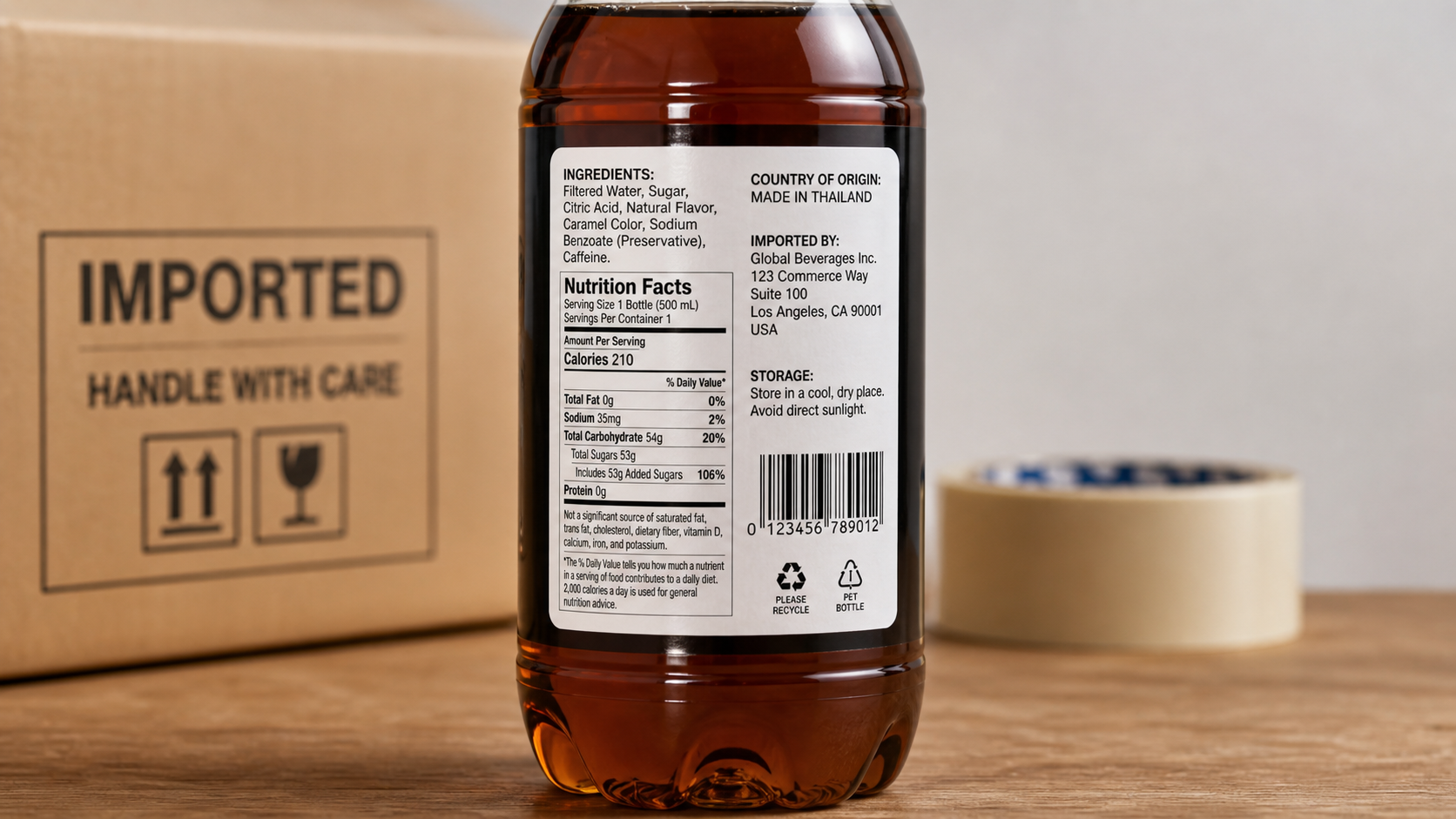
Imported beverages commonly need localised labels or over-stickering to meet Australian requirements. Over-stickers must be durable, legible, and not obscure mandatory information.
Pre-clearance checklist for importers:
- Origin statement: Confirm the correct statement for imported foods.
- Ingredient & allergen translation: Translate to English with FSANZ-approved allergen terms and formatting.
- NIP format: Convert to Australian format with kJ and per 100 mL column if required.
- Measurement units: Convert to metric (mL/L); remove non-metric-only statements.
- Advisory statements: Add required caffeine/sweetener warnings if triggered.
- Importer details: Add the Australian contact name and physical business address for recalls.
- Durable coding: Ensure date and lot codes remain readable post-stickering.
If you are managing cross-border supply from Southeast Asia, see our note on shipping beverages to Australia for operational considerations beyond labelling.
Barcodes, batch codes and traceability
GS1 barcodes are an industry expectation in Australian retail, though not part of the food standards code. Batch or lot codes and date coding support recall readiness and are essential for wholesale and retail partners.
Practical steps:
- Assign GTINs to each SKU and pack level (unit, inner, carton, pallet) to meet retailer requirements.
- Place barcodes on a flat area with enough quiet zone so scanners can read through shrink and condensation.
- Use durable inks for inkjet/laser codes so date and lot remain legible through the cold chain.
- Document coding logic so warehouses and retailers can interpret dates and batches unambiguously.
Packaging and print considerations for compliance
Packaging influences label legibility and durability. Choose substrates, inks, and finishes that protect mandatory text and codes from scuffing and moisture.
- Substrate choice: Paper labels need suitable varnish or laminate to withstand condensation; direct-to-can ink systems must preserve text clarity.
- Color contrast: Avoid placing fine black text on dark images; add a light panel or background tint for regulatory blocks.
- Cold chain: Use low-temperature adhesives and inks compatible with chilling and ice buckets.
- Can seams & bottle curves: Keep NIP, allergens, and origin statements away from tight curves and seams.
For structural decisions early in development, review packaging options for Australia and align artwork zones with chosen formats.
Preflight artwork checklist you can copy
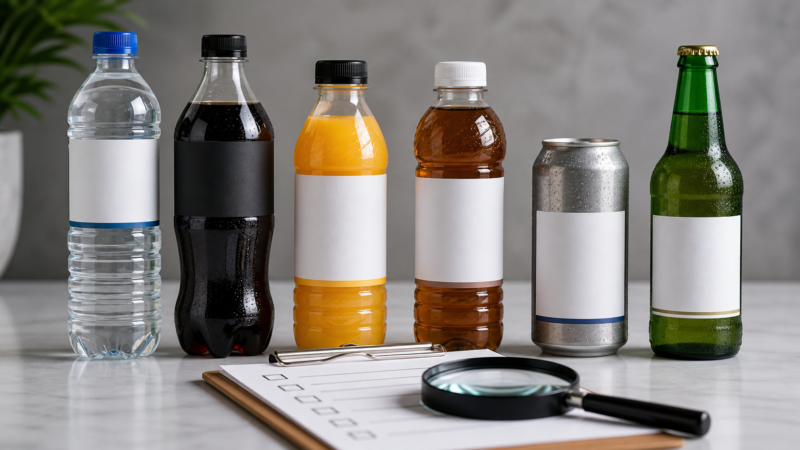
Use this end-to-end checklist before you release final print files. It assumes a standard non-alcoholic beverage and should be adapted to your product.
- Product name/description is accurate and not misleading given formulation and sensory profile.
- Front-of-pack imagery does not exaggerate characterising ingredients beyond actual percentages.
- Net contents shown in metric units on the principal display panel.
- Ingredient list in descending order by weight; compound ingredients and processing aids handled per code.
- Allergen declarations use current FSANZ plain English terms and required formatting; add a clear “Contains” summary line if appropriate.
- Characterising ingredient % declared where images, names, or claims highlight an ingredient.
- Nutrition Information Panel includes per serving and per 100 mL columns, energy in kJ, and permitted rounding.
- Serving size is realistic for the pack, consistent across claims and usage instructions.
- Advisory statements included where required (e.g., caffeine, sweeteners, quinine), with exact wording and legibility.
- Country of origin statement matches the supply chain and uses the appropriate format for imported or Australian-made foods.
- Supplier details include name and physical business address suitable for consumer contact and recalls.
- Lot/batch and date codes are present, durable, and readable on production substrates.
- Storage/preparation directions included if needed to meet shelf-life or safety expectations.
- Claims audit completed for nutrition and health-related claims; substantiation file saved.
- Legibility confirmed at actual print size on final substrates; contrast meets readability needs.
- Barcode placed with clean quiet zone; test scans through shrink and condensation.
- Die line & bleed correct; mandatory text stays inside safe zones away from seams and curves.
- Language is English; spelling and decimal separators follow Australian conventions.
- File handover: supply press-ready PDFs and outlined fonts as per printer requirements; keep an editable source file.
- Final legal review by a qualified specialist against current FSANZ standards and information standards prior to print.
FSANZ label checklist summary table
This summary groups the most common elements seen on non-alcoholic beverage labels in Australia. Always verify applicability to your product.
| Element | Applies to | Key considerations |
|---|---|---|
| English language | All retail packs | All mandatory info must be in English and legible. |
| Ingredient list | Most beverages | Descending order; handle compound ingredients correctly. |
| Allergens | Where present | Use plain English terms; required formatting; consider summary “Contains”. |
| Nutrition panel | Most beverages | Per serving and per 100 mL; energy in kJ; permitted rounding. |
| Characterising % | When ingredient is highlighted | Declare ingoing percentage; match imagery and naming. |
| Origin statement | Most retail foods | Correct format for imported vs Australian-made priority foods. |
| Net contents | All retail packs | Metric units on principal display panel. |
| Date marking | All per code | Best before vs use by; add storage if required to meet date. |
| Advisory statements | Triggered by certain ingredients | Caffeine, sweeteners, quinine/guarana; exact wording and placement. |
| Supplier address | All retail packs | Name and physical business address for contact/recall. |
| Lot/batch | All retail packs | Durable, readable coding through supply chain. |
Information for beverage brands and importers
Turn the checklist into a repeatable workflow so compliance does not depend on a single person. Align regulatory, R&D, and design teams early and document decisions in a pack copy master.
- Product brief: Define target style (e.g., 100% juice vs nectar), claims strategy, and advisory statement implications before artwork.
- Specs library: Keep verified specs for all raw materials, including allergens, caffeine content, and additive disclosures.
- Change control: Any recipe or supplier change triggers a label review.
- Mockups: Print at 100% scale on the real substrate; check legibility at arm’s length.
- Retailer requirements: Many retailers have additional barcode or artwork guidelines—add them to your preflight.
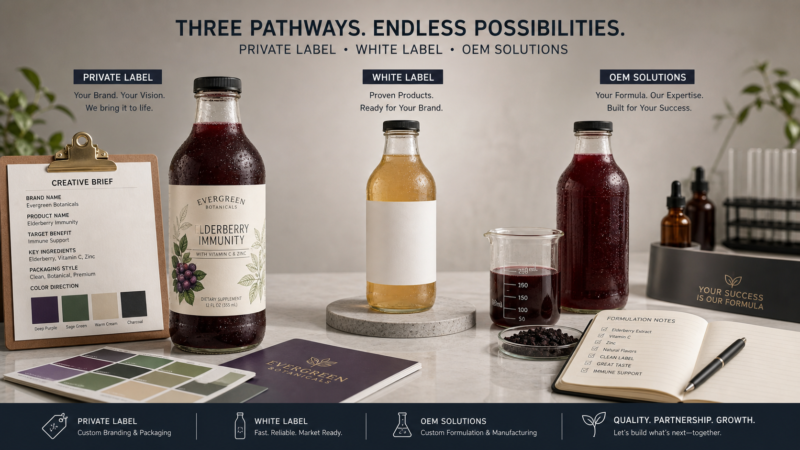
If you are weighing different development models and responsibilities for pack copy ownership, compare structures in private label vs OEM beverages. To understand infrastructure implications (shelf-life, processing, closures) see packaging options for Australia. For market access planning, review beverage certifications for Australia relevant to your category.
FAQ
Do all beverages need a Nutrition Information Panel?
Most drinks do. A standard NIP with energy in kJ and nutrients per serving and per 100 mL is typical. Limited exemptions may apply in specific cases; verify against current FSANZ rules.
Can I relabel imported drinks with a sticker?
Yes, provided the over-sticker is durable, legible, and brings the label fully into compliance without obscuring mandatory information. The final presentation must meet Australian requirements.
What belongs on the front of a beverage pack?
A clear name or description and net contents in metric units. Keep claims truthful and ensure they are supported by the back-of-pack details.
Do I have to show the percentage of fruit?
If your name, imagery, or messaging highlights a fruit or other characterising ingredient, a percentage declaration is typically required. Match the percentage to your formula at time of manufacture.
Can I say “low sugar” on a soft drink?
Only if the product meets the exact conditions for that nutrition content claim and you use permitted wording. Confirm eligibility and keep a substantiation file.
Is the kangaroo origin logo allowed on imported drinks?
No, not unless you fully meet the eligibility criteria. Imported drinks must use an accurate country of origin statement suited to imported foods.
Conclusion
Australian food label requirements for beverages focus on clarity, accuracy, and consistency across ingredients, allergens, NIP, origin, and advisory statements. Most compliance issues trace back to mismatches between front-of-pack cues and back-of-pack details, or to format and legibility oversights. Use the checklist here alongside current FSANZ standards, build an internal pack copy master, and always preflight artwork on the actual substrate before print.
If your beverage program involves multi-country sourcing or private label development, align label ownership, verifications, and packaging decisions early. For regulatory orientation, see our Australian beverage regulations guide, and for logistics context consider shipping beverages to Australia. When selecting formats, review packaging options for Australia, and calibrate responsibilities across models with private label vs OEM beverages. Finally, map any category-specific approvals in beverage certifications for Australia before you lock artwork.
Manufacturing for Australian brands
If you are sourcing for the Australian market, start with OEM beverage manufacturing for how contract production is structured, certifications and food safety systems for the evidence importers and retailers require, and export and logistics for shipping terms and documentation. To price a programme, request a quote.
Sources
Requirements on this page derive from the Australia New Zealand Food Standards Code, administered by FSANZ. Check the Code itself before finalising a label or an import plan.
- Food Standards Australia New Zealand — Australia New Zealand Food Standards Code
- FSANZ — Labelling requirements for business