


 Français
 Español
 العربية
 한국어
한국어Country of origin labelling for imported beverages in Australia requires a clear origin statement on retail packaging, with the exact wording and format depending on the beverage category and how the product was made or packed. In simple terms, imported drinks must tell shoppers where they were made, produced or packed, and Australian regulators expect that statement to be truthful, clear and easy to find.
This guide explains what counts as a compliant origin statement for drinks, how rules differ between beverage types (for example, soft drinks versus fruit juice), where to place the information, and what importers and private-label brands should prepare before launch. It also highlights how the Australian Consumer Law (ACL) and the ACCC’s enforcement approach intersect with practical labelling decisions for beverage packs.
What does country of origin labelling for imported beverages in Australia require?
At a minimum, imported beverages sold to Australian consumers must carry a clear country of origin statement on the retail package. For imported drinks, this is typically a plain text statement such as “Made in [Country]”, “Product of [Country]”, or “Packed in [Country] from imported ingredients”, depending on how and where the beverage was processed and packed.
In Australia, country of origin information for food is regulated under the Australian Consumer Law framework, with the ACCC responsible for enforcement. Most beverage brands will either need a simple text origin statement, or—if the drink qualifies as a priority food—will still use a text origin statement when it is imported (the standard mark with the kangaroo logo only applies to Australian food, not imported products). The correct choice of wording depends on the product’s manufacturing pathway.
Are beverages priority or non-priority foods for origin labelling?
Many drinks are treated as non-priority foods, which means they generally require a text country of origin statement rather than the Australian standard mark. Common non-priority beverages include bottled water, soft drinks, sports drinks, energy drinks, ready-to-drink tea and coffee, and alcoholic beverages. Fruit and vegetable juices are often treated differently and can fall into the priority food category, even when imported; however, imported priority foods still use a text-only origin statement (no kangaroo logo).
If you are unsure whether a particular beverage (for example, a juice blend with added botanicals) falls within a priority or non-priority definition, take a conservative approach and confirm the classification before finalising print artwork. The classification influences the form of origin disclosure but, for imported goods, you will not use the Australian kangaroo logo in any case.
Which origin wording should an imported drink use?
The right statement depends on how and where the drink was substantially processed and/or packed. Use straightforward, plain English phrases that ordinary shoppers will understand. While each case turns on its facts, the following principles are commonly applied:
- “Made in [Country]” is generally used when the beverage underwent substantial transformation in the named country (for example, ingredients processed and combined there to create the final drink).
- “Product of [Country]” is a stronger claim that usually implies the product and its significant ingredients originate from that country, and the processing also occurred there. Use this only when you can substantiate it across both sourcing and processing.
- “Packed in [Country] from imported ingredients” is typically used where packaging operations occur in a country but the ingredients are sourced from overseas and there is no substantial transformation in the packing country.
- Mixed supply chains (for example, concentrates from one country, sweeteners from another, and packing in a third) may require phrasing like “Made in [Country] from imported ingredients” or “Packed in [Country] from [local and/or imported] ingredients”, depending on the nature of the processing.
Always ensure the chosen wording reflects the reality of your supply chain and can be substantiated with documentation.
“Made in Vietnam” label in Australia: when and how to use it
For brands sourcing from Vietnam, the phrase “Made in Vietnam” is appropriate when the beverage is genuinely manufactured in Vietnam to its finished form. If you only fill or pack the product in Vietnam using ingredients and finished bases from elsewhere, a “Packed in Vietnam from imported ingredients” statement may be more accurate. If both processing and key ingredients genuinely originate from Vietnam, “Product of Vietnam” may be available, but it is a higher bar and must reflect both ingredient origin and processing.
Here are illustrative, non-exhaustive examples of country of origin statements for Vietnam-sourced beverages (final wording should match the actual process and sourcing):
- Made in Vietnam
- Product of Vietnam
- Packed in Vietnam from imported ingredients
- Made in Vietnam from imported ingredients
Because Australian regulators closely assess whether the wording could mislead consumers, choose the specific statement that aligns with your real manufacturing steps and keep evidence. If Australia-specific guidance elsewhere on your pack (or your website) might create confusion, rationalise the claims to avoid inconsistency.
Examples of origin statements for common beverage scenarios
Use these scenario-based examples as directional templates and adapt them to your verified process:
- Imported finished soft drink, no reprocessing in Australia: “Made in [Country]”.
- Imported juice, fully manufactured overseas: “Made in [Country]”.
- Imported juice concentrate, reconstituted and packed in Australia: “Made in Australia from imported ingredients” or “Packed in Australia from imported ingredients” depending on the extent of processing.
- RTD tea brewed and bottled overseas using imported tea leaves: “Made in [Country] from imported ingredients”.
- Beer brewed and bottled overseas from locally sourced malt and hops: “Product of [Country]” may be available if both ingredients and processing genuinely originate there; otherwise “Made in [Country]”.
These are not one-size-fits-all rules. Document your actual steps and choose wording you can evidence.
Placement, legibility and prominence
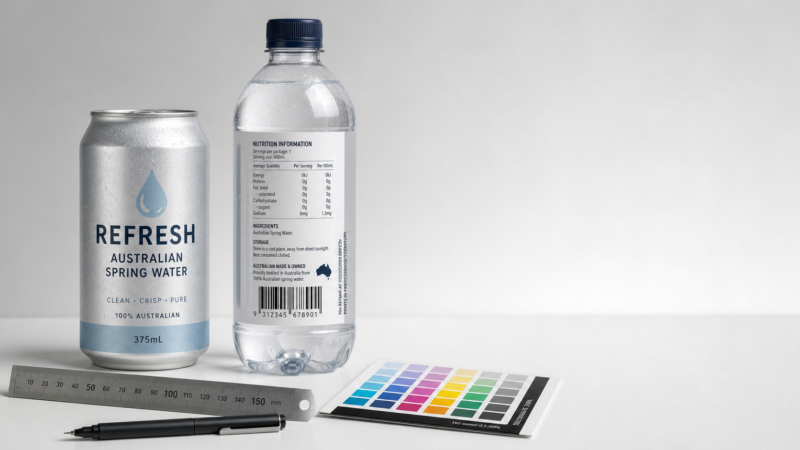
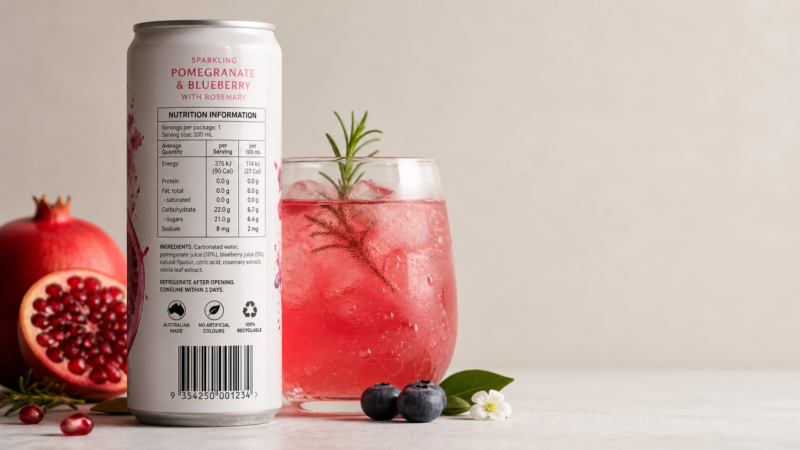
Your country of origin statement should be easy to find, easy to read and durable throughout the product’s shelf life. Good practice for beverage packs includes:
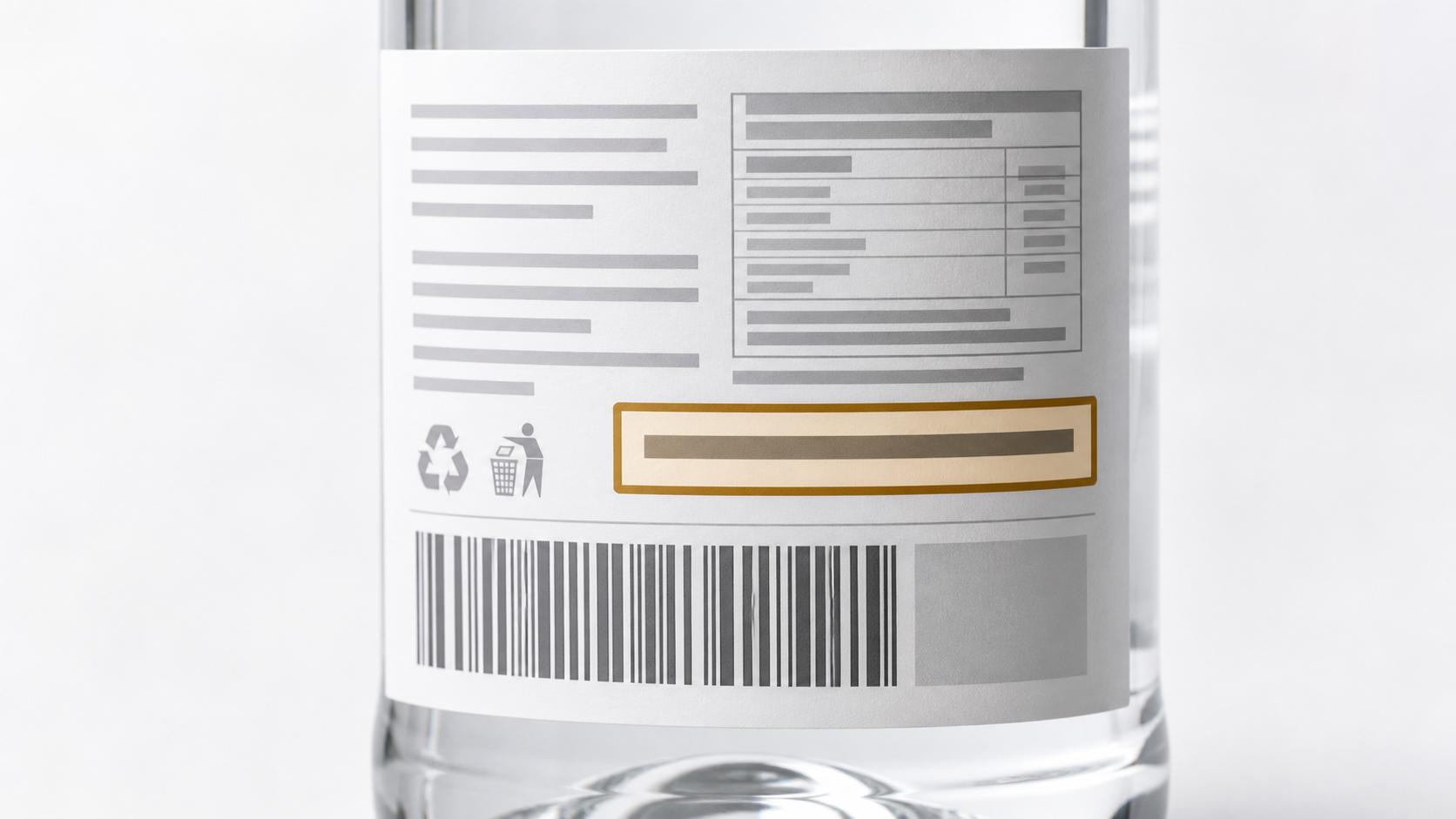
- Placement: Use a consistent location on the back or side panel near other mandatory information. Keep it unobstructed by seams, curves or accessories like tamper bands.
- Contrast: Ensure high contrast between text and background (for example, dark text on a light panel) and avoid patterns behind the statement.
- Size: Choose a font size that remains legible at normal retail distance for the container size. Avoid decorative or script fonts for mandatory statements.
- Durability: Use inks and substrates that resist abrasion, condensation and scuffing during transport and retail display.
- Consistency: Make sure the origin statement appears on every selling unit, including multi-packs, shippers sold at retail, and any on-pack promotions that could obscure the base label.
Where you publish product information online, keep the on-pack wording and the online product detail page aligned to avoid consumer confusion.
Imported vs packed-in-Australia: choosing accurate statements
Imported beverages that arrive as finished goods typically carry a straightforward origin statement of the manufacturing country (for example, “Made in [Country]”). When imported inputs are further processed or only packed in Australia, you should reflect that nuance:
- Reprocessing in Australia: If true processing takes place in Australia (for example, reconstitution from concentrate into a finished juice), then an Australian origin statement referencing imported ingredients may be available.
- Packing in Australia only: If you simply fill or pack imported bases with no substantial transformation, the statement typically reads “Packed in Australia from imported ingredients”.
- Multi-country supply chains: If a drink is mixed or blended across countries, prioritise clarity for consumers and avoid implying a single-country origin when multiple countries contributed significant inputs or processing.
When in doubt, build a simple flowchart of your process from ingredients to finished pack and choose wording that truthfully matches those steps.
Priority vs non-priority beverage labelling at a glance
The table below summarises typical expectations for drink categories. It is a practical guide and not a substitute for checking your product’s exact classification and processing pathway.
| Beverage category | Typical status | Origin statement for imported product | Positioning & notes |
|---|---|---|---|
| Bottled water | Non-priority | Text statement (for example, “Made in [Country]”) | Keep wording simple; no kangaroo logo on imports. |
| Soft drinks, energy & sports drinks | Non-priority | Text statement only | Use clear, legible text; align with supply chain documents. |
| RTD tea & coffee | Non-priority | Text statement only | Consider “Made in [Country] from imported ingredients” where applicable. |
| Alcoholic beverages (beer, wine, spirits, RTDs) | Non-priority | Text statement only | “Product of [Country]” only if ingredients and processing genuinely originate there. |
| Fruit & vegetable juices | Often priority | Text statement for imports | Imported priority foods still use text-only origin statements. |
Remember: Imported foods do not use the Australian kangaroo logo. That device is reserved for eligible Australian foods.
How to substantiate your origin statement
Australian authorities expect that you can support your claim with evidence. Collect and organise:
- Ingredient purchase records: Supplier declarations, invoices and bills of lading that show where inputs came from.
- Manufacturing documents: Batch records, processing logs and quality documentation indicating where substantial steps occurred.
- Packing records: Proof of where final filling, labelling and packaging were carried out.
- Artwork control: Version-controlled label files that show how the statement was applied, including translations if any.
Keep records current and accessible so you can quickly respond to retailer queries or regulator requests.
Common mistakes that trigger relabels or complaints
Origin statements are a small piece of copy, but errors can be costly. Watch out for:
- Using the kangaroo logo on imported drinks: The kangaroo device is not for imported foods.
- Over-claiming: Saying “Product of [Country]” when significant ingredients or processing occurred elsewhere.
- Inconsistent claims: Pack says one thing, website or shipper says another.
- Low contrast or tiny text: Shoppers should not have to hunt for the origin statement.
- Outdated artwork: Failing to update origin wording after a supply chain change (for example, moving from concentrate to NFC juice, or changing pack location).
- Foreign-only text: Providing the statement in a language most Australian consumers cannot read.
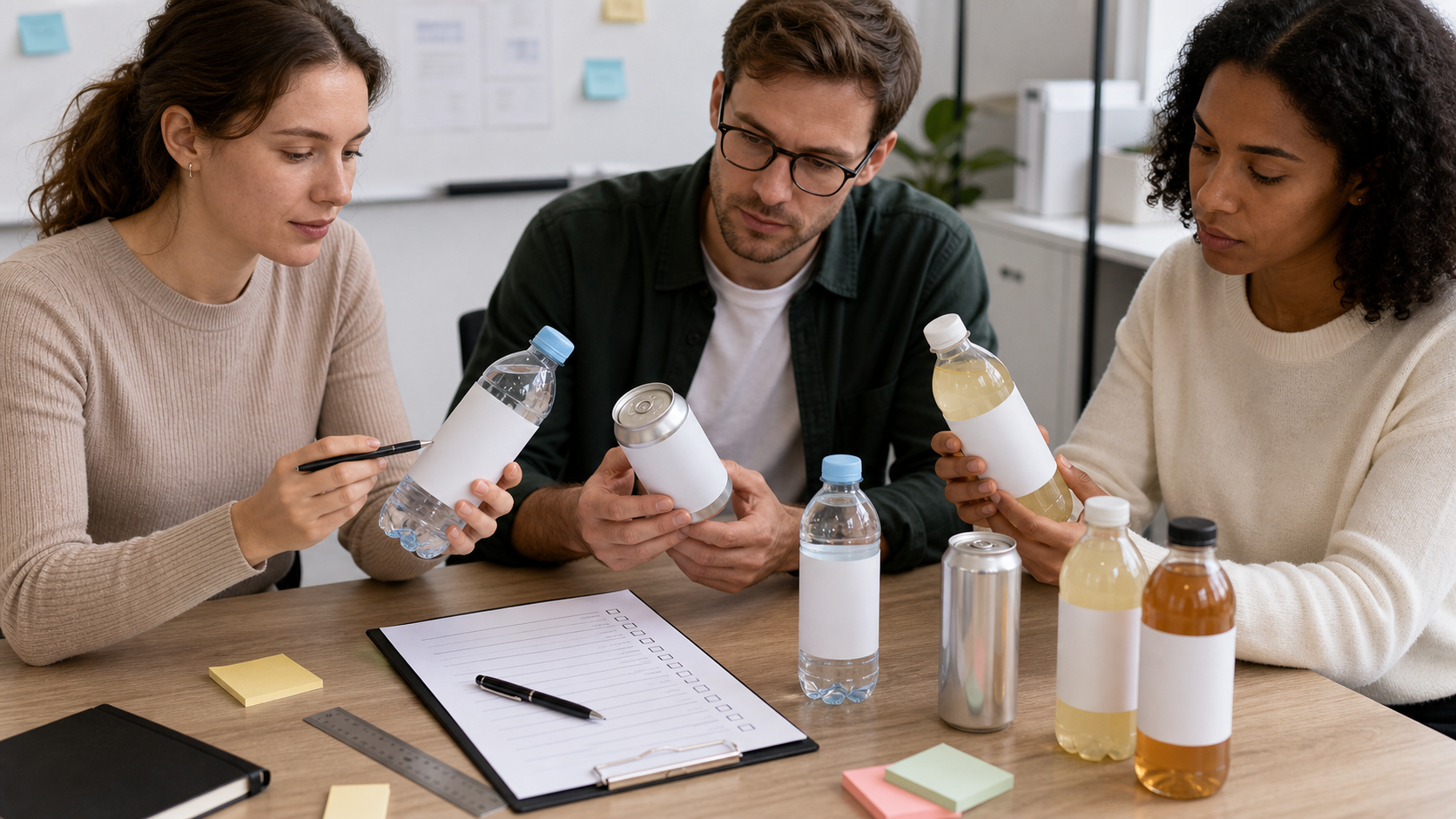
Build an internal sign-off checklist to prevent these issues, including a final print proof review before mass production. For a broader packaging review beyond origin statements, see the Australian beverage-specific checklists here: Australian Food Label Checklist for Beverages and Australian Food Label Checklist for Beverages (Part 2).
Country of origin statement vs other on-pack information
Country of origin is one piece of the total label. It should not be confused with:
- Importer or distributor address: Listing an Australian business address does not make the product “Made in Australia”.
- Trademark or brand origin: A brand with an Australian identity can still sell imported drinks; the origin statement reflects the product, not the brand’s marketing story.
- Ingredient provenance messaging: If you feature origin-themed claims (for example, spring source or fruit origin), make sure they do not contradict the overall country of origin statement.
Align these elements to avoid consumer confusion or regulator concerns.
ACCC and Australian Consumer Law: enforcement in practice
The ACCC monitors food label origin claims under the Australian Consumer Law. In practice, this means businesses should avoid misleading or deceptive conduct, ensure claims are truthful, and be ready to substantiate what they say. Retailers may also conduct their own checks and request documentation, especially for own-brand products.
If you operate a private label, build a documented approval workflow. Keep origin statements under change control, and train teams to revalidate claims whenever suppliers, processes or pack locations change.
Designing labels that scale with supply chain change
Supply chains move. To avoid reprints, consider flexible but accurate phrasing that still gives shoppers clarity. For example, when the manufacturing country is fixed but ingredient sources vary, a “Made in [Country] from imported ingredients” line may be more resilient than a more specific, less evergreen claim. When you switch from one overseas factory to another, ensure the origin statement on-pack changes as needed and old inventory is managed to prevent mixed stock on shelf.
Juice, concentrates and reconstitution nuances
Juices and fruit-based beverages can involve concentrates, purees and NFC (not-from-concentrate) bases. If you import concentrate and reconstitute, clarify whether your Australian operations amount to processing or only packing. Wording often differs between “Made in Australia from imported ingredients” and “Packed in Australia from imported ingredients” for these scenarios. If you import a finished juice in retail packs, a clear overseas origin statement is usually sufficient.
Alcoholic beverages and origin statements
For beer, wine, spirits and RTD alcohol, the same principles apply: describe where the beverage was produced, made or packed. Statements like “Made in [Country]” are commonly used for imported alcohol. If a “Product of [Country]” line is considered, confirm it reflects both ingredient origin and processing. Keep the statement legible on neck labels, can bodies or back labels, depending on format.
RTD tea and coffee
Ready-to-drink tea and coffee often involve globally sourced ingredients and outsourced bottling. If the finished drink is brewed and bottled overseas, “Made in [Country] from imported ingredients” may describe it accurately. If bottling occurs in Australia using imported bases, “Packed in Australia from imported ingredients” may be more suitable. Choose one that mirrors the actual steps.
Water, soft drinks, sports and energy drinks
For these non-priority beverages, a simple, text-only country of origin statement is expected. Imported finished goods typically say “Made in [Country]”. Where there is only packing in a particular country with no substantial transformation, consider “Packed in [Country] from imported ingredients”.
Multi-packs, variety packs and promotional sleeves
Ensure the origin statement remains visible and consistent on:
- Primary units: Bottles, cans and cartons.
- Multipack outers: Shrink wraps and cardboard outers that are sold at retail.
- Promotional sleeves or neck tags: Do not obscure the statement beneath temporary POS materials.
If primary units and multipacks are both sold separately, each selling unit should carry an appropriate origin statement.
Artwork workflow: prevent late-stage surprises
Lock in your origin statement before photography and print proofing. Practical steps:
- Early vendor alignment: Confirm the manufacturing and packing countries during supplier onboarding.
- Master copy deck: Maintain a controlled wording bank for origin statements by SKU and pack size.
- Print proof checklist: Verify placement, contrast and legibility before sign-off.
- Change management: Revalidate statements whenever the supply chain shifts.
For a broader compliance view across mandatory label elements, see Australian Beverage Regulations: A Practical Guide.
Retailer expectations and private label considerations
Major retailers often require documented substantiation of origin wording, plus proof that the pack design keeps the statement clear and consistent across formats and sizes. If you manage an own-brand range, standardise your format and position of the origin statement so your shelves look consistent and store staff can easily verify compliance on receipt.
Importers: integrate origin claims into your product brief
When briefing a beverage supplier, include a section on country of origin. Ask the manufacturer to declare:
- Where the beverage is manufactured (country and facility).
- Where final packing and labelling occur.
- Whether and how ingredients change seasonally.
- Which wording they propose (for example, “Made in [Country]”).
Keep that declaration on file alongside COAs and specifications. If you are planning your first container or a new range, review this early with your regulatory or QA team. For end-to-end planning, consult How to Import Beverages into Australia for process steps beyond labelling.
Digital channels and marketing
Keep country of origin wording consistent across physical packs, online product descriptions and marketing materials. Do not create tension between origin statements and brand storytelling about place or heritage. If you highlight farms, springs or regions in marketing, ensure the core origin statement remains truthful and unambiguous.
How to audit your portfolio
Run a periodic audit of all SKUs in market. A practical approach:
- Inventory the claims: Extract the exact on-pack origin wording and its position.
- Match with documents: Link each SKU to manufacturing and packing records that substantiate the claim.
- Risk rate each SKU: Flag low-contrast text, ambiguous phrasing, or upcoming supplier changes.
- Fix forward: Update artwork and plan a controlled sell-through of obsolete stock.
Close gaps quickly, especially when you change factories or ingredient sources.
Working with co-packers and multiple factories
Multi-facility supply adds complexity. If production can shift between countries, you may need separate artworks or a flexible statement that remains truthful for all planned origins. Keep your purchasing and artwork teams in sync so packaging matches factory allocations on each run.
Training your teams
Brief designers, marketers, buyers and QA staff on the basics of origin labelling. Share exemplars and non-examples, and explain why certain high-impact words like “Product of” require more stringent substantiation. Give your teams a one-page quick reference to speed up artwork reviews and prevent last-minute changes.
Country of origin statements and certifications
Third-party certifications (for example, organic, fair trade or recycling logos) are separate from origin claims. If you display certifications alongside country of origin statements, ensure they do not imply a different origin than the one you declare. Keep certificates on file and make sure their scope matches the actual product and facility. For a snapshot of common marks Australian importers evaluate, see Beverage Certifications for Australian Importers.
Retail readiness checklist
Before your first shipment or relaunch, confirm:
- The origin statement accurately reflects current manufacturing and packing steps.
- Text is legible, contrasted and unobstructed in the final print proof.
- Each selling unit, including multipacks, carries the statement.
- Supplier documentation substantiates the chosen wording.
- Digital listings replicate the same wording without embellishment.
For a beverage-specific master list that covers more than origin claims, revisit the two-part checklist here: Australian Food Label Checklist for Beverages and Australian Food Label Checklist for Beverages (Part 2).
Information for beverage brands and product developers
Country of origin affects more than compliance—it shapes consumer perception. Shoppers often use origin cues to infer sourcing or quality stories. Be transparent, avoid vague phrasing, and ensure that sustainability or provenance narratives align with the legal origin statement. If you plan multiple origins across the year (for example, seasonal juices), consider separate SKUs or origin-specific back labels to prevent store-level confusion.
Quick decision guide
As you finalise your statement, ask:
- Where did substantial processing occur?
- Where were the ingredients sourced from, in practical and material terms?
- Was the product only packed in a country, or actually made there?
- Is the wording understandable to an average shopper?
- Does the chosen phrase match our documents today—and next season?
If you answer these questions with evidence, your label will be far more robust in retail and regulatory reviews.
Case illustrations (generic)
The following anonymised illustrations show how statements can vary with process:
- Global energy drink brand: Concentrate produced in Country A, shipped to Country B for filling. Retail sale in Australia. Likely statement: “Made in Country B from imported ingredients”.
- Premium NFC orange juice: Squeezed and bottled in Country C, imported in retail packs. Likely statement: “Made in Country C”.
- RTD herbal tea: Brewed and bottled in Country D using imported botanicals. Likely statement: “Made in Country D from imported ingredients”.
- Canned lager: Brewed and canned in Country E with local barley and hops. If both ingredients and processing are genuinely from Country E, “Product of Country E” may be available; otherwise, “Made in Country E”.
Where this fits in the bigger compliance picture
Country of origin is one requirement among many for beverages—others include ingredient lists, allergens (where relevant), date coding, net contents, storage and preparation instructions, and category-specific rules. Plan labels holistically and sequence regulatory checks so origin wording is locked early. For an end-to-end view, see Australian Beverage Regulations: A Practical Guide.
Frequently asked questions
Below are practical answers to common queries about country of origin labelling for imported beverages in Australia.
FAQ
Do imported beverages use the Australian kangaroo logo?
No. The kangaroo device is reserved for certain Australian foods. Imported foods, including imported beverages, use a text-only origin statement.
Is “Product of [Country]” stronger than “Made in [Country]”?
Generally yes. “Product of” typically signals that ingredients and processing originate in that country, while “Made in” focuses on where the product was manufactured. Use “Product of” only when you can substantiate both ingredient origin and processing.
Can I say “Packed in Australia from imported ingredients” for a drink filled locally?
Often yes, when the beverage is filled or packed in Australia and the ingredients are imported without substantial transformation in Australia. Ensure the statement matches your actual operations.
How big should the statement be?
There is no one-size-fits-all font size for every pack. Make it clearly legible on the chosen panel, with good contrast and durable print. Shoppers should be able to read it without effort.
Where should I place the statement on a can or bottle?
Use a consistent back or side panel location near other mandatory information. Avoid curved seams or areas that will be covered by accessories or multipack wraps.
What documents do I need to keep?
Maintain ingredient sourcing records, manufacturing and packing documents, and final artwork proofs. Keep these current to match any supply chain changes.
Does the origin statement on the pack need to match my website?
Yes, keep wording aligned across pack and online to avoid confusing consumers. If your supply chain changes, update both.
Conclusion
For imported drinks in Australia, country of origin labelling is straightforward when you map your supply chain and choose wording that an everyday shopper can understand. Imported beverages—whether water, soft drinks, RTD tea & coffee, alcohol or juice—generally use a clear text statement such as “Made in [Country]” or “Packed in [Country] from imported ingredients,” with no kangaroo logo on imported products. Keep the statement legible, consistent across units and channels, and backed by documentation.
If you are preparing a new import program or private-label range, integrate origin wording early in your brief and artwork workflow. For broader support across sourcing, labelling and launch, explore How to Import Beverages into Australia and consider partnering with a capable beverage supplier for Australian importers and distributors to align packaging and production from day one.
Manufacturing for Australian brands
If you are sourcing for the Australian market, start with our OEM manufacturing programme for what the factory takes on, certifications and food safety systems for the evidence importers and retailers require, and export and logistics for shipping terms and documentation. To price a programme, request a quote.
Sources
Country of origin food labelling in Australia sits under the Australian Consumer Law and is enforced by the ACCC, separately from the Food Standards Code.
- Australian Competition and Consumer Commission — Country of origin food labelling
- Food Standards Australia New Zealand — Australia New Zealand Food Standards Code
Where to go next
Planning an Australian launch? The Australia beverage market page covers the full OEM and private label programme for Australian brands and importers: MOQ 500 cartons per SKU, 15-30 day production, HACCP / ISO 22000 / FSSC 22000, and shipping from Ho Chi Minh City. Request a quote and we reply within 24 hours.