


 Français
 Español
 العربية
 한국어
한국어A 100% rPET bottle is a beverage bottle made entirely from recycled polyethylene terephthalate resin, rather than virgin PET. In practice, this refers to the bottle body being produced from post-consumer recycled PET (PCR PET), while closures and labels are typically made from other materials unless specified otherwise.
This guide explains what 100% recycled PET means, how rPET is produced, how bottles perform versus virgin PET, and what brand owners should consider for sourcing, quality, design-for-recycling and consumer communication. Outcomes can vary widely by feedstock quality, recycling technology, and bottle design choices, so pilot trials and market-specific compliance checks are essential.
What is a 100% rPET bottle?
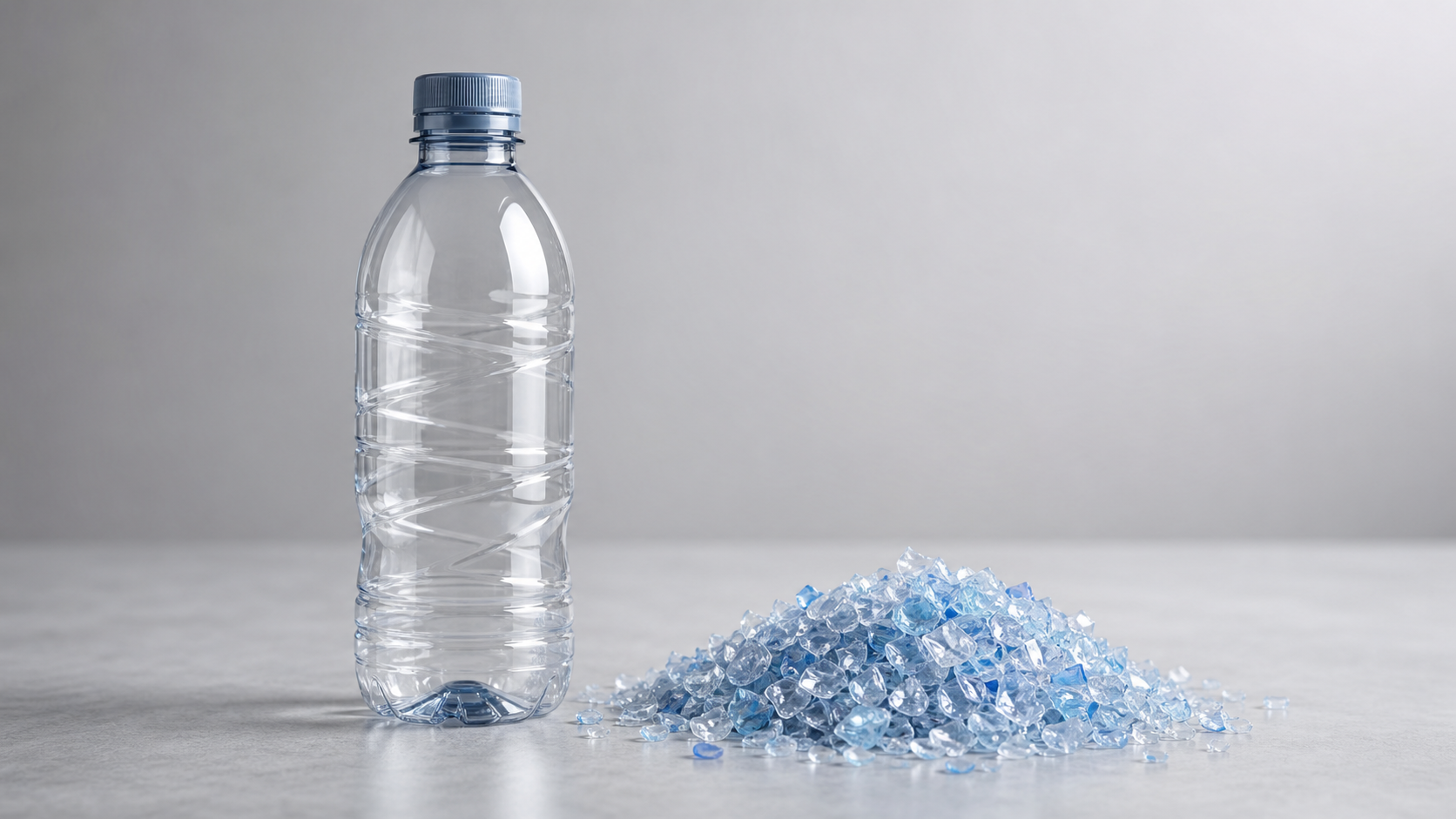
A 100% rPET bottle is a container whose PET resin content in the bottle body comes entirely from recycled PET, typically collected as used beverage bottles. It is distinct from partial rPET (e.g., 25% or 50%) and from virgin PET. Caps, labels, and liners are usually not rPET unless clearly specified, and market labeling rules vary by region.
When suppliers and brands say “100% recycled PET bottle,” they generally mean the bottle wall resin is 100% PCR PET. The term PCR refers to post-consumer recycled content that has been collected after consumer use, sorted, cleaned, and reprocessed back into food-grade rPET. Some programs also use post-industrial PET (regrind or scrap from manufacturing) or blends, so verify definitions in your market.
In beverage packaging, 100% rPET is increasingly used for still water, ready-to-drink teas, juices, and other cold-fill categories. Adoption depends on the availability of food-grade rPET, the required bottle performance, color and clarity expectations, brand positioning, and local recycling infrastructure.
How is rPET made from used bottles?
Most food-grade rPET for bottles is produced through mechanical recycling combined with advanced decontamination. Exact processes vary by supplier, but the general steps are:
- Collection: Used PET bottles are gathered via curbside systems, deposit-return schemes, or commercial channels.
- Sorting: Bottles are sorted by material type and color. Non-PET items, liquids, and contaminants are removed.
- Preparation: Labels, caps, and rings are detached; bottles are ground into flakes and thoroughly washed.
- Purification: Flakes are further cleaned and filtered to remove residual contaminants.
- Decontamination: Food-contact decontamination technologies help ensure flakes or pellets meet strict purity criteria suitable for bottle-to-bottle use, subject to market regulations.
- Pelletizing: Clean rPET flakes may be melted, filtered, and repelletized into uniform pellets; some processors supply high-spec flakes directly to preform manufacturers.
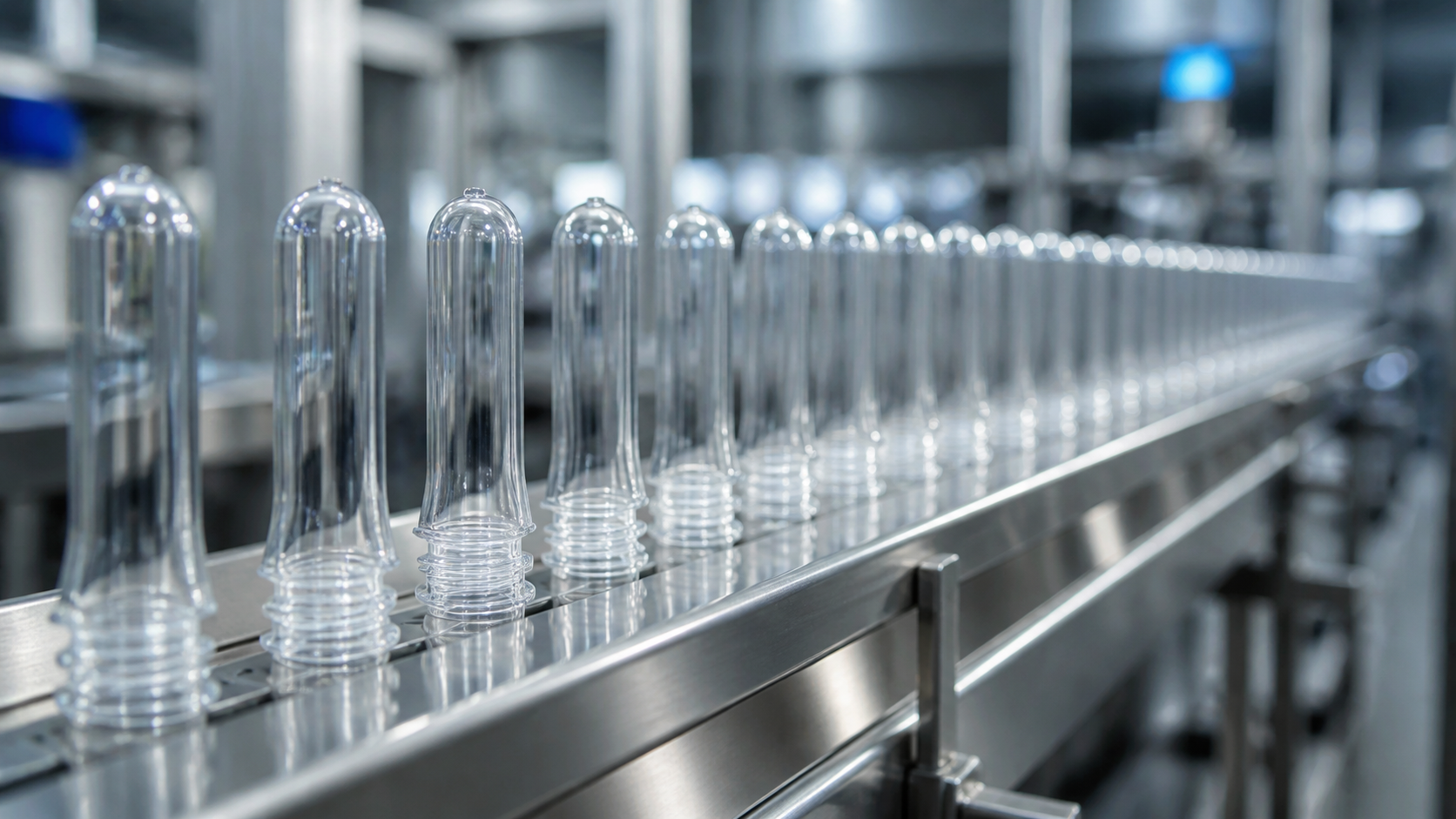
- Preform & bottle: rPET pellets or flakes are used to mold preforms, which are then reheated and blown into final bottles.
Chemical recycling routes exist (e.g., depolymerization to monomers), but availability, scale, and certification approaches differ by region. If you source rPET derived from chemical recycling, confirm how content is accounted for (e.g., mass-balance programs) and whether your market accepts such claims for on-pack communication.
Does a 100% rPET bottle perform like virgin PET?
For many cold-fill beverages, properly specified 100% rPET bottles can deliver comparable performance to virgin PET. However, clarity, color tone, intrinsic viscosity targets, top-load strength, and barrier behavior can vary by feedstock, processing, and bottle design, so application-specific testing is important.
Key considerations brands typically evaluate include:
- Clarity & haze: rPET may show a faint tint or slight haze depending on feedstock and decontamination quality.
- Color management: Some preform suppliers use approved colorants to offset gray/blue-green casts. Verify recyclability impacts before specifying color.
- Mechanical performance: Top-load and creep resistance depend on preform design, stretch ratios, and resin properties. Trial with your actual product, fill line, and logistics conditions.
- Barrier & shelf-life: For oxygen-sensitive products, confirm shelf-life targets with rPET through accelerated and real-time tests. Additives or multilayer designs may affect recyclability in certain markets.
- Organoleptics: Sensory neutrality is essential for water and delicate flavors. Specify decontamination performance and conduct migration/organoleptic testing per your market’s requirements.
What influences bottle appearance and color?
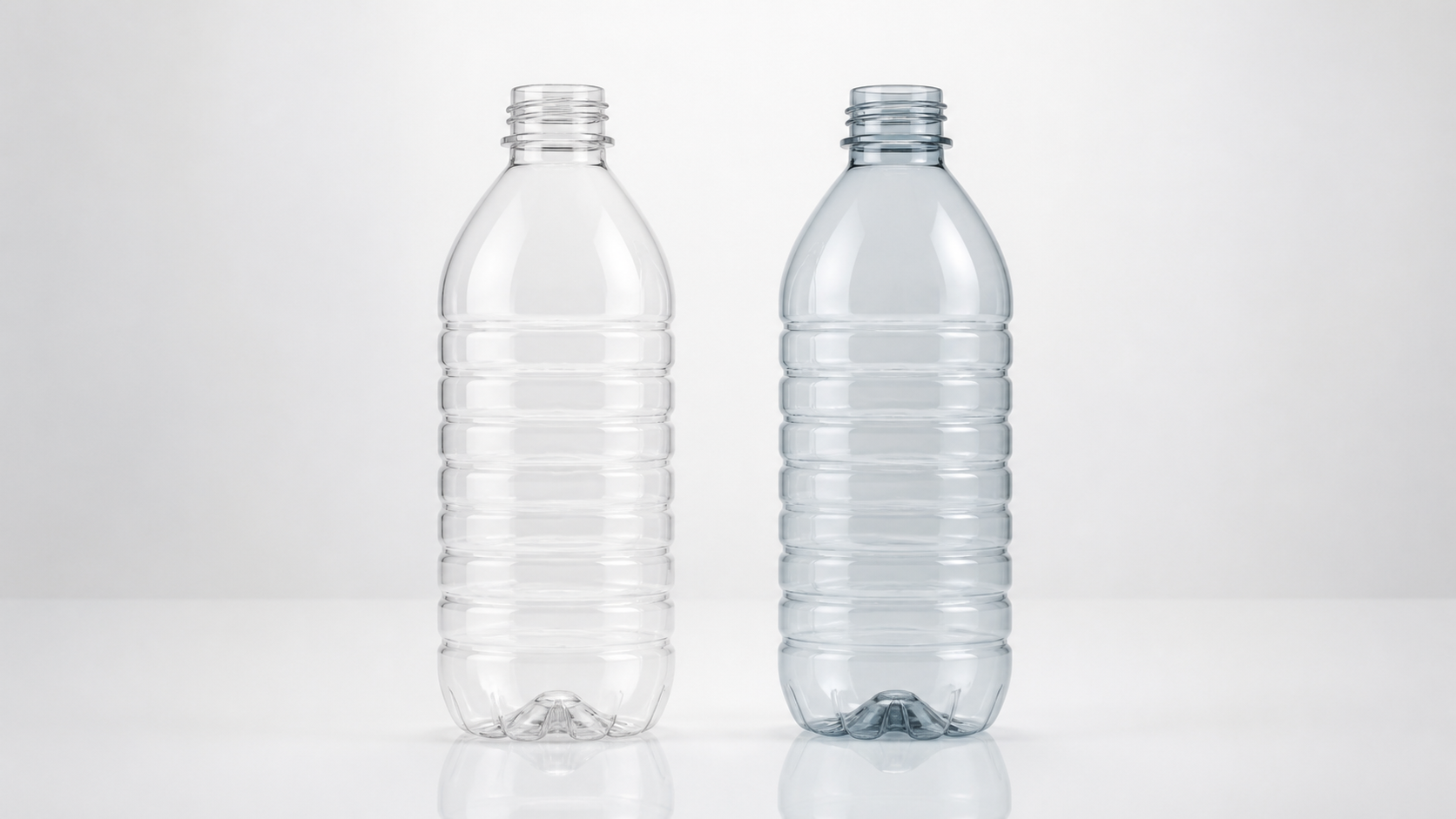
Appearance in 100% recycled PET bottles is driven primarily by feedstock quality, the proportion of clear versus colored bottles collected, residual contaminants, and the recycling technology used. A slight bluish or gray-green hue is common in high-PCR content formats; mastering bale selection, flake cleaning, filtration, and color correction helps control this.
What brands often do:
- Lean into recycled aesthetics: Accept a subtle tint as a visual cue of circularity.
- Set clear expectations: Align marketing, photography, and retail lighting plans with the actual bottle tone.
- Use considered color strategies: If colorants are introduced to neutralize tint, verify their compatibility with design-for-recycling guidance in your market.
For guidance on aligning bottle aesthetics with cost and performance, see our PET Bottle Innovation resource.
How do 100% recycled PET bottles relate to sustainability?
Using 100% rPET helps keep PET in circulation and can reduce demand for virgin PET. The overall impact depends on local collection rates, material yields, energy sources, and transport distances. Well-designed bottle-to-bottle systems can support circularity when coupled with strong consumer participation and clear end-of-life pathways.
- Material circularity: Bottles made from bottles signal a closed-loop approach that many consumers recognize.
- Resource efficiency: rPET uses existing material streams, which can be advantageous when supported by robust infrastructure.
- System dependencies: Impact outcomes vary by geography, sorting tech, and policy. Deposit-return programs, for example, can increase the supply of high-quality bales.
- Recyclability first: Design choices for labels, adhesives, pigments, and barriers strongly influence actual recyclability and yield downstream.
Design for recycling in 100% rPET bottles
Design-for-recycling (DfR) choices determine whether a 100% rPET bottle remains readily recyclable and attractive to reclaimers. While guidance differs by market, brands typically consider the following:
- Labels: Prefer floatable labels on PET, sized to aid wash-off and optical sorting. Avoid full-wrap sleeves that mask the container unless they include detectable features and are compatible with local sorting practices.
- Inks & adhesives: Specify washable inks and adhesives that do not leave residues on PET flakes after hot caustic washing.
- Colors & effects: Clear PET is most broadly recyclable. Opaque and heavy-tint designs can reduce value; confirm market-specific acceptability.
- Closures & rings: Commonly HDPE or PP. Light colors and materials that separate cleanly in recycling are favored.
- Additives & barriers: Evaluate any multilayer, oxygen scavenger, UV blocker, or PCR color correction for DfR compatibility in your target markets.
- Tethered caps: Increasingly required in some regions; verify balance of consumer convenience, line performance, and recyclability outcomes.
100% rPET vs partial rPET vs virgin PET
The right option depends on category, brand positioning, supply security, and line performance. Here is a qualitative comparison often used in early-stage decisions:
| Option | Recycled content | Appearance | Performance | Availability | Cost volatility | Positioning & notes |
|---|---|---|---|---|---|---|
| Virgin PET | 0% | Typically water-clear | Consistent for most uses | Broad | Linked to resin markets | Neutral sustainability message; widely accepted by converters |
| Partial rPET | Commonly 25–50% | Usually close to clear | Comparable when specified | Generally good | Moderate | Step toward circularity; easier color control |
| 100% rPET | 100% in bottle wall | May show slight tint/haze | Application-specific | Region-dependent | May fluctuate | Strong circularity signal; verify DfR & supply |
Sourcing and quality checklist for beverage brands
Before committing to 100% rPET at scale, teams often build a structured brief and qualifying protocol:
- Define usage: Beverage category, fill type (cold-fill/hot-fill), carbonation level, expected shelf-life, and distribution environment.
- Material specs: Intrinsic viscosity targets, contaminant thresholds, organoleptic requirements, and optical properties aligned with brand standards.
- Food-contact compliance: Obtain supplier documentation appropriate for your markets (e.g., declarations that processes are intended to meet applicable food-contact regulations). Confirm with your regulatory team.
- Decontamination & testing: Understand the recycling process, decontamination method, and typical quality metrics. Conduct migration and sensory testing on finished bottles.
- Traceability: Request lot-level traceability and clear definitions of recycled content (PCR vs. post-industrial) and any accounting approaches used.
- Converter readiness: Confirm preform supply, color management strategy, and blow-molding parameters for your bottle geometry.
- Line trials: Test preforms on your lines for blow ratio, top-load, cap application, label application, and downstream case packing.
- Logistics & storage: Check pallet stability, creep, and environmental exposure (heat, UV) effects through transit testing.
- Contingency supply: Qualify secondary sources or flexible content thresholds in case of market tightness.
Cost, supply, and risk management
rPET pricing and availability are influenced by collection rates, bale quality, demand from multiple sectors, and policy changes. Periods of tight supply can occur, especially for clear, food-grade bottle-to-bottle streams. Build resilience by:
- Dual-qualifying suppliers: Maintain approved alternates where possible.
- Considering geographic diversity: Balance proximity with the need for consistent quality.
- Aligning claims with availability: If supply pressures rise, plan how to maintain on-pack statements or adjust content responsibly.
- Forecast collaboration: Share rolling forecasts with suppliers to help secure feedstock and production slots.
What product types fit 100% rPET best?
100% rPET is commonly explored for:
- Still water and flavored water: High clarity expectations; pilot for organoleptics and slight tint acceptance.
- Juices, functional drinks, and teas: Often more forgiving on slight tint; confirm oxygen and light protection needs.
- Carbonated beverages: Validate top-load, creep, and CO2 retention; bottle design and resin specs are critical.
- Hot-fill or pasteurized products: Evaluate heat resistance and dimensional stability; not all rPET specifications suit hot-fill.
Consumer expectations also differ by market. For perspective on adopting recycled content within specific regions, see recent beverage trends in Australia.
Packaging development workflow with 100% rPET
Consider a structured workflow that unites sustainability goals with manufacturability and brand standards:
- Brief & targets: Define recycled content goals, bottle geometry, performance KPIs, and marketing claims.
- Preform selection: Choose preforms and molds compatible with rPET characteristics and your blow-molding equipment.
- Material qualification: Assess rPET supplier specs, decontamination steps, and food-contact documentation.
- Prototype runs: Blow small batches, fill with product, and evaluate clarity, color, top-load, torque, and label application.
- Shelf-life & sensory: Test oxygen ingress, carbonation loss (if relevant), and organoleptics under realistic storage conditions.
- Transit testing: Validate pallet stability, creep, and impact resistance across your logistics chain.
- DfR confirmation: Review labels, inks, adhesives, closures, and any additives against design-for-recycling guidance in your markets.
- Claims & labeling: Ensure “100% recycled PET bottle” (or similar) statements are accurate and compliant for the target market, clarifying scope (bottle body vs. cap/label) as needed.
- Scale-up & monitoring: Phase in production, monitor consistency, and keep contingency plans for supply fluctuations.
If you are building a private label roadmap, coordinate packaging choices alongside formulation and channel strategies. For context on North American market development, explore private label beverages for U.S. brands.
Communicating recycled content to consumers
Clarity builds trust. Keep messages accurate, simple, and aligned with what your quality team can substantiate.
- Be precise: If only the bottle body is 100% rPET, say so. Avoid implying the cap and label are rPET unless they are.
- Show the loop: Use visuals that reinforce circularity without overstating environmental benefits.
- Mind regional rules: On-pack wording and symbols are regulated; verify requirements in each target market.
Frequently asked questions
Is a 100% rPET bottle food-safe?
Food-contact suitability depends on the recycling process, decontamination performance, and compliance with regulations in your market. Many suppliers produce rPET intended for bottle-to-bottle use; however, brands should review supplier documentation and conduct their own migration and organoleptic testing on finished bottles.
Why does my 100% rPET bottle look slightly tinted?
rPET color is influenced by the collected bottle mix, cleanliness, and processing. Even high-quality 100% rPET can show a faint blue or gray-green cast. Some brands accept this as a circularity cue; others use compatible color strategies to manage it while considering recyclability.
Is 100% rPET more expensive than virgin PET?
Pricing varies by region, season, bale supply, and demand from multiple industries. At times, food-grade rPET can carry a premium relative to virgin PET; at other times, spreads narrow. Build scenarios with procurement and qualify alternates where possible.
Can carbonated drinks use 100% rPET?
Yes, with careful specification and testing. Validate top-load, creep, and carbonation retention with your product, closure system, and logistics profile. Bottle geometry, preform design, and line conditions are crucial to results.
What about chemical recycling and mass balance claims?
Some recycled streams use chemical processes and mass-balance accounting. Acceptance of such claims varies by market. If you consider these routes, confirm definitions, certification frameworks, and claim wording allowed in your target markets.
Key takeaways for beverage brands
100% rPET bottles offer a strong circularity signal and, when well specified, can perform effectively across many cold-fill beverage categories. Success hinges on feedstock quality, supplier capability, bottle design, and rigorous testing. Keep on-pack claims precise, align DfR choices with your markets, and secure resilient supply. With a disciplined brief and cross-functional trials, teams can unlock recycled content while protecting product quality and brand experience.