


 Français
 Español
 العربية
 한국어
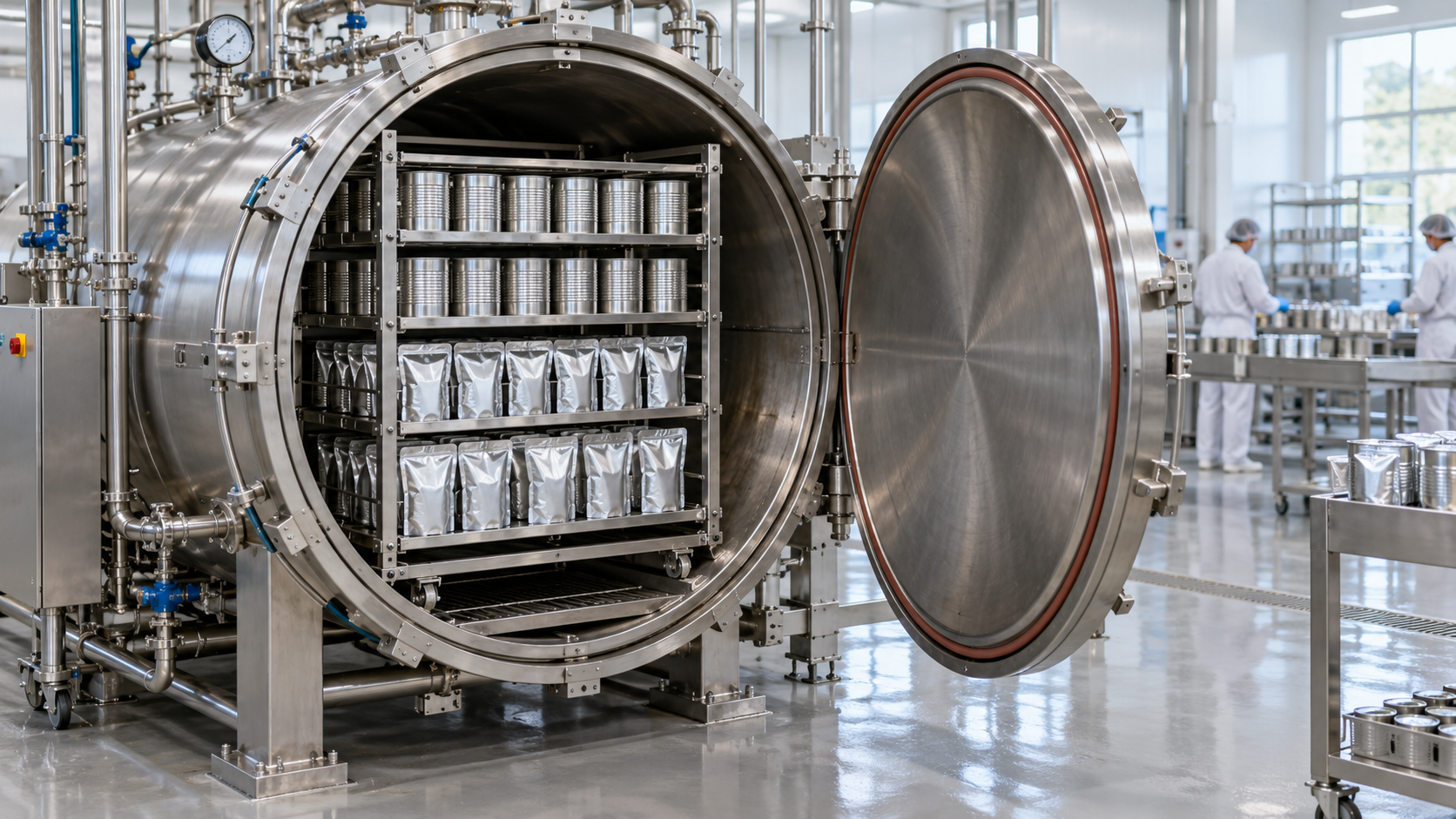
A retort is a pressure vessel that heats sealed containers with steam, water or a steam-air mixture to sterilise their contents. The main types for beverages are still, rotary or agitating, water spray and steam-air retorts, and each one changes how fast heat reaches the product and which containers it can hold.
This overview explains how the types differ, why agitation matters for viscous drinks such as milk tea and coffee, how cans, pouches and glass load differently and why overpressure is part of every cycle. It is an industry overview and does not describe the equipment of any specific plant.
What does a retort do for a beverage?
A retort sterilises a drink inside its final sealed pack by holding it at high temperature under pressure for a calculated time. This makes low-acid drinks, such as milk tea or coffee with milk, shelf-stable at room temperature without refrigeration.
The key idea is heat penetration. The retort controls the temperature of the heating medium, but the product at the coldest point of the pack lags behind it. Process times are set by how long that slowest-heating point takes to reach the required lethality, which is why pack size, shape and product viscosity matter as much as retort settings. Our overview of retort processing for beverages covers when this route fits, and the surrounding options are summarised under processing technology.
What is a still (static) retort?
A still retort holds containers in baskets or trays that do not move during the cycle. Heat reaches the product by conduction and natural convection only, so it is the simplest design but the slowest for thick products.
Still retorts are widely used for cans, glass jars and bottles, and for rigid containers that should not be shaken. They are reliable and mechanically simple. For thin liquids, convection inside the pack helps heat move. For viscous or particulate drinks, the slow centre-point heating can mean long cycles and more heat damage at the outside of the pack, which is the reason agitating designs exist.
What is a rotary or agitating retort?
An agitating retort moves the containers during the cycle, by rotating the basket or rocking it, so the contents mix and heat reaches the centre faster. It shortens process times for viscous drinks and reduces over-cooking at the pack wall.
Agitation is most useful for products where heat travels slowly by conduction alone. Examples include thickened milk teas, coffee drinks with milk and drinks with particles or gels. Because the container moves, it must be mechanically able to take rotation, and headspace affects mixing, since a bubble of air or gas inside the pack helps stir the liquid as it moves. Container choice therefore matters: the sealed can or jar needs the right headspace for the agitation to work.
What is a water spray retort?
A water spray retort heats containers by spraying hot process water over them while the chamber is pressurised with air. The water circulates from the bottom through heat exchangers and back to the spray nozzles.
The design gives even temperature across the load and allows quick cooling by switching the water source. Because pressure comes from air rather than from steam alone, the chamber can be pressurised independently of temperature, which suits flexible packs and containers that need support. Uniform spray distribution is critical, so load patterns and rack design must keep water reaching every container.
What is a steam-air retort?
A steam-air retort heats with a mixture of steam and air that is circulated by a fan, so the whole load experiences similar temperatures without immersing containers in water. The air component provides overpressure independent of temperature.
It is often chosen for pouches and trays, because there is no water to mark packaging or cause problems with certain labels, and overpressure supports flexible containers. The challenge is uniformity: the steam-air mix must be circulated well, and cold spots from poor mixing must be avoided and validated.
How do the retort types compare?
The table gives a general comparison. Suitability depends on the specific machine, the load pattern and a validated process for each product and pack.
| Retort type | Heating medium | Container movement | Typical packs | Good for |
|---|---|---|---|---|
| Still (static) | Saturated steam or water | None | Cans, glass, rigid containers | Thin liquids, simple operation |
| Rotary / agitating | Steam, water or mixtures | Rotation or rocking | Cans, jars, rigid packs | Viscous or particulate drinks |
| Water spray | Sprayed hot water with air overpressure | Usually none | Pouches, trays, cans, plastic | Even heating, flexible packs |
| Steam-air | Steam and air mixture | Usually none | Pouches, trays, plastic | Packs that dislike water contact |
Why does agitation matter for milk tea and coffee drinks?
Milk tea and coffee drinks with milk are low-acid and often slightly viscous, so heat moves slowly into the centre of the pack. Agitation speeds this up, which can reduce cooked flavour, browning and protein damage compared with a long still cycle.
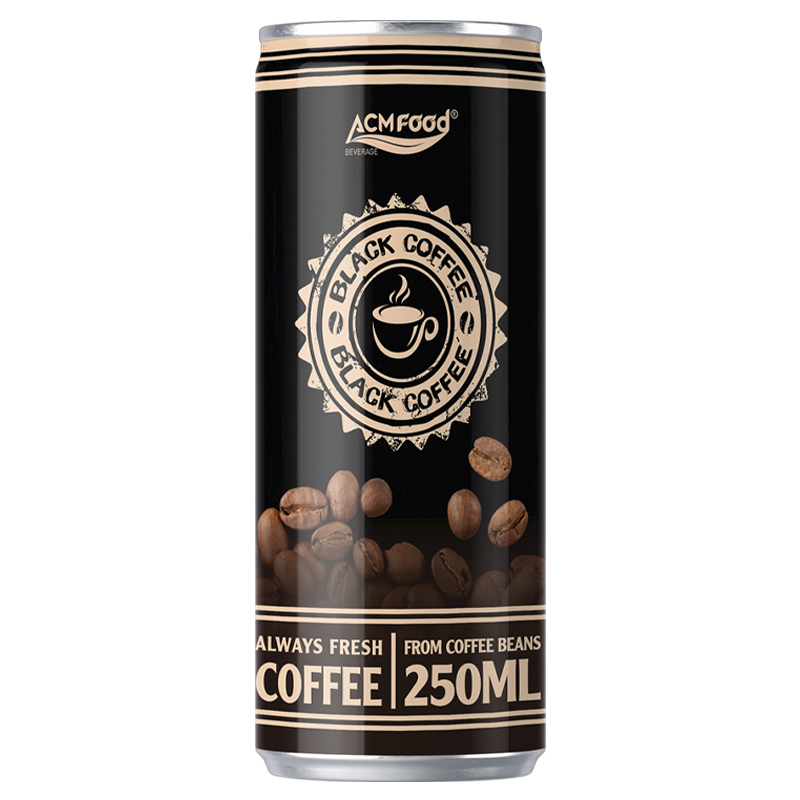
These drinks also contain fat, milk protein and sometimes stabilisers, all of which react to heat. Shorter exposure helps protect taste and appearance, although the sterilisation target must still be met at the slowest-heating point. This is why developers should send the retort operator the actual recipe, viscosity and pack, not a generic description. Our note on private label RTD coffee in canned formats shows how the pack and process interact for these products.
Cans, pouches and glass: how does the pack change the retort?
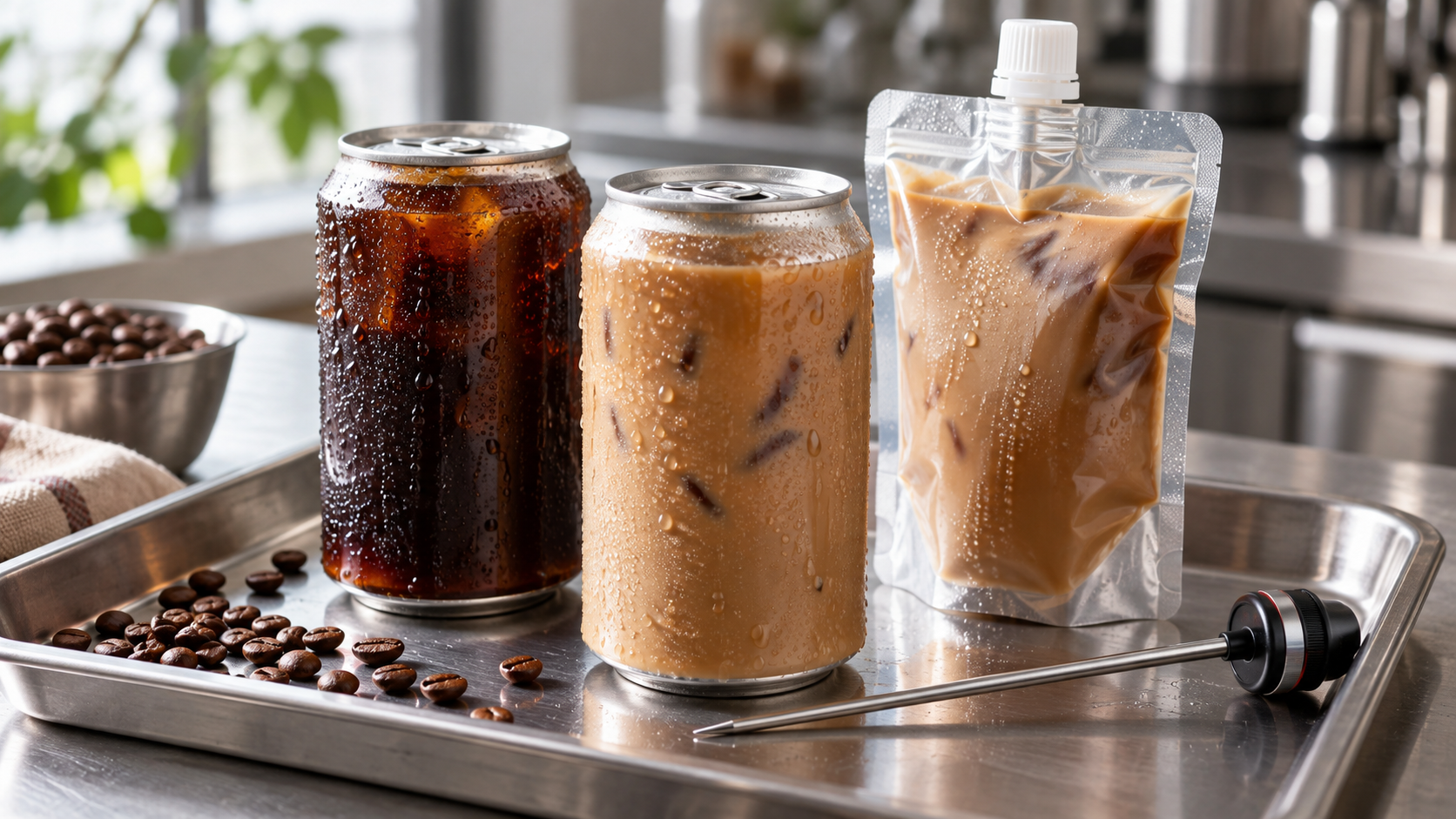
The pack decides which retort types are practical. Metal cans conduct heat well and tolerate pressure, glass needs gentle ramps and support against pressure differences, and pouches need overpressure and flat racks so they keep a uniform thickness.
- Cans: robust, quick to heat and cool, suitable for still, agitating and spray designs.
- Glass: risk of breakage from thermal shock and pressure changes, so slow, controlled ramps and counter-pressure are needed.
- Pouches: thin, flexible and prone to bursting if internal pressure exceeds external pressure, so overpressure and flat support racks are central. Pouch thickness affects heating speed.
- Plastic bottles and cups: need materials rated for retort temperature, so confirm with the packaging supplier.
What is overpressure, and why is it always used?
Overpressure is air or other pressure added to the retort chamber so that pressure outside the container stays at least as high as the pressure building inside it. It prevents bulging, seal failure and bursting during heating.
When the contents heat, they expand and vapour pressure rises. A rigid can withstands this, but flexible packs, plastic cups and glass closures can fail if the external pressure falls behind. The pressure profile is part of the process, and it is raised during heating and kept through cooling, since cooling is when seal damage often occurs.
How is a retort process validated?
A retort process is validated by measuring temperature at the slowest-heating point of the pack with probes, calculating lethality, then repeating the study under worst-case load conditions. Scheduled processes are then set from that data.
For buyers, the useful questions are:
- Who established the scheduled process, and with what thermal-process authority?
- Was heat penetration measured for this exact pack, fill volume and recipe?
- How are temperature, pressure and time recorded for each batch?
- What are the deviation rules if a cycle falls short?
- Does the process meet the rules of the target market?
Related controls such as testing of finished packs are covered in microbiological testing for beverages.
How do retort cycles affect flavour and texture?
Retort heating is long compared with UHT, so it tends to give a cooked flavour and more colour change in sensitive products. Agitation and faster cooling reduce that effect but do not remove it.
Milk-based and coffee-based drinks show this most, with typical changes including darker colour, a caramel or cooked-milk note and, in some formulations, slight protein aggregation. Developers often reformulate for retort, for example by choosing more heat-stable proteins and stabilisers, so a recipe built for another process should not be assumed to work unchanged.
How is a retort loaded and why does the load pattern matter?
The load pattern decides how evenly heat and pressure reach each container. A tightly packed or irregular load can create cold spots that were not present in the validation study, so loading is a controlled step with defined patterns.
- Racks and trays: hold containers in a fixed arrangement so that heating medium can flow between them.
- Dividers: separate layers of cans or pouches to prevent nesting and blocking flow.
- Fill and headspace: consistent fill levels keep heat penetration predictable.
- Load size: partial loads can behave differently from full loads and need their own validation.
When a pack, fill volume or load pattern changes, the process may need to be re-established.
What should be in a retort brief?
A retort brief lists the product, pH, viscosity, particulates, container material and size, fill volume and headspace, shelf life and destination. A processor needs these facts to propose a retort type and cycle.
Add the sensory limits, such as how much colour or flavour shift is acceptable, and the line capacity the project will need. Early sample costs and timelines are also worth discussing; see beverage sample costs and timelines before you commit. For wider options, vegetable-based drinks are discussed in vegetable juice manufacturing for export brands.
How do you decide between retort and other sterilisation routes?
Retort suits low-acid drinks in rigid or flexible packs that can be sealed before sterilisation and that tolerate the heat. Other routes such as UHT with aseptic filling suit products that are damaged by long heating, and the decision depends on flavour tolerance, pack and volume.
Retort has a clear advantage when the pack must be sealed first, since the container is the final protection and the risk of re-contamination after sterilisation is low. Its disadvantage is the long heat exposure, which is why viscous and delicate drinks sometimes move to a UHT and aseptic route. Pack cost also differs: cans and pouches built for retort are widely available, while aseptic packs need specialised filling lines.
Ask a processor to describe the drinks it has already run in each pack and retort type. Experience with a similar viscosity, fat level and pack is worth more than a general capability statement, and a processor that proposes a trial before a quotation usually understands the risk.
Frequently asked questions
Is a retort the same as an autoclave?
The principle is similar, since both use pressurised heat to sterilise, but a food retort is built and validated for sealed food and drink containers and their pressure profiles. The word retort is the usual term in food processing.
Can all beverages be retorted?
Not all. Retort heat can damage delicate flavours, and some products separate or darken. It tends to fit low-acid drinks that need ambient shelf life and can tolerate the heat.
Which retort is best for pouches?
Water spray and steam-air designs are commonly used because they provide controlled overpressure and even heating, but the right choice depends on the pouch, the product and the validated process.
Conclusion
Still, rotary, water spray and steam-air retorts all deliver the same outcome, a sealed pack sterilised in its container, but they differ in how fast heat reaches the product and which packs they protect. Match the retort type to viscosity, pack and flavour sensitivity.
Next step: send us your spec and target market, and we confirm the route for your drink and pack.