


 Français
 Español
 العربية
 한국어
한국어Private label ready to drink coffee is packaged coffee produced by a manufacturer and sold under a buyer’s own brand, with the recipe, can format and artwork controlled by that brand rather than by the factory. Most programmes begin from an existing base — black coffee, espresso, latte, mocha or milk coffee — and adjust coffee strength, sweetness and dairy content before the first commercial run.
This guide covers the decisions that shape an RTD coffee programme: which formats to launch first, how milk content changes the process, what actually moves unit cost and minimum order quantity, and which documents travel with an export shipment. Values such as MOQ, lead time and shelf life depend on the final specification and should be confirmed in writing for each project rather than assumed from a category average.
What is private label ready to drink coffee?
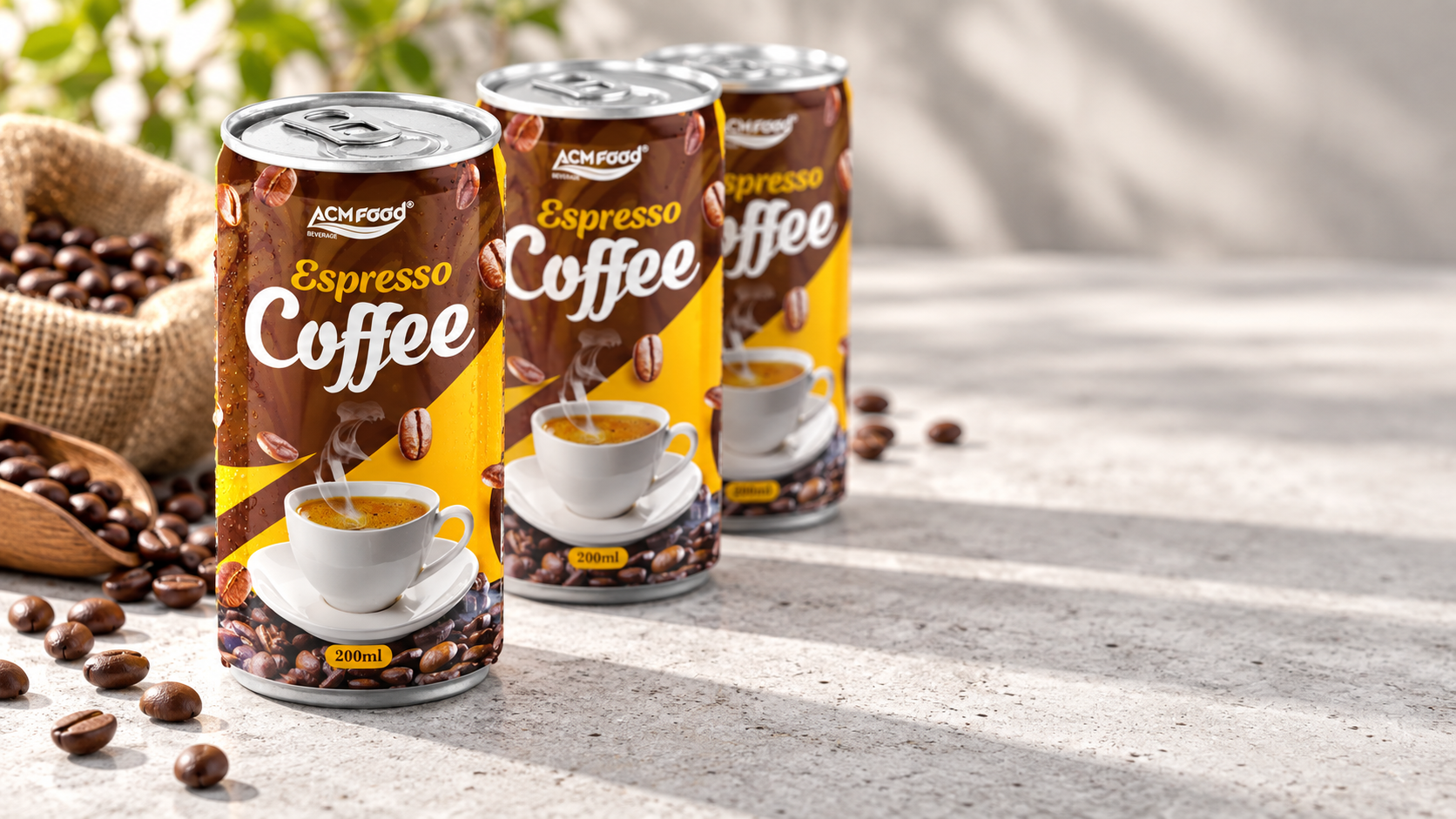
Private label ready to drink coffee is a finished, shelf-stable coffee beverage made to a buyer’s specification and sold under that buyer’s brand. The manufacturer runs the process and holds the production know-how; the brand owns the label, the positioning and the retail relationship. Who owns the recipe depends on whether the project starts from a factory base formula or from a brief the brand supplies.
That distinction matters more in coffee than in most categories, because a base recipe carries a lot of embedded work: the extraction target, the stabiliser system that keeps milk proteins in suspension, and the sterilisation schedule that makes the pack safe. A brand that arrives with a fully original formula is running a development project. A brand that adapts a proven base is running a launch. Both are legitimate, and the models behind them are set out in this comparison of private label, white label and OEM beverage models.
Which RTD coffee formats do brands usually launch first?
Most first launches sit in one of five families: black coffee, espresso, latte, mocha and milk coffee. Black and espresso are the simplest to produce and the least forgiving on raw material quality. The milk-containing variants are more complex to process but generally reach a wider retail audience, which is why many brands launch a two-SKU range with one of each.
Choosing the opening range is a commercial decision as much as a technical one. A narrow range keeps artwork, packaging stock and inventory simple; a broader range gives buyers and category managers something to build a shelf block around. Where RTD coffee sits relative to other packaged drinks is covered in this guide to the main packaged drink categories.
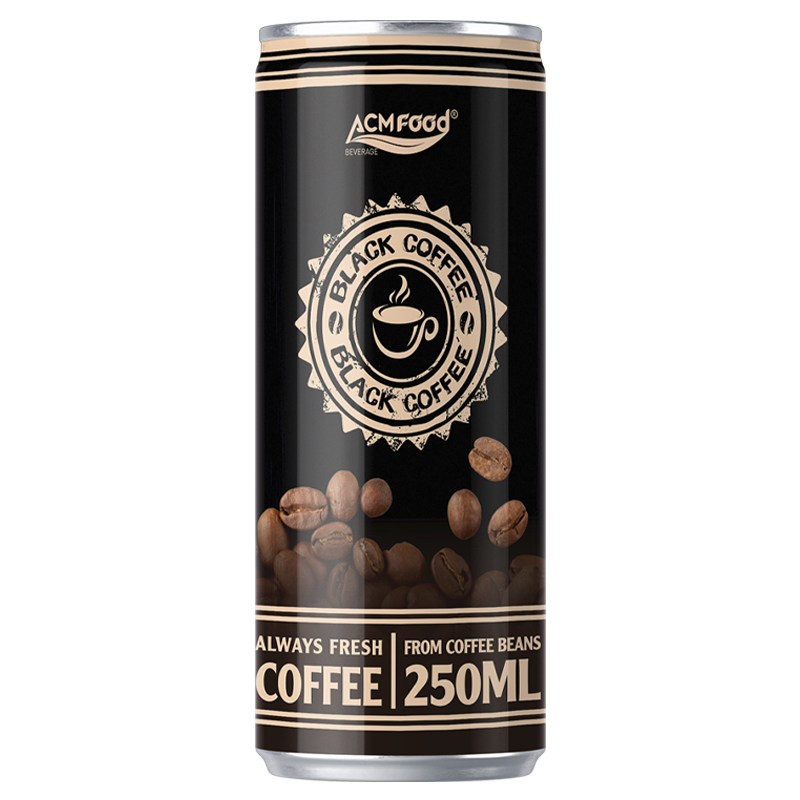
- Black coffee — no dairy, higher acidity, most sensitive to bean origin and roast profile; the cleanest showcase for a single-origin story.
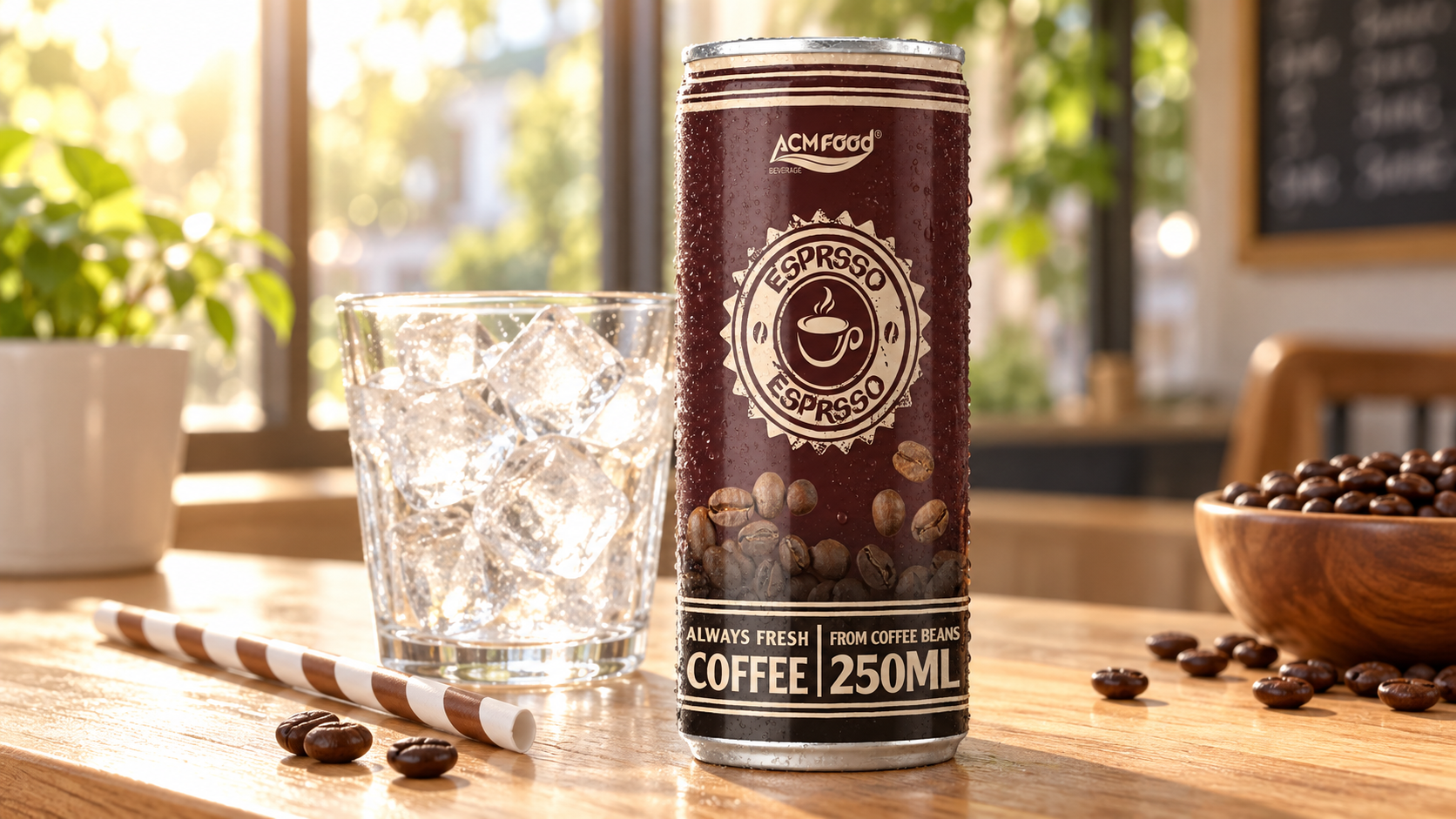
- Espresso — short, intense, usually lightly sweetened; small fill volumes suit it better than large ones.
- Latte — the broadest-appeal option; milk protein stability and mouthfeel drive most of the development work.
- Mocha — adds cocoa, which brings sediment and colour-stability questions of its own.
- Milk coffee — sweeter and typically higher in dairy solids; popular in South-East Asian and export retail channels.
How does milk content change the process?
Milk moves the product toward neutral pH, and that single change drives the rest of the process. A black coffee sits low enough on the acid scale to be treated relatively gently, while a latte or milk coffee behaves as a low-acid product and needs a more severe heat treatment — in practice, retort sterilisation or an aseptic route — to be safe at ambient temperature.
The consequences run through the whole specification. Dairy variants need a stabiliser and emulsifier system to prevent fat separation and protein sedimentation over shelf life. They brown more under heat, so the colour a buyer approves at sample stage is not always the colour that survives sterilisation. And they impose tighter constraints on the pack, because the container has to withstand the process rather than just hold the finished drink.
Can formats and fill volumes
Format selection for RTD coffee usually comes down to how the drink will be consumed and where it will be sold. Small cans suit intense espresso-style products and impulse chillers; larger cans and bottles suit milk coffee and multipack grocery. The table below sets out the qualitative trade-offs rather than prices, which vary with volume, decoration and destination.
| Format | Typical fit for coffee | Practical notes |
|---|---|---|
| Slim aluminium can | Espresso, black coffee | Strong chilled-impulse presence; efficient to ship; decoration by printed can or shrink sleeve |
| Sleek aluminium can | Latte, mocha, milk coffee | Larger serve for dairy variants; light-tight, which protects colour and flavour |
| PET bottle | Cold brew style, larger serves | Resealable; process options are narrower for low-acid dairy products |
| Glass bottle | Premium positioning | Strong shelf presence; heavier freight and higher breakage risk in long-haul export |
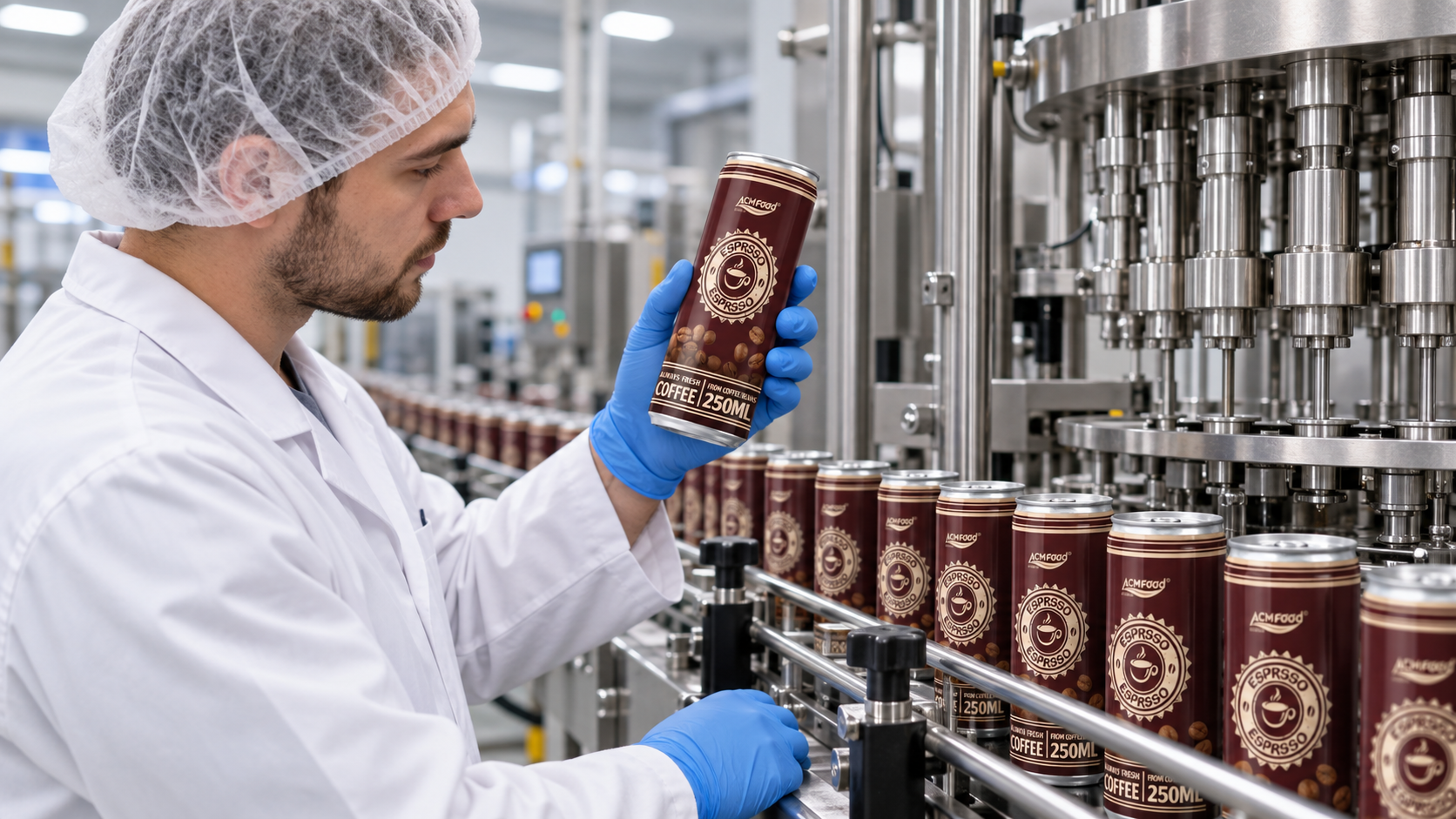
Two points are worth settling early. First, aluminium is opaque, and light exposure degrades both coffee aroma and dairy colour, so a clear pack shifts more responsibility onto formulation. Second, changing format after artwork approval is expensive, because decoration tooling and the fill specification are tied to the container.
What drives MOQ and unit cost in an RTD coffee programme?
Minimum order quantity in RTD coffee is usually set by packaging rather than by liquid. Printed cans and decorated bottles are ordered from a packaging supplier in their own minimum runs, and that quantity, not the filling capacity, tends to become the floor for the whole project. Ingredients with long procurement cycles can raise it further.
Unit cost then moves with a short list of variables, and understanding which ones are inside a brand’s control makes quotation comparison far easier:
- Coffee input — origin, form of the coffee input and the extraction target set a cost floor that formulation cannot design away.
- Dairy or plant-based content — the level of dairy solids, and whether a plant-based alternative is used, is often the single largest ingredient line in a latte-style product.
- Sweetener system — sugar, reduced-sugar blends and high-intensity sweeteners carry different costs and different label consequences.
- Container and decoration — format, fill volume and whether the can is printed or sleeved.
- Process route — the heat treatment a low-acid dairy product requires costs more per litre than the treatment a black coffee needs.
- Run length — changeover, cleaning and line set-up are spread over the batch, so short runs carry a higher cost per unit.
A quotation that does not state the assumptions behind these six lines cannot be compared like for like with another quotation. Asking a manufacturer to quote against a written specification, rather than a product description, removes most of the ambiguity.
How samples and formula approval usually run
Development normally moves through bench samples, a pilot batch and then first production. Bench samples answer taste and appearance questions cheaply. The pilot batch is where a recipe meets real line equipment, and it is the stage most often underestimated: shear, heat transfer and holding times at production scale can shift both texture and colour in a dairy coffee in ways a laboratory sample does not predict.
Approval works best when it is written down. A signed reference sample, an agreed specification sheet and a short list of accept or reject criteria give both sides something objective to check the first commercial batch against. Sensory memory is not a specification, and disagreements six months into a programme are almost always disagreements about something that was never recorded.
Labelling and export considerations
RTD coffee carries the general beverage labelling obligations of the destination market plus a few of its own. Caffeine content and its declaration, allergen labelling for milk, and any claim about sugar content are the areas that most often need attention before artwork is finalised. Requirements differ by market, so artwork should be checked against the destination rules rather than adapted from a domestic version.
For brands shipping into the United States, the format-level requirements are set out in this label checklist for imported beverages, and the wider commercial context for launching there is covered in this overview of private label beverage programmes for U.S. brands. Whichever market is first, artwork approval should sit behind label review, not in front of it — reprinting decorated cans is one of the more avoidable costs in a launch.
Information for brands planning an RTD coffee launch
A product brief does not need to be long, but it does need to be specific. The items below are the ones that most often decide whether a first quotation is useful or has to be redone:
- Which variants are in the opening range, and which one is the lead SKU.
- Target coffee strength and sweetness, ideally with a reference product both sides can taste.
- Dairy, plant-based or non-dairy, and any allergen restrictions that follow from that choice.
- Container format, fill volume and decoration method.
- Destination markets, since these set labelling, claim and documentation requirements.
- Any label claim the brand intends to make, so it can be checked against the formula before artwork.
- Expected annual volume and how it splits across the range, which affects both cost and scheduling.
FAQ: private label ready to drink coffee
Does a private label RTD coffee brand own the recipe?
It depends on how the project started. A recipe developed specifically to a brand’s brief is usually treated differently from a factory base formula the brand has adapted. Ownership, exclusivity and any restriction on the manufacturer selling a similar product to others should be written into the agreement rather than assumed.
Why do latte and milk coffee cost more per can than black coffee?
Two reasons stack. Dairy solids are a significant ingredient cost in their own right, and a near-neutral pH product requires a more demanding heat treatment than an acidic black coffee. The process route, not just the recipe, is part of the price difference.
Can one recipe be filled into both cans and PET bottles?
Not automatically. The container and the process are chosen together, and a low-acid dairy coffee in particular has narrower packaging options than a black coffee. Running the same product in two formats is possible, but it should be planned as two specifications rather than one.
How far ahead should artwork be finalised?
Artwork should be finalised only after the label content has been checked against the destination market’s rules and the formula is stable. Decorated cans and sleeves are produced ahead of filling, so a late formula change that alters a declaration can strand printed packaging.
Conclusion
A private label ready to drink coffee programme is mostly a sequence of linked decisions rather than a single choice of supplier. The variant mix determines the process route, the process route constrains the packaging, and the packaging usually sets the minimum order quantity. Brands that settle those three in order, and record what they agreed, tend to reach a first commercial batch with fewer reworks.
If you are scoping an RTD coffee range, a short written brief covering variants, format, destination markets and any intended label claim is enough for a manufacturer to respond with a specification and a quotation you can actually compare. ACMFOOD develops and fills canned coffee alongside its other beverage formats and can review a brief against what is realistic to produce and export.