


 Français
 Español
 العربية
 한국어
UHT (ultra-high temperature) treatment makes a low-acid plant-based or coconut milk drink commercially sterile, but the heat that makes it safe is also what can make it unstable. Fouling in the plant, sedimentation, creaming and brown colour all trace back to what the heat does to proteins, starches and fats.
This article looks at the stability problems that appear after UHT in plant and coconut milk drinks, where homogenisation fits in the line, how stabilisers are chosen and what to put in a development brief. The general role of the process is explained separately in our guide to UHT processing for beverages.
Why are plant-based drinks harder to stabilise after UHT?
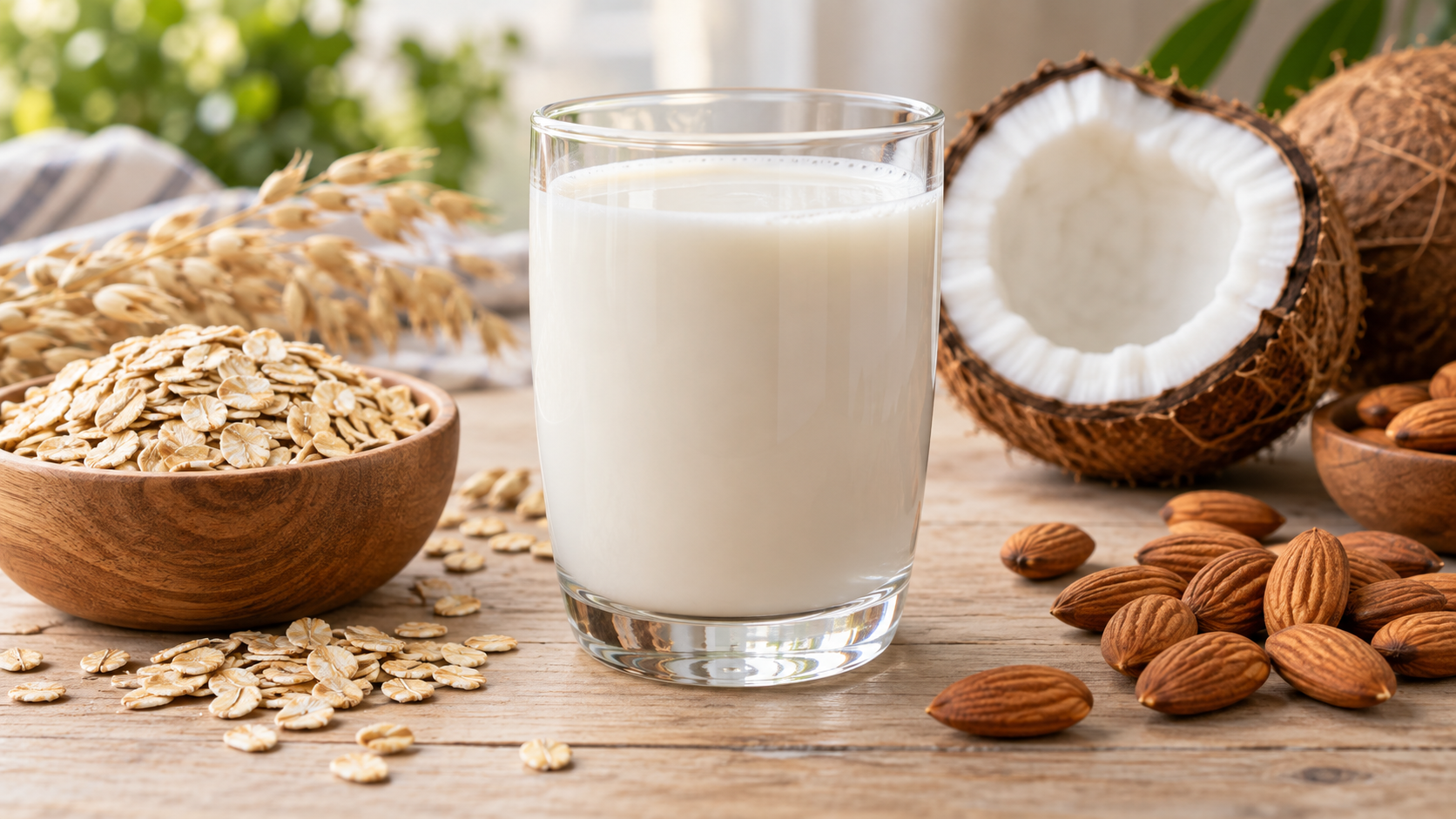
Plant-based drinks contain proteins, starches, fibres and oils in forms that react differently to heat than cow’s milk does. UHT can denature proteins, gelatinise starch and break emulsions, so particles may aggregate, settle or separate once the drink cools and sits on a shelf.
Milk has a long processing history, and its main proteins and fat globules behave in well-known ways. Oat, soy, almond, rice and coconut bases differ from one another and from dairy, so a stabiliser system that works for one cannot be copied across without testing. Low acidity also means the product needs a commercially sterile process, which is why UHT or retort routes come up for these drinks and why the stability work happens around that heat step.
What causes fouling during UHT?
Fouling is a layer of deposit that builds up on heat-exchange surfaces during a production run. In plant-based drinks it is usually made of denatured protein, gelatinised starch and mineral scale, and it reduces heat transfer until the line must be stopped and cleaned.
Fouling matters because it shortens run times, raises cleaning costs and can change the heat treatment the product actually receives. Causes include:
- Protein denaturation: heated protein sticks to hot metal surfaces.
- Starch gelatinisation: starch swells and thickens near the wall, forming a gel layer, especially in oat-based drinks that have not been enzymatically treated.
- Mineral precipitation: calcium and other salts can precipitate when heated, particularly in drinks fortified with minerals.
- Air in the product: dissolved air can form bubbles at hot surfaces that encourage deposits.
A processor should be able to tell you the expected run length between cleans for a similar product, not a promise for a recipe that has not been run.
Why do plant-based drinks sediment?
Sedimentation happens when insoluble particles are heavier than the liquid and nothing holds them in suspension. After UHT, particles may be larger or more aggregated than before, so they fall faster and form a layer at the bottom of the pack.
Typical sources are fine solids from the base material, mineral additions such as calcium salts and aggregated protein. Particle size reduction, enough viscosity or a network built by a stabiliser can slow settling. Coconut milk drinks add a further factor: they contain fat and fibre fractions that can separate in different directions, which brings us to creaming.
What is creaming, and how does it differ from sedimentation?
Creaming is the upward movement of fat droplets to form a layer at the top of the pack, the opposite direction to sedimentation. It occurs when fat droplets are lighter than the surrounding liquid and are not held apart by an adequate emulsion.
Coconut-based drinks are prone to it because coconut fat is a significant component. A visible cream layer is not unsafe, but consumers often read it as a defect, and it may be hard to redisperse by shaking. Smaller droplets from good homogenisation and a suitable emulsifier or hydrocolloid system are the main tools against it.
Where should homogenisation sit relative to UHT?
Homogenisation can be placed upstream of the UHT heat step, downstream of it in an aseptic homogeniser, or both. Each position has trade-offs, and the right choice depends on the product, the equipment and the stability target.
| Position | What it does | Benefit | Risk or cost |
|---|---|---|---|
| Upstream of UHT | Reduces particle and droplet size before heating | Simple, non-aseptic equipment | Heat can re-aggregate particles afterwards |
| Downstream (aseptic) | Breaks aggregates formed by heat | Better control of final particle size | Requires aseptic homogeniser and tighter hygiene |
| Two stages (both) | Reduces size before and after heat | Strongest stability result for demanding recipes | Higher equipment and maintenance cost |
The pressure used, whether one or two stages are applied, and the temperature at homogenisation all change the result, so settings should come from trials on the recipe rather than from a general rule.
How are stabilisers chosen?
Stabiliser choice follows the instability that has been observed. Gellan gum is widely used to suspend particles, while emulsifiers and some hydrocolloids help keep fat dispersed. The right system depends on the base, pH, minerals and heat treatment.
Points to check when selecting a system:
- What is failing: sediment, cream layer, gelling, phase separation or grittiness each call for a different fix.
- Heat stability of the ingredient: some hydrocolloids lose function or dissolve differently at UHT temperatures.
- Interaction with minerals: calcium fortification can destabilise proteins and change how a stabiliser performs.
- Mouthfeel: too much stabiliser makes the drink thick or slimy.
- Label and market rules: permitted additives and their names differ by country.
The same logic appears in other creamy or particulate drinks, as in our notes on chocolate drink formulation, filling and stability.
Why does Maillard colour appear?
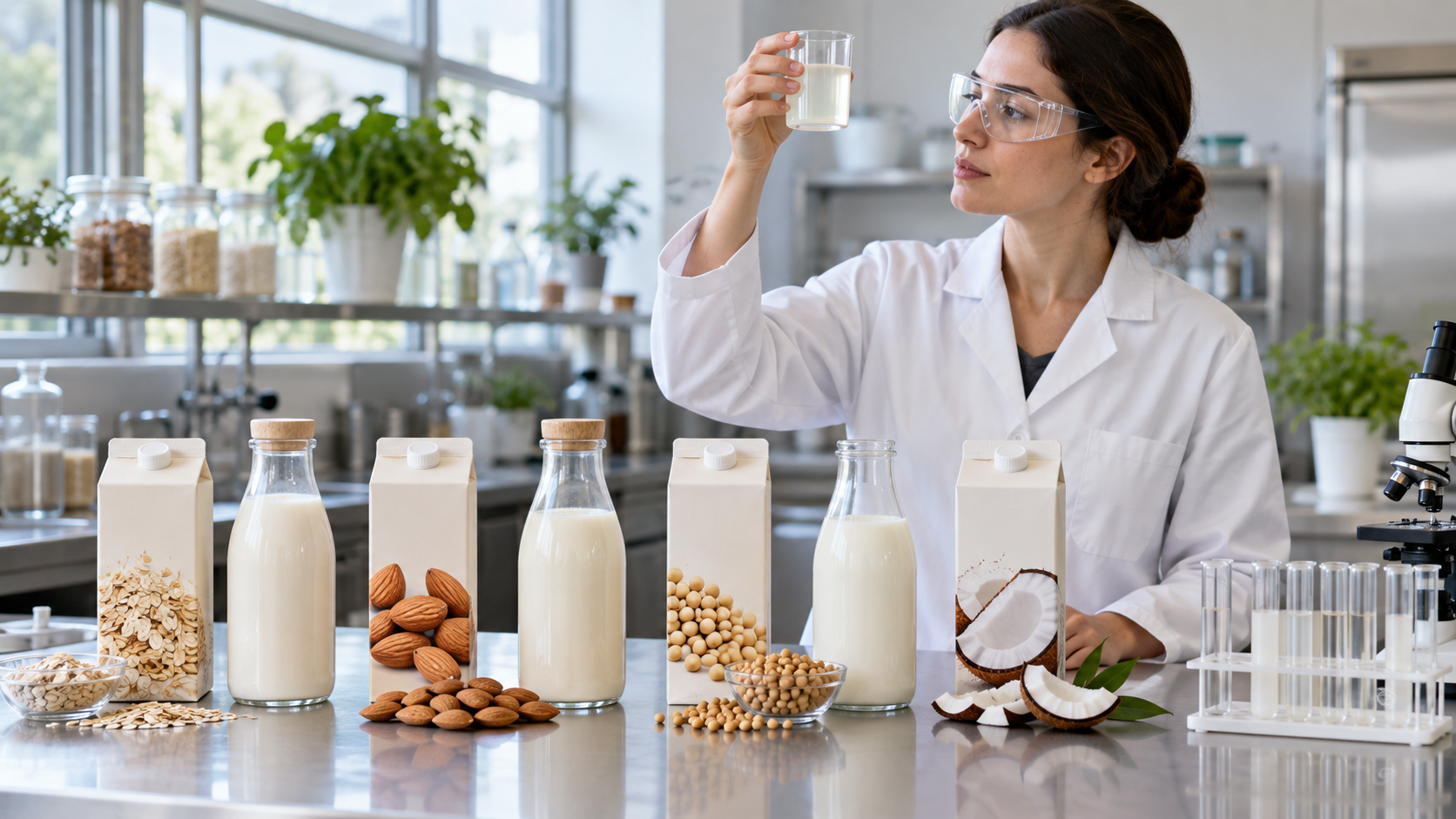
Maillard browning is a reaction between reducing sugars and amino groups that speeds up with heat and time. In UHT plant-based drinks it can give a beige or tan colour and a cooked flavour, especially in recipes rich in sugar and protein.
Reducing the effect involves recipe and process choices. Lower reducing-sugar content, careful control of pH, shorter heat exposure and cool storage all help. Colour can also continue to change during storage, so judgement on day one is not enough; shelf-life trials should compare colour and taste over time at the intended storage temperature.
Does direct or indirect UHT matter?
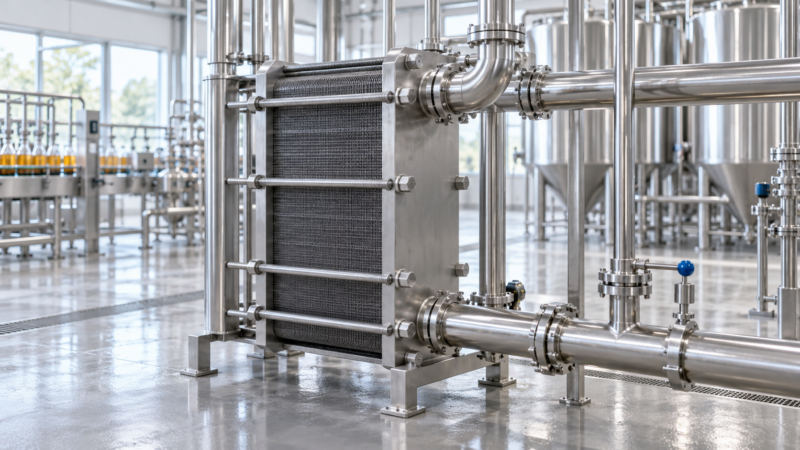
Yes. Direct systems inject or infuse steam into the product and flash it off, giving very rapid heating and often less fouling. Indirect systems heat through metal walls, as in tubular or plate exchangers, and are more prone to deposits with sticky products.
Direct heating adds and removes water, so product composition must be controlled, and the steam quality has to be suitable for contact with food. Indirect systems are simpler in that sense but demand more attention to fouling. Which one a processor uses affects what recipes it can run well, so ask early.
What should a development brief include?
A development brief should describe the base ingredient, target pH, fat and protein levels, fortification, desired texture and the shelf life and storage temperature. Without them, a processor cannot judge whether UHT is enough or whether the recipe needs reworking.
- Base material and any pre-treatment, such as enzyme-treated oats or coconut cream fraction.
- Target pH and any acidulants, since low pH changes protein stability.
- Mineral or vitamin fortification, because it affects stability.
- Pack type, because the fill route follows UHT. See choosing a filling technology by beverage pH.
- Sensory targets: colour, viscosity, sweetness and acceptable cooked notes.
- Shelf life, storage temperature and the destination market.
How do pH and minerals change stability?
Protein stability in plant-based drinks depends strongly on pH and on dissolved minerals, especially calcium. Moving the pH toward the isoelectric point of the protein or adding calcium can cause protein to clump and settle during or after heat treatment.
This is why a recipe that is stable unfortified can fail once minerals are added. A developer usually balances pH with buffer salts and chooses the mineral form carefully, since different calcium sources dissolve and react differently. Testing at the actual UHT conditions is essential, because bench-top stability at room temperature does not predict behaviour after heat.
What shelf-life tests matter for plant-based UHT drinks?
The most useful tests follow the drink across its intended shelf life at the intended storage temperature, checking appearance, sediment, cream layer, viscosity, pH, colour and taste at set intervals. Accelerated tests at higher temperature can help but do not replace real-time data.
- Visual checks: sediment, cream layer, gelling and clarity in the pack and after pouring.
- Physical measures: viscosity, particle size and pH over time.
- Sensory checks: flavour, off-notes and mouthfeel against a fresh reference.
- Microbial stability: incubation of sealed packs to confirm commercial sterility.
- Transport simulation: vibration and temperature cycles that mimic shipping.
Because the drink is low-acid, the sterility result matters as much as the physical one. A pack that looks fine but is not sterile is a safety problem, so physical and microbial results should be reviewed together.
How do sweeteners and flavours interact with UHT?
Sugars, sweeteners and flavours can all change under UHT heat. Reducing sugars feed browning, some flavour compounds are lost or altered and some sweeteners lose sweetness or develop off-notes at high temperature.
For export drinks, the choice of sweetener system also has labelling consequences, which differ by market. Our notes on sweetener systems for export beverages cover the trade-offs. In general, add flavours after heat treatment where the process allows it, and test the finished drink, not only the base.
What should be tested before the first commercial run?
Before the first commercial run, the recipe should have passed bench trials, a pilot UHT trial and a shelf-life study on pilot product. Skipping pilot work is the most common reason a promising recipe fails at scale.
Bench samples are heated in small equipment that does not reproduce the heating profile, holding time and shear of an industrial plant, so they can give optimistic results. A pilot plant, or a short trial on the production line with the real recipe, shows fouling behaviour, homogenisation response and the effect of the actual hold time. Keep samples from the start, middle and end of a run, because fouling changes the heat treatment as the run proceeds and the end of the run can behave differently from the start.
Document each trial with the recipe version, process settings and results. If the final recipe changes, even a small stabiliser adjustment, repeat the stability work at least in part. Documented trials also support the specification that the importer and the factory will agree.
Frequently asked questions
Is UHT the only option for coconut milk drinks?
No. Retort sterilisation in a sealed pack is another common route for low-acid drinks, and each affects texture and colour differently. The choice depends on the pack and the stability target.
Can sediment be avoided completely?
It can often be reduced to a level acceptable for the product’s positioning, but zero separation is not realistic for every recipe. Many consumers accept a gentle shake instruction, which should be stated on the label where needed.
Does UHT remove the need for refrigeration?
For a correctly processed and aseptically packed drink, ambient storage is possible until the pack is opened. After opening, the drink should be refrigerated, and storage claims must match validated shelf-life data.
Conclusion
Stability after UHT is built into the recipe, not added at the end. Protein, starch, fat and minerals set the problem, homogenisation and stabilisers manage it, and trials confirm it over the full shelf life.
Next step: send us your spec and target market, and we confirm the route for your plant-based or coconut milk drink.