


 Français
 Español
 العربية
 한국어
한국어Retort processing is an in-pack sterilisation method that heats sealed containers to achieve commercial sterility, making beverages shelf-stable without refrigeration. In beverage manufacturing, retorting is a proven route for products that cannot be safely or economically hot-filled or aseptically packed, particularly high-pH and protein-containing drinks.
This article explains when retort processing is the right answer, how the F0 value informs process design, what sensory trade-offs to expect, and how packaging and validation choices shape outcomes. We focus on practical decision criteria for brand owners and product developers considering canned drinks, retort pouches, glass, or retortable PET.
What is retort processing and in-pack sterilisation?
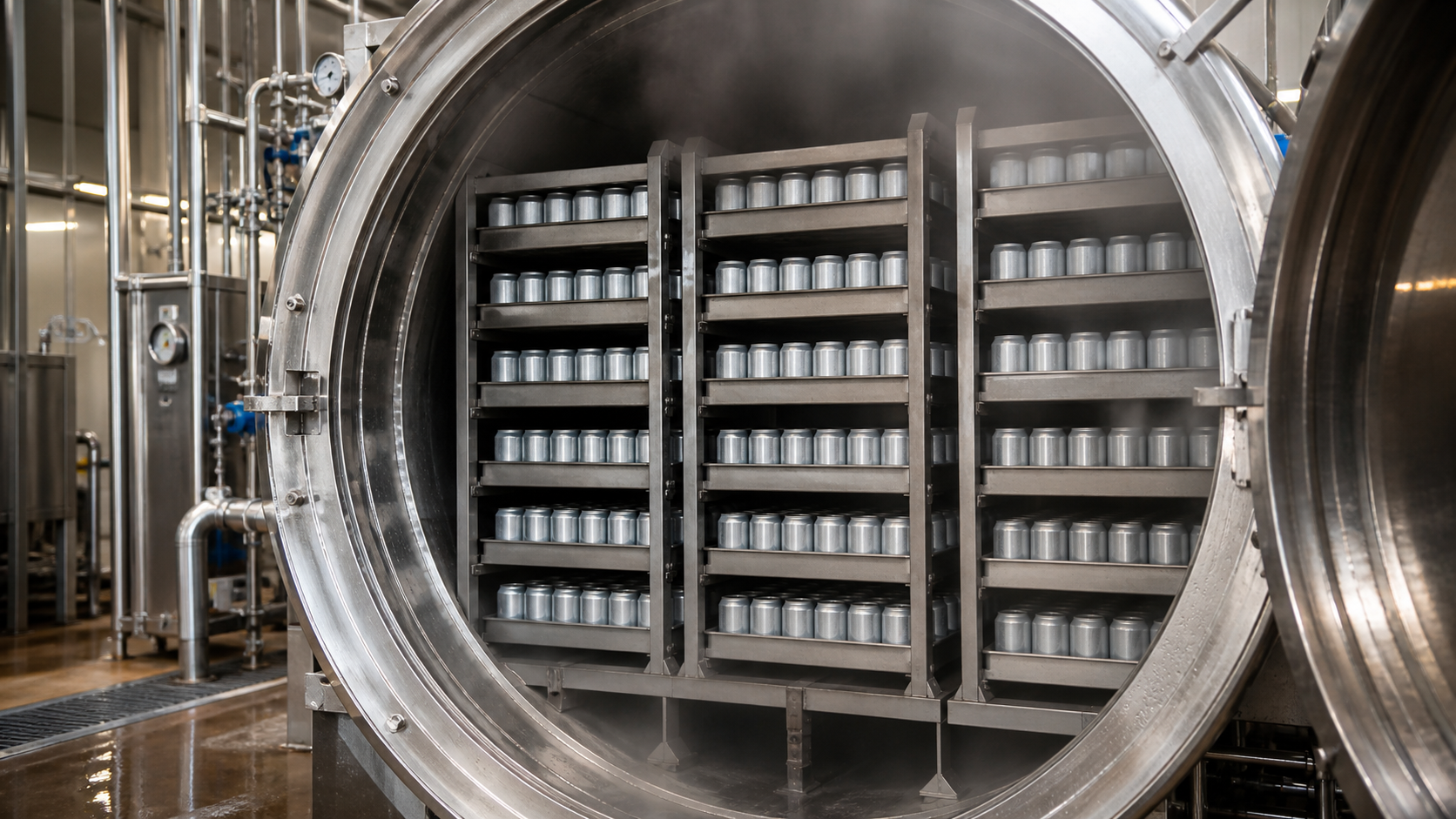
Retort processing is thermal sterilisation applied to a beverage after the package is sealed. The container and its contents are heated together under pressure, then cooled, delivering a shelf-stable product with commercial sterility.
In practical terms, sealed cans, pouches, glass jars, or retortable PET bottles are loaded into a pressure-rated vessel (the retort/autoclave). The system uses steam, water spray, or water immersion, often with overpressure, to reach the target temperature and hold it for the designed time before controlled cooling. Because sterilisation happens inside the package, there is no need for a sterile filling room as with aseptic processing.
Retorts vary by mode: still retorts (static), rotary retorts (agitation to improve heat transfer), steam-air systems, water-spray, and water-immersion. The best choice depends on product viscosity, particulates, container type, and desired quality outcomes. For canned drinks, double-seam integrity, internal coatings, and dimensional stability under pressure are central considerations.
In-pack sterilisation is widely used for high-pH beverages where spore-forming microbes are a primary safety concern, and for formulations with particulates that challenge aseptic filling. It also suits portfolios where multiple pack formats are required without building a full aseptic line.
When is retort processing the right answer for beverages?
Retort processing is typically the right answer for shelf-stable beverages that are high pH, include protein or fat, or contain particulates, and for brands prioritising robust safety margins, flexible pack formats, and ambient distribution without a sterile filling suite.
Commonly suited categories include:
- Milk- and plant-based beverages (e.g., RTD coffee or tea with dairy or alternatives, nutritional and protein shakes).
- High-pH soups, broths, and savory drinkables, or vegetable-forward blends where acidity is not sufficient for hot-fill.
- Fruit & dairy blends or cereal-based drinks where fat and protein complicate aseptic conditions.
- Beverages with particulates (pulp, grains, cubes) where heat penetration control favors in-pack sterilisation.
- Export-oriented SKUs needing long ambient shelf life under variable logistics conditions.
Strategic decision points we see across the industry:
- Product pH and composition: High-pH or protein/fat matrices lean to retort or UHT-aseptic rather than hot-fill.
- Particulates and viscosity: Larger particulates or thick systems favor retort with validated heat penetration.
- Packaging strategy: Cans, pouches, and certain PET/glass options are retortable; aseptic needs compatible formats and sterile fill.
- Scale and flexibility: Retort can be efficient at moderate volumes and multi-format portfolios.
- Route-to-market: Ambient distribution, long-haul export, and uncertain storage favor in-pack sterilisation’s resilience.
For broader context on thermal options, see our processing technology overview.
How does the F0 value guide process design?
The F0 value conceptually represents the cumulative microbial lethality delivered to a product, expressed as an equivalent time at 121.1°C (250°F). In beverage retorting, F0 is used to design, validate, and monitor cycles that achieve commercial sterility without unnecessary quality loss.
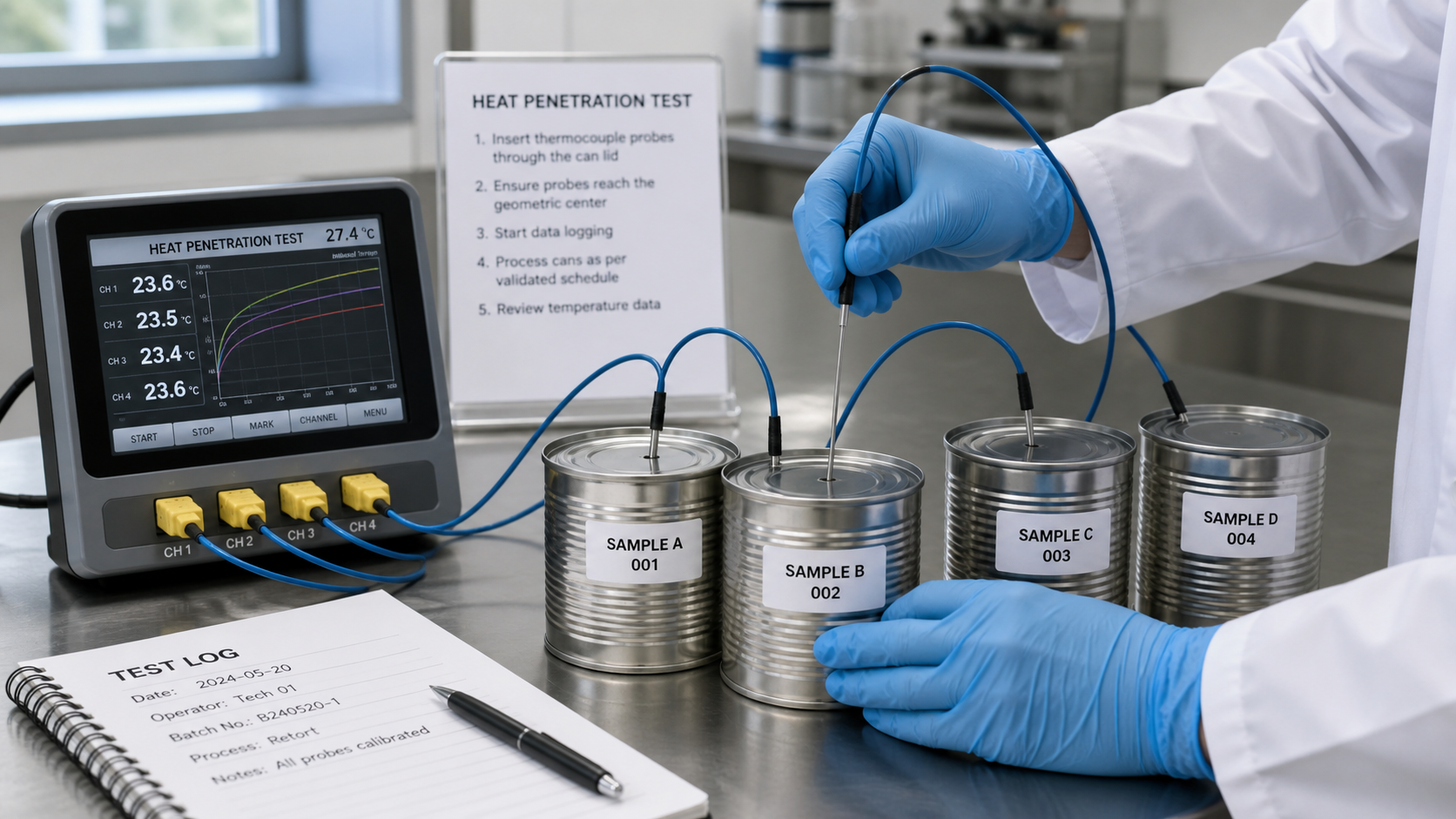
In practice, F0 is not a fixed number for all beverages. It depends on target microorganisms, product pH/composition, container dimensions, and the location of the cold spot. Process authorities combine heat-penetration studies, container mapping with thermocouples, and lethality calculations to define a cycle (come-up, hold, and cooling) that meets safety targets.
Several variables shape the delivered F0 and quality outcome:
- Come-up time and distribution: Faster, more uniform heating (e.g., water-spray with overpressure or rotary agitation) can reduce overall heat load.
- Agitation: Rotary retorts improve convective heating in viscous or particulate products.
- Container geometry and load pattern: Larger formats and dense loads slow heat penetration; basket mapping identifies cold spots.
- Process temperature profile: Small differences in temperature control can materially change lethality and sensory impact.
The objective is to meet the required F0 for safety while minimising flavor dulling, color changes, and texture damage. That balance is the heart of retort process design.
What are the sensory and colour impacts to expect?
Higher heat loads can mute fresh top-notes, deepen or brown color, and soften particulates. In milk- or plant-protein systems, more intense heating may drive Maillard reactions and cooked notes. The degree of change depends on formula, pH, sugars, proteins, and the retort mode and cycle.
Quality-preservation levers used across the category include:
- Cycle optimisation: Reduce overall heat load by shortening come-up time and using overpressure or agitation modes.
- Recipe adjustments: Calibrate acidity, sweetness, and buffering to temper browning and preserve brightness.
- Flavor strategy: Layer heat-tolerant flavors and replenish delicate top-notes post-process where formats allow (most retort formats do not permit post-fill additions).
- Color management: Select retort-stable colors and leverage oxygen management and chelation where appropriate.
- Particulate engineering: Size, blanch, or pre-process inclusions to achieve target texture after retort.
Packaging choices for retort beverages
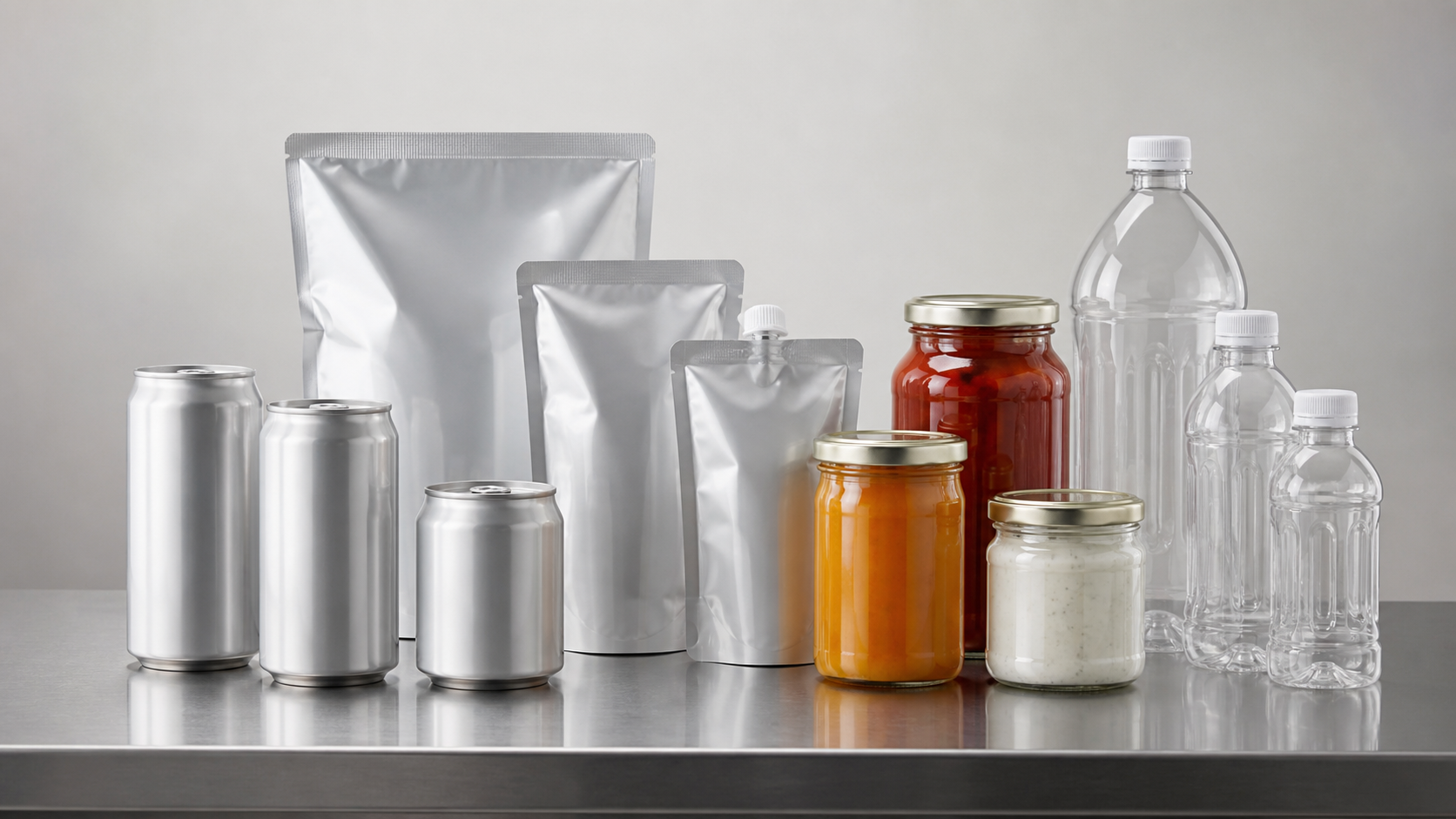
Retort unlocks several ambient-ready formats, each with technical implications for heat transfer, integrity testing, and consumer experience.
- Metal cans (aluminum or steel): The workhorse for canned drinks; excellent heat transfer, robust double seam, broad line availability. Requires coating compatibility with the beverage matrix.
- Retort pouches: Thin profile enables rapid heat penetration and quality retention; lightweight with strong shelf efficiency; requires careful sealing and handling.
- Glass jars/bottles: Premium cues and barrier; slower heat-up and cool-down; stresses closure integrity and thermal shock control.
- Retortable PET: Lightweight and shatter-resistant; needs specially designed containers to resist deformation under heat and overpressure.
Choosing between cans and PET often balances sensory targets, cost, sustainability narratives, and line access. For a deeper look at format trade-offs, see aluminium can vs PET bottle.
Retort vs UHT-aseptic vs hot-fill vs tunnel pasteurisation
All four are proven for shelf-stable portfolios, but they are not interchangeable. The right path depends on pH, formulation, pack format, and desired sensory profile.
| Process | Primary packaging | Suited beverages | Pros | Limitations & notes |
|---|---|---|---|---|
| Retort (in-pack sterilisation) | Cans, retort pouches, glass, retortable PET | High-pH, protein/fat systems, particulates | Robust safety margin, format flexibility, ambient logistics | Higher heat load; potential flavor/color changes; needs container integrity control |
| UHT + aseptic fill | Aseptic-compatible cartons, PET, select bottles | Dairy/plant drinks, neutral pH, smooth systems | Lower overall heat load vs in-pack; fresh profile | Requires sterile environment; sensitive to particulates; higher system complexity |
| Hot-fill | Heat-resistant PET, glass | High-acid beverages (e.g., many fruit drinks) | Simpler than aseptic; good for acidic matrices | Not for high-pH safety targets; can affect volatile aroma |
| Tunnel pasteurisation | Cans, glass, some bottles | Finished-pack pasteurised, typically high-acid | Pack-level lethality; suited to certain drink styles | Generally lower lethality than sterilisation; not for high-pH spore control |
For export-oriented fruit beverages, see our overview of shelf-stable juice manufacturing for process pathways in acidic systems.
Validation, quality control and risk management
Yes/no outcomes are not enough in retort; validation is evidence-driven. A qualified process authority typically develops and documents the cycle, then verifies with instrumented runs and routine monitoring protocols.
- Heat penetration studies: Thermocouples at cold spots establish time-temperature histories and delivered lethality.
- Load mapping and repeatability: Basket position, stacking patterns, and agitation settings are standardised.
- Container integrity: Double-seam checks for cans, seal integrity for pouches, closure torque and vacuum as applicable.
- Process controls: Calibrated sensors, pressure/temperature interlocks, come-up time limits, and cooling controls.
- Post-process handling: Drying, coding, storage conditions, and rejection protocols to protect sterility.
Brand owners auditing a co-man should confirm documentation, calibration records, operator training, and container integrity testing. Our guide on auditing a Vietnamese beverage manufacturer outlines practical checkpoints relevant to retort operations.
Commercial considerations for brand owners
From a business lens, retort can be attractive when you need ambient logistics resilience, global shipping flexibility, and format diversity. It also enables incremental innovation on existing canning infrastructure at many facilities.
- Capex/opex trade-offs: Retort lines can be more accessible for moderate volumes than full aseptic suites.
- Throughput vs quality: Faster cycles and agitation can improve both, but require compatible packaging and validation.
- Portfolio strategy: One process serving cans, pouches, and select PET can simplify go-to-market across channels.
- Regulatory and market fit: Labeling, claim language, and shelf-life substantiation vary by market; build evidence at brief stage.
If your roadmap also includes high-acid SKUs, consider parallel platforms (hot-fill or tunnel pasteurisation) alongside retort. For acidic lines, review shelf-stable juice manufacturing options.
Development checklist before you choose retort processing
Before locking in retort, align your product brief across technical, sensory, and commercial criteria.
- Product fundamentals: Target pH, water activity, matrix (dairy, plant, protein, fat), and presence/size of particulates.
- Packaging short list: Cans (diameter/height), retort pouches, glass, or retortable PET; closure systems and coatings.
- Quality targets: Aroma brightness, color retention, texture of inclusions, and acceptable cooked notes.
- Process mode: Still vs rotary; steam-air vs water-spray; required overpressure; load configuration.
- Validation plan: Heat penetration, cold-spot identification, F0 target rationale, monitoring and release criteria.
- Operational controls: Seaming/sealing checks, burst and vacuum testing, coding, traceability, and rework limits.
- Market and claims: Shelf-life statement, storage conditions, claim language aligned with regulations.
- Cost-to-serve: Line speeds, changeover complexity, pack weight and freight impacts.
To structure options and trade-offs, start with a concise processing technology overview. If you are relocating a formula or format, plan ahead for heat penetration and pack redesign in a move an existing beverage recipe project.
FAQ
Does retort processing always require metal cans?
No. Retort works with several formats including cans, retort pouches, glass, and specially engineered retortable PET. The right choice depends on heat transfer needs, consumer experience, and line availability.
Is retort the same as pasteurisation?
No. Pasteurisation targets vegetative microorganisms and is typical for high-acid beverages. Retort processing is a sterilisation approach designed for commercial sterility in shelf-stable, often higher-pH beverages.
Can I retort carbonated drinks?
Generally, no. Carbonation expands under heat and pressure, complicating container integrity and safety. Shelf-stable carbonated products typically use different processing routes. If carbonation is essential, discuss alternatives with your process authority.
What F0 should I target for my beverage?
It depends on product pH, composition, container geometry, and target microorganisms. A qualified process authority should determine the appropriate lethality level and validate it with heat-penetration studies and documented monitoring.
Will retort processing change flavor and color?
Some change is likely, with magnitude depending on formula and cycle design. Agitation, rapid come-up, and recipe adjustments can help preserve top-notes and color while meeting safety targets.
Retort processing is a mature, flexible pathway to ambient-shelf beverages when products, markets, or packaging call for in-pack sterilisation. By centering the F0 design on safety while optimising cycle and format, brands can balance shelf stability with appealing sensory profiles. If you are comparing retort against aseptic or hot-fill, use a structured brief, consider format strategy early, and involve a process authority to align lethality with quality from day one.