


 Français
 Español
 العربية
 한국어
한국어Beverage certifications in the USA combine mandatory FDA compliance with voluntary, market-driven standards that U.S. buyers use to qualify and monitor suppliers. Understanding how these pieces fit together helps importers, distributors, and brand owners reduce risk and move products through U.S. customs and retail onboarding faster.
This guide explains what is legally required by the U.S. Food and Drug Administration (FDA), what is commonly expected by retailers and e-commerce platforms, and how to verify a manufacturer’s documentation before placing orders. If you need a complementary overview of the rule landscape, see our U.S. beverage regulations guide.
What counts as “beverage certifications” in the USA?
In the U.S., “beverage certifications” usually refers to two layers: FDA compliance that is legally required for food and beverage imports, and voluntary third-party certifications (for example, GFSI schemes) that many retailers and buyers expect during supplier qualification. The first is about legality; the second is about marketplace acceptance and risk management.
FDA requirements govern safety programs, process controls, facility registration, labeling, import procedures, and recordkeeping. Voluntary certifications validate that a manufacturer’s food safety system meets recognized global benchmarks or specific consumer-positioning standards (e.g., kosher, halal, organic). Both layers can be important in commercial practice, especially for private label and national retail listings.
Which FDA requirements apply to imported beverages?
For most non-alcoholic beverages, importers must meet U.S. FDA rules covering facility registration, food safety controls, labeling, and import processes. In addition, the Foreign Supplier Verification Programs (FSVP) require the U.S. “importer of record” to verify that foreign suppliers are producing products to U.S. safety standards.
Key FDA-related elements for beverage imports typically include:
- Facility registration: Most foreign food facilities that manufacture, process, pack, or hold beverages for U.S. consumption must be registered with FDA and keep registration current.
- FSVP obligations: The U.S.-based importer is responsible for supplier evaluation, verification activities, and recordkeeping to demonstrate that products meet U.S. safety standards.
- Process controls: Depending on the product, the facility may operate under Juice HACCP (21 CFR Part 120) or under risk-based preventive controls and current Good Manufacturing Practice (cGMP) frameworks for human food.
- Thermal processing filings: Low-acid canned foods and acidified foods have specialized control and filing requirements overseen by qualified process authorities.
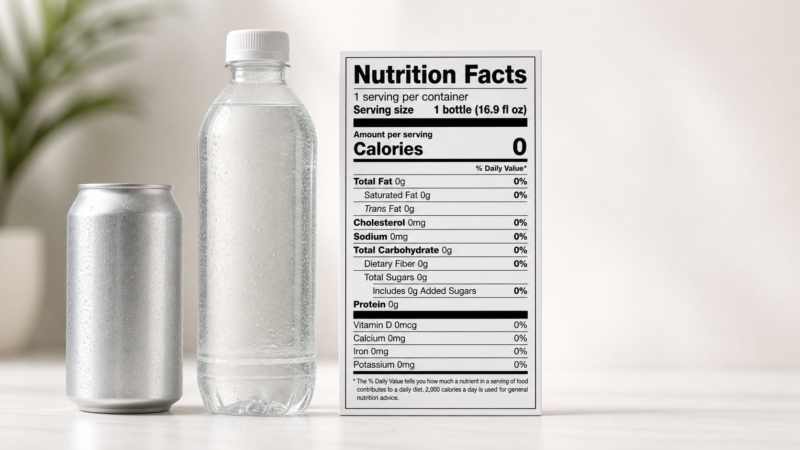
- Label compliance: Mandatory statements, ingredient declarations, allergens, Nutrition Facts, and appropriate product identity must comply with FDA labeling rules for foods and beverages.
- Prior Notice: FDA requires advance electronic Prior Notice for most food shipments arriving in the U.S.
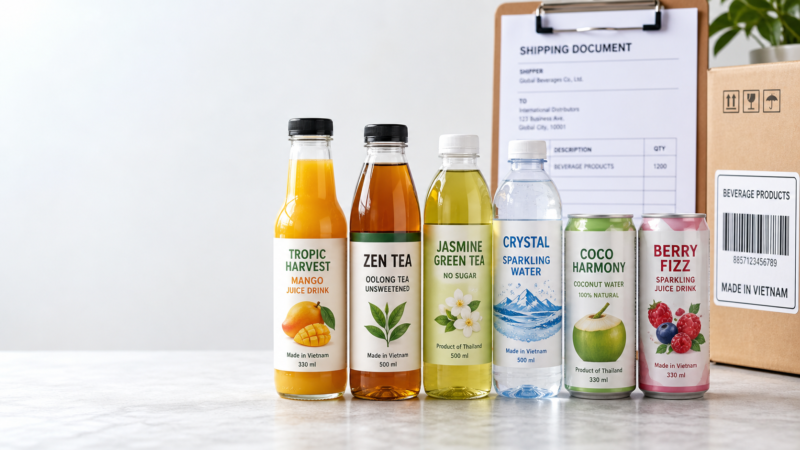
Logistics steps, cold chain, and documentation should align with customs procedures and FDA admissibility checks. For timing and paperwork across the route, see our guide to shipping beverages to the U.S.

Do U.S. buyers need a GFSI beverage manufacturer?
Not by law, but often yes in practice. Retailers, foodservice chains, and many e-commerce platforms strongly prefer or require a GFSI-recognized certification (such as FSSC 22000, BRCGS, or SQF) for supplier approval. GFSI audits don’t replace FDA rules; they complement them with structured, independently verified system controls.
Reasons U.S. buyers ask for GFSI certification include:
- Comparable baseline: GFSI benchmarking lets buyers compare suppliers across countries with similar audit frameworks.
- Ongoing oversight: Certification relies on periodic audits to maintain status, incentivizing continuous improvement and corrective actions.
- Retail onboarding: Many major accounts list GFSI certification as a prerequisite, which can shorten approval timelines.
Which scheme is “best” depends on product scope, existing systems, and auditor availability. FSSC 22000 is common in beverages, as are BRCGS and SQF across global supply networks.
How does juice HACCP certification fit with FDA compliance?
Juice HACCP is a U.S. regulatory framework for juice processors that requires hazard analysis and critical control points for safety. FDA requires compliance with the Juice HACCP rule; a third-party “HACCP certificate” is a marketplace proof point but is not the regulation itself.
In practice:
- Regulatory compliance: Juice HACCP programs are built to satisfy FDA’s juice rule; FDA can review plans, records, and monitoring.
- Third-party certificates: Buyers may ask for an external HACCP audit certificate as evidence of program maturity and implementation.
- GFSI alignment: GFSI schemes also require HACCP-based food safety plans; this can streamline combined compliance and certification maintenance.
For fruit and vegetable juices (including concentrates and NFC), expect to see a formal HACCP plan, validation records, corrective actions, verification activities, and training documentation for relevant personnel.
What is FSSC 22000 for beverage factories?
FSSC 22000 is a GFSI-benchmarked certification that builds on ISO 22000 food safety management systems plus prerequisite programs (PRPs) tailored to the facility type. For beverage factories, it offers a structured, auditable framework encompassing management commitment, hazard analysis, operational controls, and continual improvement.
Why U.S. buyers value FSSC 22000 for beverages:
- System integrity: Emphasizes management systems, risk assessment, and documented controls across manufacturing, sanitation, supplier management, and traceability.
- Global acceptance: Recognized by many international retailers and co-manufacturing networks as a credible benchmark.
- Compatibility: Integrates with existing HACCP or preventive control programs and can align with regulatory documentation used for FDA inspections.
FSSC 22000 certification is voluntary and not an FDA requirement, but it can reduce onboarding friction with U.S. buyers and provide confidence in the maturity of a beverage factory’s systems.
What documents should U.S. importers request?
Request documents that allow you to evaluate regulatory compliance, system robustness, and batch-to-batch consistency. Assemble a targeted, scope-specific package rather than asking for “everything,” which can delay onboarding without improving clarity.
- FDA basics: Facility registration confirmation; Prior Notice process; U.S. agent details if applicable.
- Food safety programs: Juice HACCP or preventive controls plan summary; hazard analysis; validation studies; monitoring and verification procedures; corrective action logs; internal audit schedules.
- Thermal process controls (if relevant): Process authority letters; scheduled process documentation; heat treatment parameters; hermetic seal controls; container integrity checks.
- GFSI certification: Current certificate with scope statement (products, processes, locations), last audit date, nonconformities and corrective actions if the supplier is willing to share summaries.
- Ingredient & packaging dossiers: COAs for key ingredients; specifications for sweeteners, acids, flavors, colors; water quality reports; primary packaging specifications and compliance statements (food contact declarations where applicable).
- Microbiological & chemical testing: Finished product test plans; shelf-life study summaries; environmental monitoring for ready-to-drink lines; allergen cleaning validation if allergens are present on site.
- Traceability & recall: Lot coding format; mock recall test summaries; supplier approval list and risk ratings; receiving and release procedures.
- Label compliance materials: Draft artworks; ingredient statements; juice content and “from concentrate” declarations; flavor labeling approach; caffeine disclosure if used; country of origin statement; allergen statements; claim substantiation files.
- Operational readiness: Master sanitation schedules; pest control programs; training records for HACCP/PCQI roles; calibration and maintenance logs.
Tip: Map each requested document to a specific verification objective. For example, request a process authority letter to confirm scheduled thermal processes, or request environmental monitoring summaries to assess Listeria controls for refrigerated, ready-to-drink lines.
How to verify an FDA-compliant beverage manufacturer?
Use a structured supplier approval process: evaluate the quality system, cross-check regulatory readiness, and confirm that the scope covers your products. Verification should combine documents, interviews, and—when feasible—an on-site or remote audit.
- Define scope: Clarify product type, process (hot-fill, aseptic, HPP, carbonation), packaging, shelf life, and intended U.S. sales channels.
- Pre-qualification: Request current GFSI certificate and FDA registration status; confirm whether the facility operates under Juice HACCP or preventive controls.
- Program review: Assess HACCP/PC plan adequacy; check validation, monitoring, verification, and corrective actions for critical controls (e.g., pH, fill temperature, retort/HTST, cleaning efficacy).
- Label readiness: Confirm ingredient statements, allergen management, and Nutrition Facts preparation approach; discuss claim substantiation and artwork review timelines.
- Pilot runs: Align on trial protocols, sampling, and release criteria; verify that batch records capture the critical data you will need for FSVP.
- Audit: Conduct a remote or on-site audit to validate the documented system against real practices, including sanitation, storage, and traceability.
If you plan to scale with national retailers, consider engaging an FDA-compliant beverage manufacturer with a strong audit track record. For support with outreach and scoping, see options for a suitable manufacturer for U.S. brands.
What labeling rules should beverage brands check?
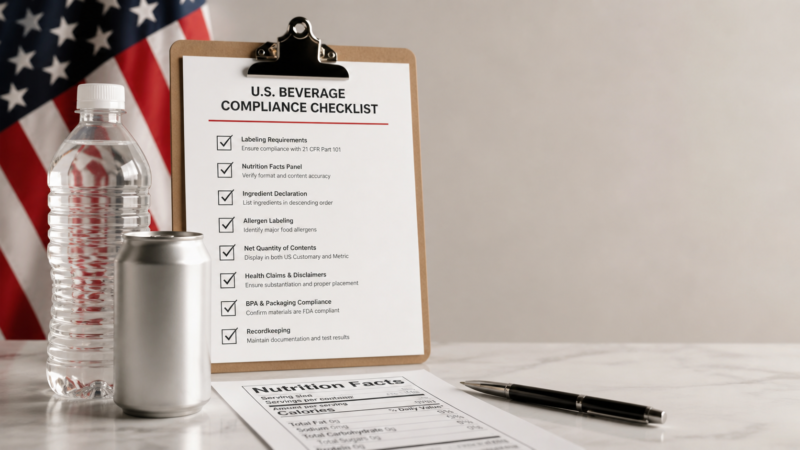
Labeling must align with FDA food labeling requirements for beverages. Artworks should be reviewed early to avoid relabeling or holds at the border. Focus on mandatory statements, truthful product identity, and any optional claims supported by records.
- Statement of identity: The common or usual name (e.g., “Sparkling Water,” “100% Orange Juice,” “Apple Juice Drink”).
- Net quantity: Proper units and placement.
- Ingredient list: Listed by descending weight; identify sub-ingredients as needed.
- Allergens: If present, declare in the manner required by U.S. law.
- Nutrition Facts: Correct format and nutrient declarations consistent with formulation and lab tests as needed.
- Juice content: Percentage of juice and “from concentrate” declarations where applicable.
- Flavors & colors: Appropriate flavor labeling and use of approved color additives; avoid implying the presence of ingredients that are not used.
- Claims: Keep claims truthful and not misleading; ensure you have substantiation files for voluntary claims (e.g., “no added sugar,” “contains vitamin C”).
- Caffeine disclosure: If you add caffeine, follow appropriate labeling practices consistent with product type and target consumers.
- Origin & business information: Include responsible party details as required.
Coordinate early between your formulator, regulatory reviewer, and artwork team so that updates to formula or process are mirrored in the label and supporting records.
Do shelf-stable, refrigerated and HPP beverages follow different controls?
Yes. Shelf-stable, refrigerated, and HPP-treated beverages use different control strategies, validation data, and distribution requirements. Matching the control scheme to the product and its hazards is essential for both FDA compliance and retail acceptance.
Typical differences include:
- Shelf-stable hot-fill/aseptic: Emphasis on validated heat processes, container integrity, pH/aw control, and commercial sterility. Documentation may include scheduled processes from qualified authorities.
- Acidified or low-acid canned foods: Specialized rules include process filings and strict monitoring of critical parameters like pH, temperature, and time, supported by verification and records.
- Refrigerated HPP beverages: HPP is a non-thermal lethality step; processors still validate shelf life and manage cold chain rigorously. Environmental monitoring for refrigerated, ready-to-drink lines may be part of the verification tools used by the facility.
- Cold chain & transport: Maintain appropriate temperatures and sanitary transport conditions with records to back them up.
Retailers will expect clarity about process controls, packaging compatibility, shelf life, and distribution conditions for each product format.
How do certifications differ for private label vs contract manufacturing?
Private label buyers and contract manufacturers often use the same certification frameworks, but responsibilities and document flows can differ. Clarify who is the U.S. importer, who owns label compliance, and which facility certificates cover the exact product and packaging format.
- Scope alignment: Ensure the factory’s certificate scope includes your beverage category, processing method, and packaging materials.
- FSVP responsibility: The U.S. party named as the FSVP importer must maintain verification records for the specific product and supplier.
- Change control: Final sign-off on formulation, processing parameters, and label changes must trigger document updates and, if needed, revalidation.
- MOQ & planning: Certification audits, artwork cycles, and process validations can affect timelines. Factor these into your beverage MOQ for U.S. projects and launch plan.
Marketplace certifications commonly requested
Beyond FDA compliance, the following marketplace certifications are frequently requested by U.S. buyers. Choose those that match your brand promise and target accounts; avoid over-certifying without a clear commercial benefit.
| Certification | Issuer | GFSI recognized? | Typical scope for beverages | Positioning & notes |
|---|---|---|---|---|
| FSSC 22000 | Foundation FSSC | Yes | ISO 22000-based food safety management plus PRPs for beverage plants | Common in beverage factories; strong system orientation and global acceptance |
| BRCGS Food | BRCGS | Yes | Comprehensive food safety and quality requirements for manufacturers | Widely requested by retailers and brand owners across categories |
| SQF | Safe Quality Food Institute | Yes | Food safety code with quality program options | Popular in North America; integrates safety and quality modules |
| HACCP certificate | Accredited certification bodies | Indirect | Audited implementation of HACCP principles | Useful proof point; does not replace regulatory HACCP requirements |
| Kosher | Recognized kosher agencies | No | Religious dietary compliance for ingredients and processes | Aligns with consumer positioning and specific retail channels |
| Halal | Recognized halal agencies | No | Religious dietary compliance, including ingredient sourcing | Important for markets and customers seeking halal assurance |
| Organic (USDA) | Accredited certifiers to USDA standards | No | Certified organic ingredients and production per USDA organic rules | Requires certified supply chain; labeling rules apply |
| Non-GMO Project | Non-GMO Project | No | Verification against the organization’s standard | Consumer-facing seal; requires ongoing verification |
Step-by-step compliance roadmap for the first U.S. shipment
Use this roadmap to reduce surprises on your initial entry. Tailor steps to your product type and sales channels.
- Define product scope: Clarify formulation, process, packaging, shelf life, temperature control, and intended claims.
- Map regulatory path: Determine if you fall under Juice HACCP or preventive controls; confirm any acidified/low-acid canned food requirements.
- Select certification approach: Decide whether you need a GFSI-recognized scheme now (e.g., FSSC 22000) or a staged plan aligned to target retailers.
- Build the document set: Assemble safety plans, validation data, supplier approvals, and traceability procedures aligned to FSVP expectations.
- Develop the label: Prepare compliant artworks, including juice % and any flavor or caffeine labeling, and collect substantiation for claims.
- Pilot run & testing: Execute trial production; verify controls, shelf life, and finished product specs with COAs.
- FSVP importer readiness: Identify the U.S. FSVP importer, complete risk evaluations, and define verification activities and records.
- Logistics alignment: Finalize Prior Notice workflow and transport conditions; prepare shipment documentation and temperature records.
- Retail onboarding: Share GFSI certificates, audit summaries as allowed, and standardized quality questionnaires with buyers.
- Ship & monitor: Submit Prior Notice, ship, and monitor for customs/FDA queries. Keep contingency stock for relabel or rework if needed.
- Post-market follow-up: Track consumer feedback, complaints, and quality metrics; close any audit or buyer action items.
- Continuous improvement: Update risk assessments, training, and supplier status based on new data, seasonality, or formulation changes.
Costs, timelines and pitfalls
Compliance is not just about passing an audit—timelines and operational realities matter. Plan for the following considerations:
- Audit scheduling: Lead times for certification bodies and auditors can extend, especially around peak seasons.
- Scope creep: Unclear product scope results in repeated document changes and label edits.
- Translation & terminology: Ensure technical English aligns with FDA terminology in plans and SOPs.
- Testing window: Micro and shelf-life studies may require multiple iterations across storage conditions.
- Artwork cycles: Retailer feedback, allergen language, and flavor descriptors can trigger multiple revisions.
- Change management: Ingredient substitutions and supplier changes must be reflected in hazard analyses, COAs, and labels.
- Recordkeeping discipline: Strong documentation practices make FSVP verification and inspections smoother.
Information for beverage brands and importers
Certifications and FDA compliance are most effective when integrated into your commercial plan. Treat them as part of your sourcing and category strategy, not an afterthought.
- Product brief: Share target nutrition profile, desired claims, thermal/refrigeration approach, pack formats, and distribution plan.
- Quality agreement: Define responsibilities for specifications, deviations, nonconforming product, change control, and recall coordination.
- Retail alignment: Prioritize certifications and documents commonly requested by your target channels.
- Supplier diversification: Qualify secondary suppliers where feasible to spread risk and manage capacity.
- Data consistency: Keep one source of truth for formula, label, and regulatory notes; version-control documents shared with partners.
Looking to expand your sourcing network? Explore options for a vetted supplier for U.S. importers and align expectations on safety, documentation, and timelines right from the start.

Selling into Australia as well? See beverage certifications for Australian importers.
FAQ
Is there such a thing as “FDA certification” for beverages?
No. FDA does not “certify” beverage factories or products. FDA sets rules for safety, labeling, and imports; compliance is required. Many buyers also ask for third-party certifications, but those are separate from FDA.
Do I still need FSVP if I buy through a U.S. distributor?
An FSVP importer must be designated for covered products. The responsible party and documentation duties depend on your commercial arrangement and who is named as the FSVP importer.
Is GFSI certification mandatory for U.S. entry?
No. It is not a legal requirement. However, many retailers and large buyers strongly prefer or require it for supplier approval and onboarding.
Does “juice HACCP certification” replace FDA’s juice rule?
No. FDA requires compliance with the juice rule; a third-party HACCP certificate is evidence of implementation but does not substitute for regulatory obligations.
Are organic or Non-GMO seals enough for FDA compliance?
No. Consumer-positioning certifications do not replace FDA safety, labeling, or import requirements. Treat them as additions to your compliance foundation.
How often must facility registration be renewed?
FDA requires periodic renewal of food facility registrations. Keep the registration active and up to date to avoid delays or holds.
Do I need a mock recall?
Many buyers expect evidence of traceability and recall capability. Conducting and documenting a mock recall helps demonstrate system readiness.
Who is responsible for label compliance?
The responsible firm marketing the product in the U.S. must ensure the label is truthful, not misleading, and compliant with FDA rules. Coordinate roles with your manufacturer in a written agreement.
What if our beverage is refrigerated and HPP-treated?
Validate lethality and shelf life, maintain cold chain, and ensure labeling aligns with the product’s characteristics. HPP is typically used alongside other controls and robust sanitation programs.
Note: Regulations evolve. Consult qualified regulatory professionals for product-specific advice.
In summary: FDA compliance establishes the non-negotiable baseline for U.S. beverage imports, while voluntary certifications—especially GFSI schemes like FSSC 22000—help satisfy retailer expectations and strengthen due diligence. Build a document set that supports FSVP, validate your process for the product type, and align label and claims with U.S. rules. With the right plan, beverage certifications USA can become a commercial accelerator, not a bottleneck.
When you are ready to move from scoping to execution, align stakeholders, confirm timelines, and engage partners early so audits, testing, and artwork cycles do not block your first purchase order or retail review.
Manufacturing for U.S. brands
If you are sourcing for the U.S. market, three pages cover what buyers ask first. The OEM route sets out how a specification becomes a shipped container; certifications and food safety systems covers the documents customs and retailers will ask you to produce; export and logistics covers shipping terms and the document pack. To price a programme, request a quote.
Sources
Certification requirements referenced here come from the U.S. regulator and from the certification scheme owners themselves.
- U.S. Food and Drug Administration — FSMA Final Rule for Preventive Controls for Human Food
- FDA — Juice HACCP
- Foundation FSSC — FSSC 22000 certification scheme
- Global Food Safety Initiative (GFSI)