


 Français
 Español
 العربية
 한국어
Juice HACCP in the United States requires a processor to build a process that consistently achieves a 5-log reduction of the most resistant microorganism of public health significance likely to occur in the juice. Several processes can qualify, but each one has to be validated and documented, not just named.
This article explains the rule in plain language, how hot fill, flash pasteurisation and high pressure processing each fit it, the logic of the shelf-stable exemption and the documents an importer is likely to ask for. It is general information, not legal advice, and the regulation itself should be read for any specific product.

What does the juice HACCP rule require?
The rule requires juice processors to have a HACCP plan with control measures that consistently produce at least a 5-log reduction, for a period at least as long as the product’s shelf life, in the pertinent microorganism. That microorganism is the most resistant one of public health significance likely to occur in the juice.
The requirement sits in 21 CFR Part 120, which applies to juice and juice products sold in the United States, including imported ones. The treatment must be applied directly to the juice, with a limited allowance for citrus processors that treat the fruit surface. The plan must be written, the process must be monitored and records must be kept. A 5-log reduction means a 100,000-fold reduction in the target organism, a statistical target that depends on validation data, not a visual or sensory check.
What does 5-log reduction mean in practice?
A 5-log reduction means that the process reduces the number of target organisms by a factor of 100,000. If a juice started with 100,000 organisms per millilitre, the process would leave an expected one per millilitre or fewer.
It is a performance standard, not a method. The regulation does not prescribe a particular temperature or machine. The processor chooses the process and must show with scientific evidence that it reaches the target for its product. That is why a process validation study, with a named target organism and defined critical limits, is the heart of the file.
How does flash pasteurisation meet the requirement?
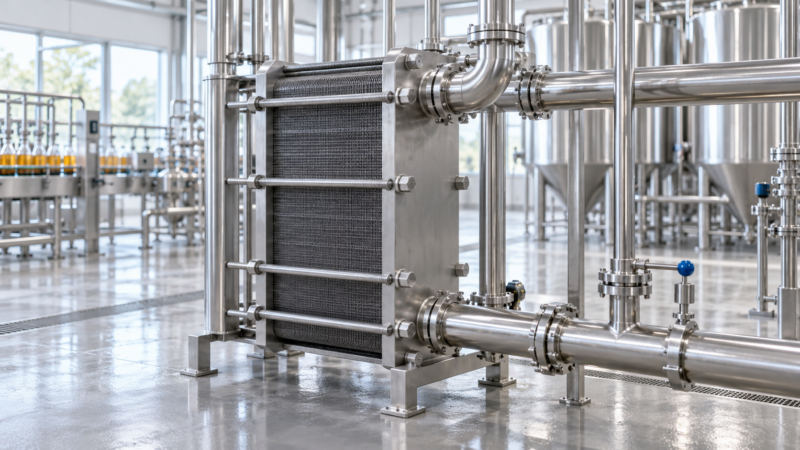
Flash pasteurisation can meet the requirement when its time and temperature, measured at the holding tube, are shown to deliver the 5-log reduction for the target organism in that juice. The critical limits are usually a minimum temperature and a minimum hold time.
Evidence usually includes the holding tube design, flow rate controls, a flow diversion valve that sends under-temperature product back for re-treatment and calibrated temperature recording. Because the juice is treated before filling, the HACCP plan also has to account for what happens afterwards, including filler hygiene. For a comparison of the process families, see tunnel pasteurisation for bottled and canned drinks.
How does hot fill meet the requirement?
Hot fill meets the requirement when the juice is heated to a validated temperature and filled and held in the container for a time that delivers the 5-log reduction on both the juice and the inner container surfaces and closure.
The control points include filling temperature at the filler, the hold time before cooling and the container orientation or inversion where used. Under-filling temperature, a slow line or a stoppage can let product cool below the critical limit, and then the lot has to be handled as a deviation. The packaging side of hot fill is described in our article on choosing a filling technology by beverage pH, and the wider shelf-stable route is in shelf-stable fruit juice manufacturing for export markets.
How does HPP meet the requirement?
HPP can meet the requirement when pressure, hold time and product conditions are shown by validation to deliver the 5-log reduction against the target organism. Critical limits normally include minimum pressure and minimum hold time at a defined product temperature.
HPP is a batch process in the final pack, so records are kept per cycle. The validation must reflect the actual juice, particularly its pH, because acidity affects how well pressure reduces vegetative pathogens, and the study organism should be relevant to the product. The product is treated in its container, so post-process contamination risk is low, but the chilled supply chain becomes part of safety and quality. See HPP for beverages: what cold pressure can and cannot do.
How do the three processes compare?
The table summarises how each process typically approaches the requirement. It does not replace a process authority’s validation for a specific product.
| Process | Typical critical limits | Where the kill step happens | Main record | Main watch point |
|---|---|---|---|---|
| Flash pasteurisation | Minimum temperature, minimum hold time | In the holding tube, before filling | Temperature chart, flow diversion log | Filling hygiene after the heat step |
| Hot fill | Minimum fill temperature, hold time, container handling | In the container, using product heat | Filler temperature log, hold time record | Cap and neck contact with hot product |
| HPP | Minimum pressure and hold time, product temperature, pH | In the sealed pack, per batch | Pressure and time record per cycle | Validation for the juice’s pH and cold chain |
What is the shelf-stable exemption?
The regulation exempts two groups from the 5-log control measure requirement: processors subject to the low-acid canned food rules, and processors using a single thermal processing step sufficient to achieve shelf-stability, or a thermal concentration process that heats all ingredients. Exempt processors must still document the thermal process in their hazard analysis.
The logic is that a thermal process strong enough to make juice shelf-stable at ambient temperature is already stronger than the pathogen reduction target, so a separate 5-log step would be redundant. The exemption is narrow and conditional, however. It relies on a single thermal step that achieves shelf stability, and the processor must include a copy of the thermal process in its written hazard analysis. A claim that a product is exempt should therefore come with that documentation.
What documents will an importer ask for?
US importers typically ask for the written HACCP plan or a summary, the hazard analysis, the validation evidence for the 5-log step, monitoring and verification records and proof of staff training. Without these, the importer cannot show that it is bringing in compliant product.
- Hazard analysis: identifying the pertinent microorganism and the control measures.
- HACCP plan: critical control points, critical limits, monitoring and corrective actions.
- Validation study: scientific basis for the 5-log claim for this juice and process.
- Monitoring records: temperature, time or pressure logs for the lots being shipped.
- Corrective action records: what happened when a limit was missed.
- Verification: calibration records and periodic review of the plan.
- Training evidence: that the person who develops and verifies the plan is trained as required.
For the labelling side of US entry, see the US food label checklist for imported beverages. For a view of the testing that supports verification, see microbiological testing for beverages.
How does pH influence which process qualifies?
Acidity influences both the choice of process and the target organisms. High-acid juices are generally treated against acid-tolerant pathogens, while low-acid juices raise additional concerns, and the pertinent microorganism in the hazard analysis changes accordingly.
For this reason the hazard analysis should name the pH of the finished juice and the organism it is designed against. A change in recipe that raises pH, such as blending with a less acidic juice, can change the validation basis. Processors should review the plan whenever formulation changes, and importers should ask which version of the plan covers the lot they are buying.
What does validation of a 5-log process involve?
Validation shows scientifically that the process delivers the required reduction, usually through published data, challenge studies on the actual juice or a combination. It is done before the process is used and repeated when the process changes.
- Choose the target organism: the most resistant organism of public health significance likely to occur.
- Define critical limits: temperature, time, pressure or other parameters.
- Collect evidence: literature, challenge testing or both, relevant to the juice and equipment.
- Document the study: who did it, how, and what it showed.
- Verify in production: check that the line really holds the critical limits.
Verification does not stop after approval. Records must show that every lot was made inside the limits.
What happens when a critical limit is missed?
When a critical limit is missed, the plan must specify a corrective action: hold the affected product, re-treat it or destroy it, and find and correct the cause. Product processed outside the limit cannot simply be released.
Flash lines often use a flow diversion valve to send under-temperature product back automatically. For hot fill, a line stop may require the affected bottles to be isolated and assessed. Corrective action records are among the first things an auditor or importer asks to see, because they show that the system works when something goes wrong.
How can an importer review a supplier’s juice HACCP file?
An importer can review the file by checking that it names the pertinent microorganism, states the process and critical limits, contains validation evidence and shows records for recent lots. Each of these should be traceable and consistent with the others.
Start with the hazard analysis. It should match the product actually shipped, including its pH and processing route. Next check that the critical limits in the plan match the limits on the monitoring records, and that the records are signed and dated. Look for evidence of calibration of the thermometers, pressure sensors and flow devices, since a precise record from an uncalibrated sensor proves little. Finally, check that deviation records exist and that they show the product was handled as the plan says.
If any part is missing, ask for it before the first shipment. A supplier that is organised can usually provide the file quickly, and a delay in producing basic records is itself useful information about the quality system.

Frequently asked questions
Does juice HACCP apply to imported juice?
Yes. Juice sold in the United States must meet the requirements of 21 CFR Part 120 whether it is made domestically or abroad. Importers are responsible for verifying that foreign suppliers meet them.
Is pasteurisation enough on its own?
Not by name alone. The pasteurisation conditions must be shown to achieve the 5-log reduction for the product, and the HACCP plan must cover everything else that can go wrong, including contamination after the heat step.
Does the rule apply to all drinks?
It applies to juice and juice products as defined in the regulation. Whether a given beverage counts as a juice product depends on its composition and labelling, so classification should be checked for each product.
Conclusion
The 5-log rule asks for a result and for evidence: any of flash pasteurisation, hot fill or HPP can qualify, but only with validation and records. Plan the file before shipping, not after the importer asks for it.
Next step: send us your spec and target market, and we confirm the route and the documents your destination expects.