


 Français
 Español
 العربية
 한국어
한국어A beverage Certificate of Analysis (COA) is a batch-specific report that lists key quality, safety, and regulatory parameters tested for a finished drink or ingredient, along with the methods and results. This guide explains how to read a beverage COA step by step so you can verify identity, compare results to specifications, and decide whether a batch is acceptable.
If you have ever searched for “certificate of analysis beverage,” this practical walkthrough will help you interpret common COA sections, understand typical test categories for soft drinks and juices, spot red flags, and connect the document to labeling and import requirements.
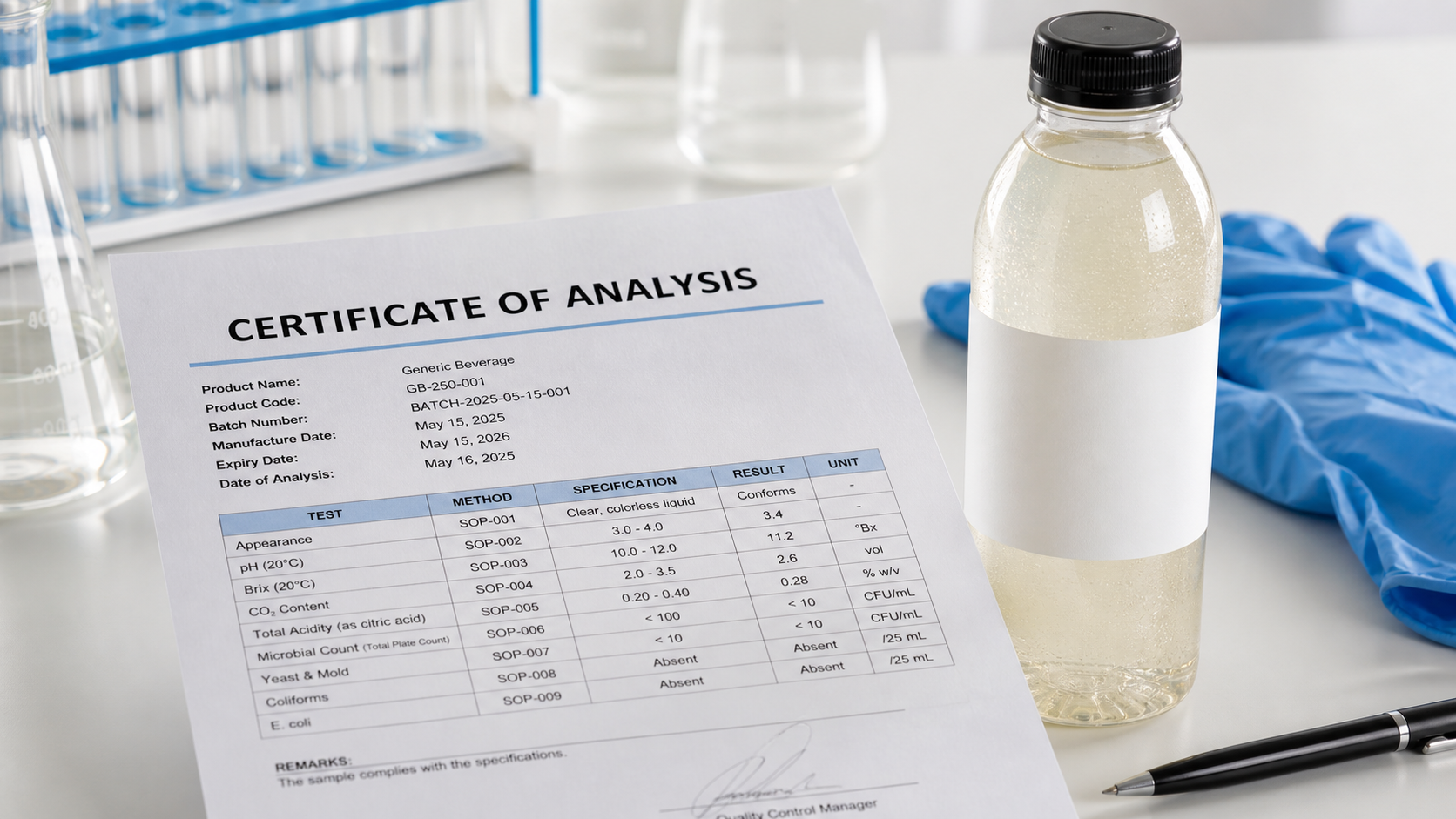
What is a Certificate of Analysis (COA) in beverages?
A COA is a lot- or batch-level document issued by the manufacturer or an accredited laboratory summarizing tests performed on a specific beverage or ingredient. It confirms the product meets defined specifications at the time of testing and provides traceability via batch number, production date, and method references.
Why does a COA matter for importers and brand owners?
The COA links your purchase order to verifiable quality and safety results. It supports due diligence, helps prevent nonconformances at the border or in retail audits, and informs release decisions. It can also support certifications or customer-specific requirements when combined with your product specification and supplier quality agreements.
If third-party certifications are part of your program, ensure the COA aligns with your certificate scope and controls. See the overview of relevant frameworks in Certifications.
How to read a beverage COA step by step
Use this practical sequence when reviewing any COA.
- Confirm identity: Product name, variant, pack size, and brand/PL line match your order and specification.
- Trace the batch: Batch/lot number, production date, and expiry/best-before are present and legible. These must match labels and shipping documents.
- Check the scope: The COA clearly states whether it covers finished product, concentrate, base, or an ingredient.
- Verify sampling: Look for a sampling reference or statement indicating representative sampling of the batch.
- Review test list: Parameters should reflect your specification and market requirements (e.g., Brix for juices, caffeine where applicable, microbiology where required).
- Match methods: Each parameter should cite a recognized or validated method (e.g., AOAC, ISO, ICUMSA, internal validated SOP).
- Compare results to specs: Each result should have a corresponding Specification or limit. Review Status or pass/fail if shown.
- Note reporting terms: Understand ND (not detected), <LOQ (below limit of quantitation), and rounding rules if provided.
- Confirm sign-off: A responsible person’s name, role, signature (wet or electronic), issue date, and lab/manufacturer details.
- File & link: Store the COA with the batch records and link it to receiving logs, labels, and certificates used for export/import.
Which parameters are commonly listed on a soft drink COA?
COAs vary by product type and market. Soft drinks and juices often include identity, physicochemical, microbiological, additive, and sensory checks. The selection should mirror your specification and regulatory needs. Below are typical categories you may see.
- Identity & appearance: Color/clarity, absence of foreign matter, label/pack verification.
- Brix & sugar profile: Degrees Brix for juices/nectars or sweetened beverages; sugar composition when applicable. For background on Brix in juices, see Fruit Juice Brix Explained.
- Acidity & pH: Titratable acidity and pH for flavor balance and process control.
- Carbonation: CO2 volume/pressure checks for carbonated soft drinks.
- Additives/actives: Caffeine, sweeteners, colors, preservatives (e.g., benzoate/sorbate), vitamins or minerals where fortified.
- Microbiology: Aerobic plate count, yeast & mold, coliforms, pathogens where required by risk assessment.
- Chemical safety (as applicable): Heavy metals, contaminants, migration for packaging-contact risks per program.
- Sensory: Aroma, taste, mouthfeel, off-notes screening against a reference standard.
- Packaging integrity: Torque, seam/closure checks, fill volume, leak tests.
| COA section/parameter | What it indicates | Common references | What buyers verify |
|---|---|---|---|
| Product identity | Links result to exact SKU/variant | Spec sheet, artwork code | Name, flavor, pack size match PO/spec |
| Batch & dates | Traceability and shelf life window | Lot code format SOP | Lot, production, and best-before readable |
| Brix / sugar | Soluble solids/sweetness target | ICUMSA/AOAC methods | Result aligns with product positioning |
| pH / acidity | Acid profile for taste & safety controls | AOAC/ISO titration & pH SOPs | Within agreed specification range |
| Carbonation | CO2 level and shelf stability | Internal validated SOP | Matches label claims and QC settings |
| Microbiology | Hygiene and safety indicators | ISO/AOAC culture methods | Meets limits; “ND” where required |
| Additives/actives | Presence/level of declared ingredients | AOAC/ISO, HPLC/UV methods | Compliance with formulation & market rules |
| Sensory | Consistency with reference standard | Internal panel SOP | No off-notes; passes acceptance |
| Packaging checks | Container performance and fill | Torque/seam SOPs | Meets closure, seal, and volume criteria |

How do you interpret results vs. specifications?
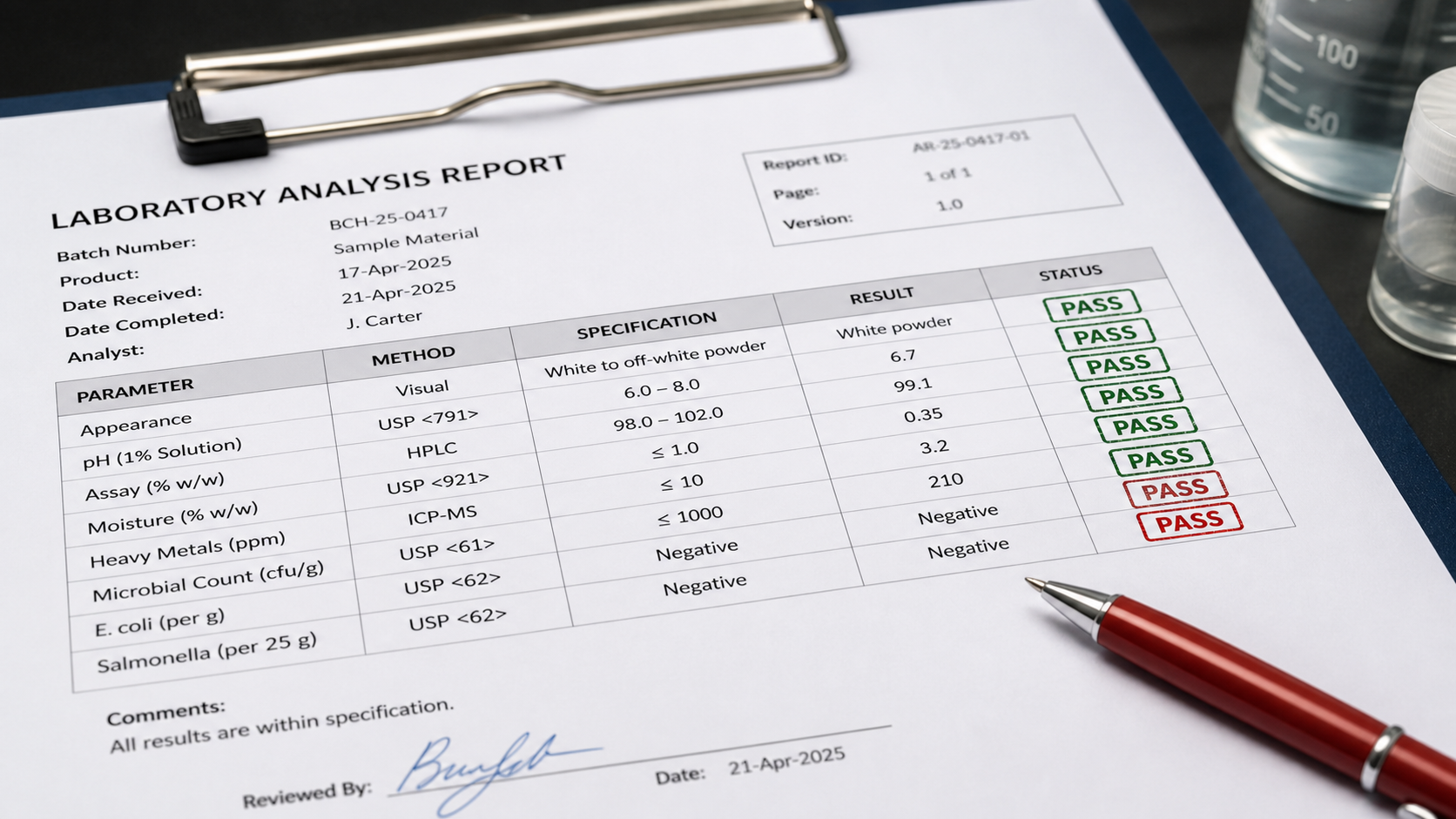
Start by locating three fields for each parameter: Result, Specification (target, range, or limit), and Status (pass/fail). A parameter passes when the reported value meets the stated specification or is not detected where a “not detected” requirement applies. Where a spec is a range, evaluate the full interval. If the COA lists uncertainty or rounding rules, interpret results according to those rules.
- ND / <LOQ: “Not detected” or “below limit of quantitation” indicates the analyte was not measurable by the method used. It does not necessarily mean absolute zero.
- Method-specific context: Results depend on the method. For example, different sugar or acid methods can produce slightly different values; consistency of method is essential for trending.
- Units matter: Ensure units match your spec (e.g., mass per volume vs. percent). Unit mismatches are a common source of apparent failures.
- Out-of-spec (OOS): If a parameter fails, request an investigation, potential retest, and a corrective action plan. Hold the batch until disposition is agreed.
What should you verify about batch identity and traceability?
Batch identity ties the COA to physical goods. Ensure the lot number format on the COA matches the coding on cases and individual units. Record cross-checks during receiving and link the COA to inbound inspection logs.
- Batch/lot & production date: Match COA, case codes, and pallet labels.
- Quantity/packaging: The pack type, closure, and volume on the COA align with what shipped.
- Chain of custody: If testing is external, the COA should identify the laboratory and sampling responsibility.
- Document linkage: Align with your SOPs and the manufacturer’s documented Production Process to ensure sampling represents the full batch.
Understanding test methods and acronyms on a COA
COAs typically cite recognized or validated methods so buyers can assess reliability and comparability. You may see references to ISO, AOAC, ICUMSA, internal SOP numbers, or instrument techniques such as HPLC, GC, ICP, or spectrophotometry.
- Why methods matter: Results are method-dependent. Agree on methods in your specification and keep them consistent across batches and suppliers.
- Validation: Internal methods should be validated for accuracy, precision, and matrix suitability. COAs may note validation status.
- Revision control: Check issue dates and revision numbers to ensure the latest method version was applied.
Do COA parameters change by beverage type?
Yes. Your specification should define parameters by product style and risk profile. While core identity and microbiology checks are common, some tests are more relevant for certain categories:
- Fruit juices & nectars: Emphasis on Brix, juice content, acidity, and sensory alignment with varietal profile. See Fruit Juice Brix Explained for purchase-level context.
- Carbonated soft drinks: Carbonation control, pH, sweetener verification, color stability, and closure/torque testing.
- Coconut water: Identity, mineral profile where specified, clarity, and heat-process validation for shelf-stable formats. For sourcing context, see Vietnamese Coconut Water: Why Vietnam Is the World’s Top Source.
Common red flags and how to resolve them
When a COA raises questions, act quickly and document your review. Typical issues include:
- Missing batch identifiers: Ask the supplier to reissue the COA with the correct lot number and production date.
- No specification column: Request the matching product specification or a COA format that includes limits for each parameter.
- Mismatched units: Confirm units and request a corrected COA with consistent reporting.
- Out-of-spec results: Initiate a hold, request retesting or root cause analysis, and agree on rework, replacement, or waiver per your quality agreement.
- Unclear methods: Ask for method references or validation summaries to support comparability.
- Unsigned/undated COAs: Request an authorized sign-off with role and contact details.
COA vs. Product Specification vs. Certificate of Conformance
These documents work together. Use this comparison to align expectations and audits.
| Document | Purpose | Who issues | When used |
|---|---|---|---|
| Certificate of Analysis (COA) | Reports actual batch test results vs. specification | Manufacturer or accredited lab | Per batch, supports release and receiving |
| Product Specification | Defines target values, ranges, methods, and packaging | Brand owner & manufacturer | At development; baseline for COA review |
| Certificate of Conformance | Declares batch conforms to agreed requirements | Manufacturer | Often accompanies COA to affirm compliance |
Linking the COA to labeling and import documentation
The COA is part of a broader compliance file that includes artwork approvals, ingredient lists, and market-specific statements. For U.S.-bound products, align results and formulations with labeling and import checks:
- Review formulation and test outcomes alongside the Nutrition Facts Label for Beverages in the United States.
- Cross-check finished goods paperwork against the U.S. Food Label Checklist for Imported Beverages.
- Ensure traceability fields and lot coding align with shipping documents and your quality program.
For certification alignment and a clean audit trail, keep COAs together with approved specs and relevant certificates in the same batch file. If your supplier’s program is certified, see Certifications to understand scope and evidence.
FAQ
Is a COA mandatory for every beverage batch?
Requirements vary by customer program, retailer, and jurisdiction. Many buyers require a batch-specific COA for every shipment. Even when not mandatory by law, a COA is widely used to support release decisions, due diligence, and audit readiness.
Can a COA be electronic?
Yes. eCOAs are common. They should include an authorized sign-off, issue date, and a secure link to method references or attachments per your quality agreement.
What does “ND” or “<LOQ” mean on a COA?
“ND” means not detected by the stated method; “<LOQ” means below the method’s limit of quantitation. These indicate the analyte was not measurable under the test conditions, not necessarily absolute zero.
How recent should a COA be?
COAs are typically batch-specific and issued near the production date. If a product is reworked or held for an extended period, your program may call for a review or retest according to risk and shelf-life considerations.
Key takeaways for beverage buyers
A well-constructed COA lets you confirm batch identity, compare results to specifications, and document compliance. Focus on identity fields, method references, and pass/fail against your agreed limits. Clarify ND and LOQ reporting, ensure signatures and dates are present, and file the COA with batch and labeling records. Where questions arise, request clarification or retesting and document the resolution.
Build your standard review checklist, align it with your product specifications, and link COAs to labeling and import files for a robust, audit-ready process. For broader operational context, review your supplier’s documented Production Process and certification scope via Certifications.
Compliance and shipping at ACMFOOD
For the certificates and food safety systems buyers and customs ask us to produce, see certifications and food safety systems. For shipping terms, the document pack and container planning, see export and logistics. To discuss a specific market, request a quote.
Request a quote