


 Français
 Español
 العربية
 한국어
한국어Fruit juice Brix is the percentage of soluble solids in juice, used as a practical proxy for sweetness and concentration. For beverage buyers, Brix links directly to how products are positioned on shelf—juice vs nectar vs juice drink—shaping fruit content expectations, labeling, and cost structure.
This guide explains what Brix measures, how suppliers control it, and how you should write Brix into briefs, specifications, and contracts. You will also see how Brix interacts with fruit content and category rules so you can evaluate samples and quotes with confidence.
What is Brix in fruit juice?
Brix indicates the percentage of soluble solids in a liquid. In fruit juice, most soluble solids are sugars, but organic acids, minerals and other solubles also contribute. A higher Brix generally signals a more concentrated or sweeter-tasting juice, but Brix alone does not equal sugar content or quality.
Juice technologists often talk about soluble solids content (SSC) and Brix almost interchangeably. Because acids and aroma compounds also affect taste, Brix is interpreted together with titratable acidity (TA), pH, color, pulp level, and sensory results. The Brix/acid balance is especially relevant to perceived sweetness, brightness, and flavor definition.
Each fruit has a recognized “single-strength” Brix range—i.e., the Brix level typically associated with not-from-concentrate juice for that fruit. Industry references (for example, widely used trade guidelines) help buyers and suppliers align on targets without guessing. When you evaluate quotes or ask for COAs, check that the Brix claimed is appropriate for the fruit and product style.
How is Brix measured and controlled in production?
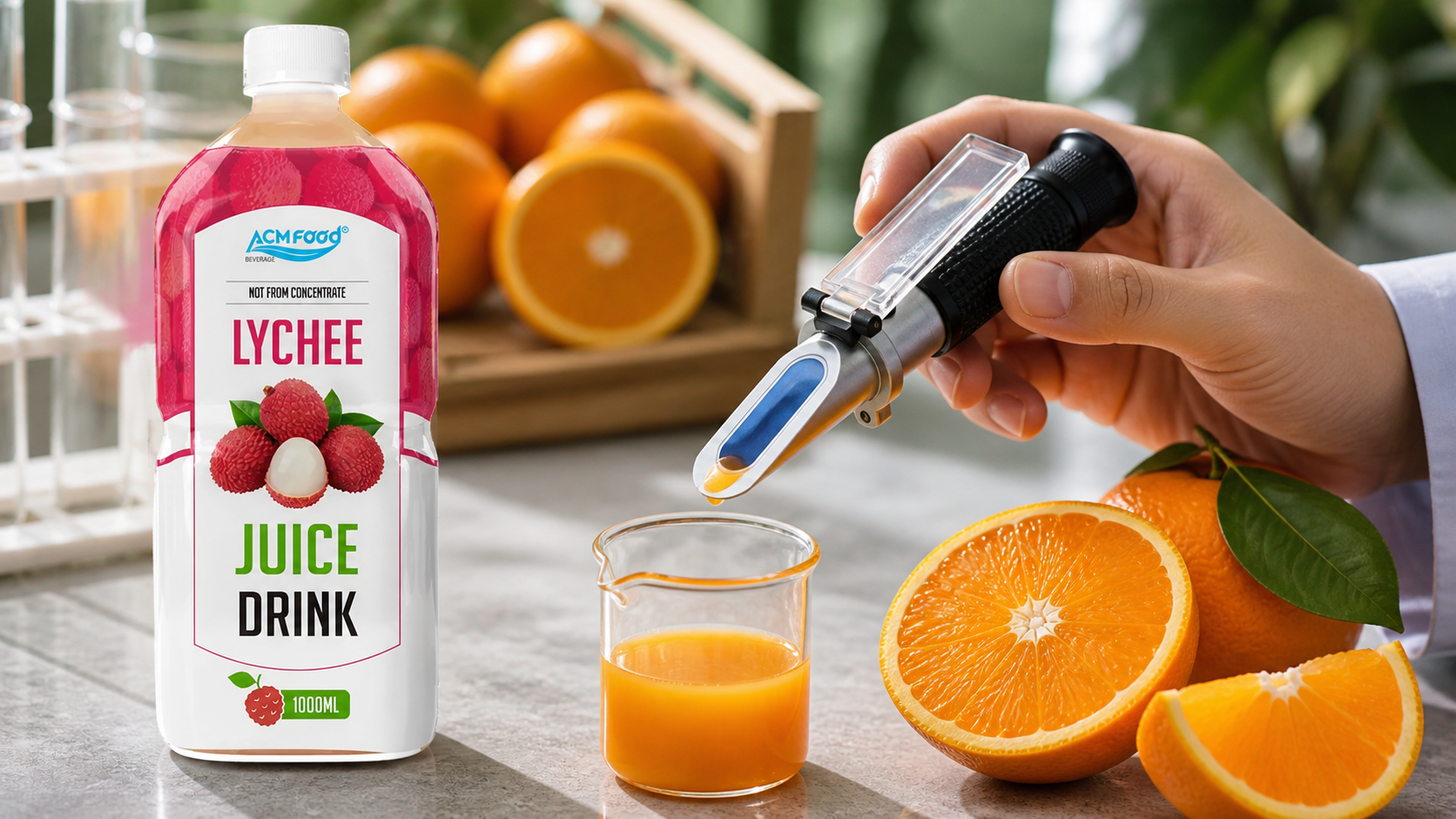
Suppliers commonly measure Brix with a refractometer, either handheld or bench-top, and report it at a defined reference temperature. Your specification should state the temperature basis and method to avoid disputes. Many plants also log in-line measurements and laboratory confirmations across batches.
Manufacturers control Brix by blending juices and concentrates, adjusting concentration during evaporation, and reconstituting concentrates back to single-strength with a calculated water addition. When producing from concentrate, a mass-balance calculation sets the reconstitution water required to reach the intended single-strength Brix.
Buyers should confirm which adjustments are permitted. For example, increasing Brix with sugar or non-juice sweeteners may be lawful for nectar or juice drinks in many markets but is typically not permitted for 100% juice. If you want sweetness adjustments without added sugar, some markets allow adding juice concentrates from the same or other fruits. Your spec and labeling plan must match the destination market’s rules.
What is the difference between juice, nectar and juice drink?
In simple terms, 100% juice aims to deliver the fruit’s single-strength profile without non-juice sweeteners; nectar is a diluted fruit beverage that may include added sugars or sweeteners; and a juice drink is a broader category with generally lower fruit content and more formulation flexibility. Exact definitions vary by market and must follow local regulations.
| Category | Typical definition | Sweeteners allowed | Fruit content expectation | Positioning & notes |
|---|---|---|---|---|
| 100% juice | Juice at single-strength or reconstituted from concentrate to single-strength. | Generally, no non-juice sweeteners. Some markets allow juice concentrates for taste balance. | Derived entirely from fruit juice. Specific fruit content claims must follow local laws. | Perceived as most natural; typically higher raw material cost and fruit intensity. |
| Nectar | Fruit beverage made by diluting juice/puree with water; formulation varies by fruit. | Often allows added sugar or permitted sweeteners within regulatory limits. | Fruit content is usually set by regulation and depends on the fruit and market. | Balances flavor, mouthfeel, and price; common for pulpy or tart fruits. |
| Juice drink | Broad beverage category with juice as one component among others. | Typically allows sugars and/or high-intensity sweeteners as permitted locally. | Fruit content may be lower and must meet local labeling rules for any claims. | Wider flavor flexibility; often used for value, functional blends, or reduced-sugar strategies. |
Because terminology is regulated, always align naming, ingredient list, and claims with your target market. If you plan cross-border sales, lock the category early and verify compatibility with all labeling jurisdictions you target.
How do Brix, fruit content and labeling connect?
Brix affects fruit taste perception and cost, but “fruit content” and permitted sweetening are legal-linguistic issues, not just technical ones. A beverage can test high in Brix because of added sugar or high-intensity sweeteners yet contain relatively low fruit content. Conversely, a 100% juice can have moderate Brix and still be fully compliant and authentic.
When a supplier presents Brix, ask what contributes to those soluble solids—pure fruit solids, sugar syrup, other sweeteners, or juice concentrates. For reconstituted products, confirm the concentration factor used and the basis for calculating single-strength. COAs should list Brix, method, temperature basis, and other relevant parameters so your regulatory and QA teams can review them against the label plan.
If your product will make front-of-pack claims (for example, “no added sugar”), ensure that the formulation pathway to reach your target Brix does not conflict with those claims in the destination market. Small formulation choices can have outsized consequences for claims and compliance.
What should buyers put in a Brix specification?
A precise Brix spec helps avoid disputes and protects your brand. At minimum, include:
- Product basis: NFC (not-from-concentrate) or from concentrate; single-strength or concentrate sold for reconstitution.
- Target Brix and tolerance: The acceptable range at the stated reference temperature and method (e.g., handheld or bench refractometer).
- Temperature basis & method: State the temperature and measurement method your QA team will use; include whether automatic temperature compensation is required.
- Brix adjustment policy: What adjustments are permitted (none; juice concentrates only; sugar; high-intensity sweeteners), subject to market regulations and label claims.
- Acidity and pH: Include titratable acidity and pH ranges to manage Brix/acid balance and sensory consistency.
- Fruit variety and origin: Specify preferred varieties or origins if they impact flavor, color, or supply risk.
- Clarity and pulp: Clarified vs cloudy, pulp percentage or sieve spec, and any filtration or fining requirements.
- Color parameters: Define target color space or visual standard and the method used to assess it.
- Microbiological & processing: Thermal process or alternative stabilization; shelf-life target and storage conditions.
- Packaging format: Bulk (aseptic, frozen) or retail pack; headspace and fill temperature expectations where relevant.
- COA requirements: Certificate of analysis fields (Brix, temperature, TA, pH, color, sensory notes, lot traceability).
- Calibration & sampling: Require documented instrument calibration and the sampling plan (start-up, in-process, finish).
- Regulatory fit-for-market: Confirm the category (100% juice, nectar, juice drink) and the exact markets for compliance review.
When preparing a brief, use a structured template so nothing is missed. This fruit juice RFQ guide can help your team capture Brix method, tolerances, and all related quality details in one place. If you are still selecting partners, see how to choose a fruit juice manufacturer that can hold tight Brix and sensory targets at scale.
Common pitfalls when using Brix for quality decisions
Brix is powerful but imperfect. Avoid these common traps:
- Confusing Brix with sugar-only: Brix includes all soluble solids, not just sugars. Two juices with the same Brix can taste different if their acidity and flavor volatiles differ.
- Ignoring Brix/acid balance: Perceived sweetness depends on acidity. Manage TA and pH alongside Brix to avoid flat or cloying profiles.
- Assuming high Brix equals high fruit content: Added sugars or sweeteners can raise Brix without increasing fruit proportion. Check the formulation and legal category.
- Comparing across fruits: Different fruits have different single-strength Brix norms. Compare against the correct reference for that fruit, not across fruits.
- Overlooking temperature effects: Brix readings shift with temperature. Always record the temperature basis and use temperature compensation where applicable.
- Sampling errors: Inhomogeneous tanks, pulp settling, or air bubbles can skew readings. Follow a robust sampling procedure.
- Unclear reconstitution math: From-concentrate products require clear concentration factors and mass-balance calculations to hit true single-strength.
- Label claim conflicts: Sweetness adjustments that help meet a target Brix can jeopardize “no added sugar” or other claims in some markets.
Practical scenarios buyers face
Consider these realistic, Brix-related decisions:
- Reconstituted apple juice vs nectar: A supplier offers a nectar with appealing taste at a competitive price. Even if the Brix is similar to apple single-strength norms, the nectar may include added sweeteners and lower fruit content. Check the category and label plan before comparing cost per liter.
- Orange blend consistency: A 100% juice spec targets a clean, bright profile. The supplier proposes blending origins and harvests to hold Brix and Brix/acid ratio within tolerance. Your spec should define sensory, TA, and Brix ranges so this flexibility still lands on the same consumer experience.
- Reduced-sugar positioning: For a juice drink, you target lower total sugars without non-nutritive sweeteners. The formulator suggests leveraging lower-Brix fruits and aroma-forward blending. Here, Brix drops, but perceived flavor can remain strong when acid balance and aroma are tuned.
From lab numbers to sourcing decisions
Brix is a lab number with commercial weight: it shapes fruit load, yield, taste profile, and compliance. Use it to compare quotes, but always with category rules and claims in mind. If you are vetting factories, add Brix control to your supplier audit checklist, including instrument calibration, sampling SOPs, and COA format.
As you model commercial scenarios—100% juice vs nectar vs juice drink—connect Brix to run size and packaging to avoid surprises on working capital. Read about private label juice MOQ and how Brix targets influence concentrate call-offs and inventory. For budgeting, map how fruit load and category choice move the cost of private label juice from ingredient line items through to landed cost.
FAQ
Does higher Brix always mean better juice?
No. Higher Brix can indicate more concentration or sweetness, but quality also depends on fruit character, acidity, aroma, color, pulp and freshness. A perfectly balanced moderate-Brix juice can outperform a very sweet, low-acid juice in consumer tests.
Is Brix the same as sugar content?
Not exactly. Brix measures total soluble solids, which include sugars plus acids and other solubles. It correlates with sweetness, but it is not a direct measure of sugar-only unless additional analysis is performed.
Can I compare Brix between different fruits?
Use caution. Each fruit has its own typical single-strength Brix range. Compare against the appropriate reference for that fruit and product style rather than comparing, say, apple to orange or mango to grape.
How is fruit content verified in from-concentrate products?
Through mass balance and reconstitution calculations based on concentration factors, supported by COAs and production records. Independent verification may include audits, documentation reviews, and analytical checks consistent with regulatory frameworks.
Which should I choose: 100% juice, nectar or a juice drink?
Start with your consumer promise, flavor goals, pricing, and claims strategy. 100% juice emphasizes fruit authenticity; nectar balances taste and cost; juice drinks offer broad flexibility for blends or reduced-sugar concepts. Align the category with your market’s rules and your brand positioning.
Conclusion & next steps
Brix gives buyers a simple, comparable datapoint that connects directly to taste, fruit load, and category. Use it alongside acidity, pH, color, pulp and sensory to build a rounded spec. Lock the category early—juice vs nectar vs juice drink—and ensure your formulation pathway matches labeling rules and claims in your target markets. Capture Brix targets, method, temperature basis, and adjustment rules in your RFQ and contracts, then verify with robust COAs and audits. That way, your product delivers the intended flavor and compliance, batch after batch.
Turning this into a product
For the formats, ingredients and processing routes the factory actually runs, see beverage product capabilities. The production side is covered under OEM beverage manufacturing services; for launching under your own label, see private label beverages. To discuss a specification, request a quote.
Sources
The distinction between juice, nectar and juice drink, and the minimum Brix values behind it, come from the Codex general standard for fruit juices and nectars (CXS 247-2005). Individual markets set their own labelling rules on top of it.
- Codex Alimentarius (FAO/WHO) — Standards, including CXS 247-2005 General Standard for Fruit Juices and Nectars
- U.S. Food and Drug Administration — Guidance for Industry: Food Labeling Guide
- Food Standards Australia New Zealand — Australia New Zealand Food Standards Code