


 Français
 Español
 العربية
 한국어
한국어Co-packer vs contract manufacturer refers to two ways beverage brands outsource production: a co-packer typically fills and packages your already-developed product, while a contract manufacturer usually offers broader, turnkey support that can include formulation, ingredient sourcing and regulatory services. In practice, the terms often overlap, so the real difference is the scope you agree in writing.
This guide clarifies definitions, where the models diverge, how pricing and risk allocation change, and how to choose the best fit for your stage and goals. You will also find a side-by-side comparison table and a practical RFP checklist to help you brief partners effectively.

What is a co-packer in beverages?
A co-packer (contract packer) is a production partner that primarily focuses on converting your provided inputs into finished, packaged goods according to your specifications. You bring the commercial-ready formula and, depending on the agreement, some or all materials (ingredients, packaging). The co-packer runs the line, executes quality checks and delivers case-packed products.
Typical co-packer roles in beverages include:
- Receiving your formula and processing instructions (thermal process, mixing order, carbonation targets, etc.).
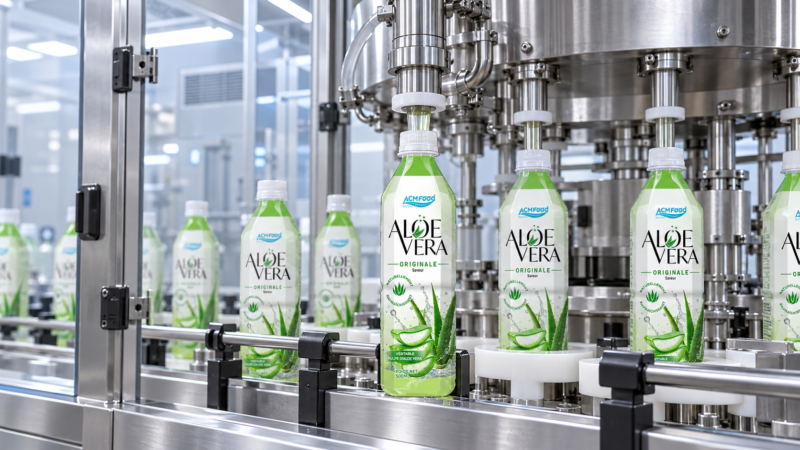
- Filling, sealing, pasteurizing or tunnel processing as required, then coding and case packing.
- Executing agreed quality checks (fill volume, seam/cap torque, temperature, visual defects).
- Managing changeovers and sanitation between SKUs or formats.
When to consider a co-packer:
- You already have a validated formula and process parameters.
- Your brand can supply all or key inputs (e.g., base, concentrate, labels) at agreed specs.
- You want an execution-focused partner to efficiently run lines at scale.
What is a contract manufacturer?
A contract manufacturer typically offers broader, turnkey capability. Beyond running lines, they can help develop or optimize formulations, source approved ingredients and packaging, and manage regulatory & technical documentation for target markets. Many also coordinate third-party testing, shelf-life studies and production planning across multiple SKUs or formats.
Typical contract manufacturer roles include:
- Product development support: flavor trials, stability considerations, sweetener strategies, color and turbidity management.
- Procurement: sourcing approved ingredients and packaging at specified grades and lead times.
- Scale-up: translating benchtop formulations into commercial batch sheets and processing windows.
- Compliance documentation: assisting with nutrition labeling inputs, ingredients statements and market-specific claims feasibility depending on the project brief.
- Supply chain coordination: aligning MOQs, safety stock, and production cadence.
Co-packer vs contract manufacturer: what’s the difference?
In general, a co-packer focuses on execution of your finished formula using provided materials, while a contract manufacturer offers a wider remit: formulation support, sourcing, compliance coordination and turnkey delivery. However, many providers blend both models. The only reliable way to define the difference is to document scope, responsibilities and pricing in your agreement.
| Area | Co-packer (typical) | Contract manufacturer (typical) | Positioning & notes |
|---|---|---|---|
| Product development | Not included; you provide a final formula and specs | Can support ideation, benchtop trials, and scale-up | Turnkey support reduces R&D burden but adds fees |
| Ingredient sourcing | You source and supply (or nominate vendors) | They source to approved specs and manage lead times | Helps consolidate supply but confirm approval steps |
| Packaging procurement | Often you supply, or they buy to your PO | Commonly included in turnkey scope | Check MOQs, storage, obsolescence terms |
| Quality documentation | Batch records; in-process QC per SOPs | As left + stability studies and broader documentation | Define test methods, acceptance limits, and CoAs |
| Regulatory inputs | Limited to production compliance | Can assist with labeling inputs and compliance data | Brand remains responsible for final label and claims |
| Ownership of formula | Yours; they run per your instructions | Depends on engagement; proprietary or shared if developed | Clarify IP in the master agreement |
| Pricing model | Conversion fee (tolling), set-up, changeover | Turnkey cost-plus or fixed per unit, by scope | Map what’s included vs pass-through |
| Forecasting & inventory | You plan and hold most inputs | They may hold or manage inventory under terms | Align safety stocks and liability |
| Flexibility | Efficient for stable, defined SKUs | Better for evolving products and new launches | Change control is key in both models |
| Best for | Brands with mature formulas needing capacity | Brands needing development + execution | Choose by your capability gaps |
Which model fits your brand stage and needs?
Match the model to your internal capabilities, launch timeline and risk appetite:
- Pre-launch or reformulating: A contract manufacturer can help translate concept to commercial reality, run pilot trials and align ingredient MOQs with your demand curve.
- Scaling a validated SKU: A co-packer can efficiently add capacity and geographic reach if your formula and bill of materials are locked.
- IP-sensitive formulas: Use a co-packer with strict confidentiality when you own sourcing and formula; or a contract manufacturer with clear IP clauses and restricted disclosure.
- Private label expansion: Contract manufacturers often maintain approved ingredient and packaging catalogs to accelerate timelines.
- Multi-market compliance: A contract manufacturer may coordinate inputs for different markets, while the brand finalizes labels with local counsel.
For a strategy overview on supplier models in the U.S., see private label vs white label vs OEM.
How do pricing models differ?
Expect different cost structures and responsibilities:
- Co-packer (conversion-based): A per-case or per-unit conversion fee to run your materials, plus set-up and changeover charges, line-time minimums, and sanitation downtime. You often purchase and own ingredients & packaging, absorbing price swings.
- Contract manufacturer (turnkey): A bundled per-unit price that includes ingredients and packaging at agreed specs. The manufacturer manages procurement and may charge cost-plus margins or fixed pricing with escalation clauses.
Across both models, request transparency on:
- Included vs pass-through costs: freight-in, storage, testing, artwork prepress, palletization details.
- Yield and waste assumptions: breakage, start-up losses, and how variances are reconciled.
- Change control fees: flavor tweaks, label revisions, or supplier substitutions mid-contract.
- Minimums: run-size minimums, and component MOQs when you buy custom caps, sleeves, or printed cartons. If you’re exploring private label, review Private Label Fruit Juice MOQ: What Buyers Need to Know.
What to include in your RFP or product brief
A precise brief prevents misunderstandings and speeds quotations. Include:
- Commercial objective: product type, target markets, desired launch window, volume forecast and ramp assumptions.
- Formula status: benchtop prototype vs commercial formula; processing method (HTST, tunnel pasteurization, hot-fill, carbonated cold-fill).
- Bill of materials: ingredient list with specs and preferred suppliers; allergen statements; packaging components (bottle/can size, closure, label/sleeve, tray/case).
- Regulatory considerations: inputs for labeling (serving size, ingredients, allergens). For U.S. labeling mechanics, see Nutrition Facts label for U.S. beverages.
- Shelf-life target & testing: required studies, storage conditions, and micro limits if applicable to the product type.
- Quality and certifications: define needed programs and audit rights (e.g., HACCP-based systems), without implying claims on pack.
- Logistics: delivery terms, pallet pattern, stretch wrap, case coding, and ship-to details.
- Artwork & prepress: dielines, proofing steps, and sign-off responsibilities.
Quality, compliance, and risk allocation
Both models require clear governance. Helpful provisions include:
- Specifications hierarchy: master product spec, approved vendor list, and change-notification thresholds.
- Testing and release: in-process checks, finished product criteria, and documentation such as Certificates of Analysis where applicable.
- Traceability & recall roles: lot coding requirements, record retention, mock-recall expectations, and notification timelines.
- IP and confidentiality: ownership of formulas, process know-how, and artwork; limits on reuse across clients.
- Force majeure and contingency: risk-sharing for supply shocks, substitute materials protocols, and surge capacity planning.
Can one partner be both?
Yes. Many beverage partners offer both co-packing and contract manufacturing services. You might start with turnkey support to move fast, then migrate to a leaner co-pack scope once the formula is mature and volumes stabilize. Use a master service agreement with detailed statements of work so scope can expand or contract without renegotiating fundamentals.
Geography matters: U.S. and Australia examples
Commercial and regulatory contexts vary by market, which may influence your choice:
- United States: Consider logistics to main distribution hubs, state-specific recycling and deposit labeling, and your compliance workflow. If you’re evaluating partners, review contract beverage manufacturing for U.S. brands.
- Australia: Seasonal fruit availability and long internal distances can affect planning. Read about contract manufacturing in Australia or explore a beverage manufacturer for Australian brands if you need local fill capacity.
If your growth path includes private label SKUs for the U.S. market, align your sourcing and label strategy by revisiting private label vs white label vs OEM.
FAQ: Co-packer vs contract manufacturer
Do co-packers develop recipes?
Typically no. Co-packers usually run your finalized formula and specs. Some facilities have optional development services, which is closer to a contract manufacturing model. Confirm scope and fees in your SOW.
Who buys ingredients and packaging?
In co-packing, brands often purchase and supply materials. In contract manufacturing, the partner commonly procures to approved specs and passes through costs per agreed terms. Always clarify liability for overages, obsolescence and storage.
Who owns the formula and process?
Brands generally own their pre-existing IP. If the partner contributes development, ownership may be proprietary to the brand, shared, or licensed. Define IP ownership, use rights and confidentiality in the contract.
What about MOQs and changeovers?
Both models have line-time minimums and changeover costs. Contract manufacturing adds upstream MOQs on ingredients and packaging. Plan your SKU mix to minimize changeovers and consider insights from Private Label Fruit Juice MOQ: What Buyers Need to Know.
Is white label the same as contract manufacturing?
White label refers to selling standardized formulas under your brand; contract manufacturing is a service model that can cover custom or standard products. They can overlap, but one describes product type and the other describes a production relationship.
Conclusion: turn definitions into clear scope
“Co-packer vs contract manufacturer” is less about labels and more about scope, accountability and risk-sharing. If you have a ready formula and materials, a co-packer can add efficient capacity. If you need formulation, sourcing and compliance help, a contract manufacturer can deliver a turnkey path to market. Either way, a precise brief, aligned specifications and robust change control are the fastest route to reliable supply.
Planning a market-specific rollout? Explore contract beverage manufacturing for U.S. brands and contract manufacturing in Australia to understand regional considerations before you finalize your scope.