


 Français
 Español
 العربية
 한국어
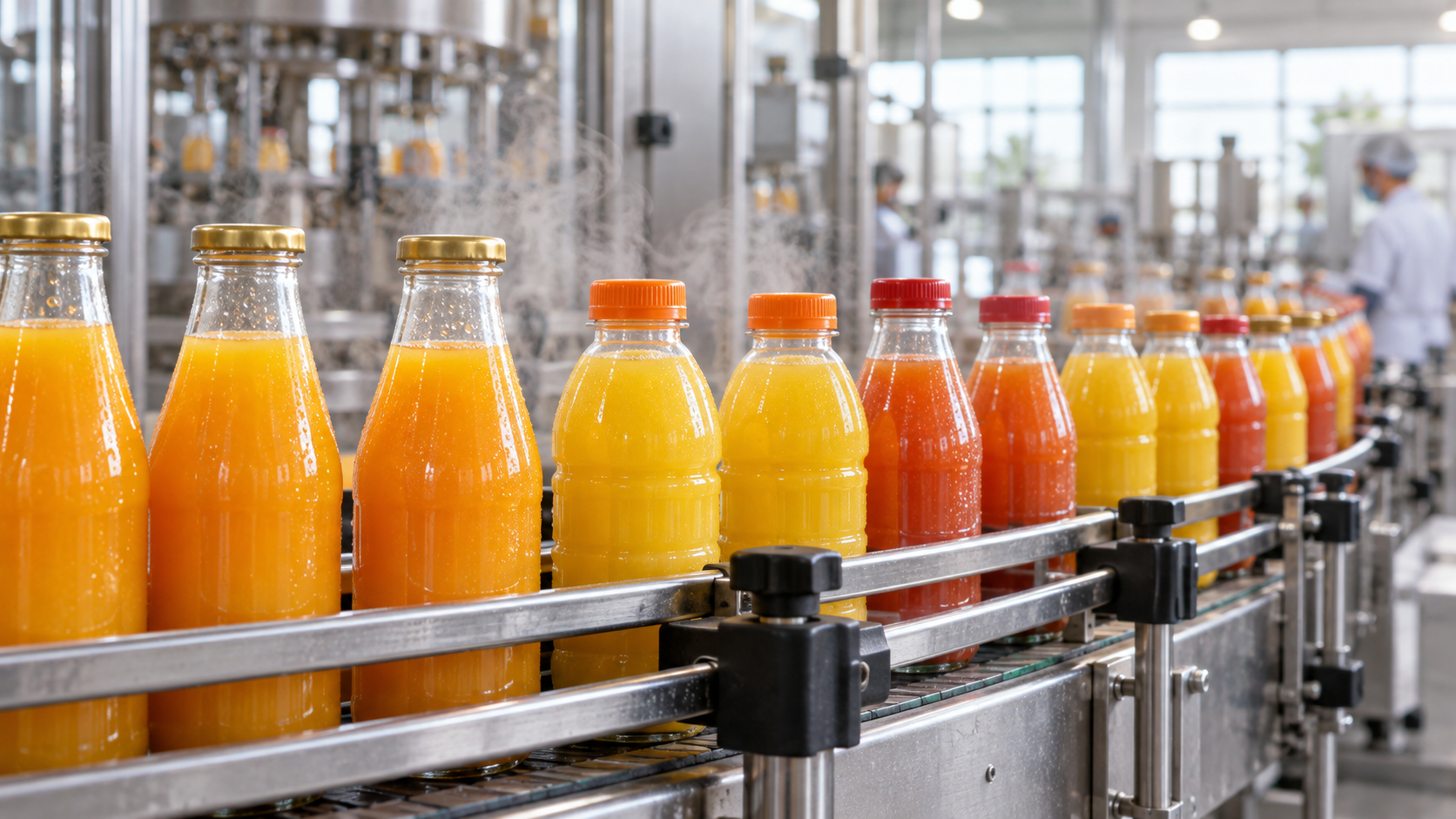
Hot-fill hold time is the period the sealed, hot-filled bottle stays hot enough for the product to treat the inside of the cap and neck. The cap needs heat too, because it is the part of the pack most likely to stay untreated if the bottle is cooled too soon or never turned to contact the closure.
This article covers the temperature and time logic at the closure, why bottles are inverted or laid down, what a cooling tunnel does and why under-cooling hurts flavour. It is a narrow technical piece; the wider picture of hot filling is in choosing a filling technology by beverage pH.
Why does the cap need heat in a hot-fill process?
The cap and the neck of the bottle are filled with air or headspace, not with liquid, so they are not automatically sterilised by the hot product. Unless hot liquid or hot vapour contacts them for long enough, microorganisms on the underside of the cap may survive.
When a bottle is filled, the liquid reaches the filling level and a headspace remains between it and the closure. The cap is sealed onto a neck that has been contacted by splashes and rising vapour, but the inside surface of the cap may not have been in contact with hot liquid. That surface is exactly where a surviving organism could later grow if conditions allow. Contact between the hot product and the closure during a defined hold is therefore part of the kill step, and it is why hot fill is a pack-and-product process, not only a product process.
What is hold time, and how is it set?
Hold time is the interval between capping and the start of cooling, during which the product keeps the closure surface at or above a target temperature. It is set by validation for the specific product, bottle, cap and line.
Two numbers define it: the temperature at the closure, and how long that temperature is kept. The relationship between them is inverse. A higher temperature allows a shorter hold, and a lower temperature needs a longer hold to achieve the same reduction. The values depend on the target organism, the acidity of the product and the local regulatory expectation, so no universal figure should be copied from another product. The process authority or validation study should state the limits, and the filler records should show that each lot met them.
Why are bottles inverted or laid down?
Inversion or laydown brings the hot liquid into contact with the inside of the cap and the neck, which would otherwise stay in headspace. The bottle is turned for a set time so that the liquid washes the closure surface.
Different lines do this in different ways. Some tip the bottle upside down on a conveyor or holding rack, some lay it on its side, and some use a holding conveyor that keeps the bottle upright after a hot-fill sequence designed to splash the closure. The choice depends on the bottle shape, the cap and the available space. Laydown and inversion need consideration of the cap seal, since hot liquid pressing against the closure tests the liner and thread, and a poor seal can leak or draw in contamination as the contents cool.
How do the common approaches compare?
The table gives a general comparison of closure-treatment methods in hot filling. It is not a recommendation for a specific line.
| Approach | How the closure is treated | Strength | Point to watch |
|---|---|---|---|
| Inversion hold | Bottle turned upside down for a set time | Direct liquid contact with cap | Seal integrity under hot liquid pressure |
| Laydown hold | Bottle laid on its side on a conveyor | Easier mechanically for some bottle shapes | Contact with the full closure surface |
| Upright hold | Bottle held upright after capping | Gentle handling | Depends on vapour and fill height to treat the cap |
| Cap pre-treatment | Cap sterilised before application | Reduces reliance on hold | Extra equipment and validation |
What does the cooling tunnel do?
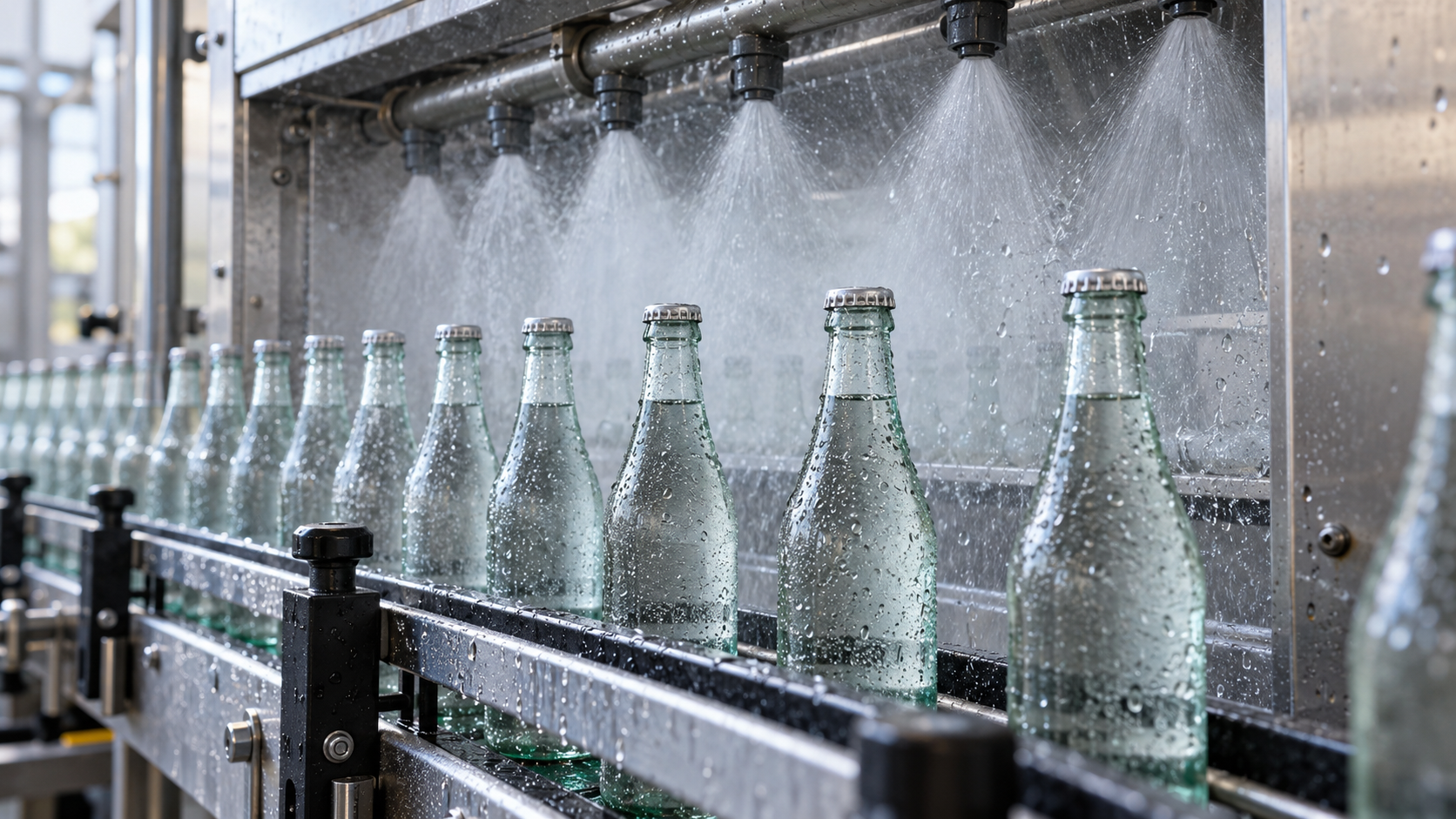
The cooling tunnel brings the hot-filled bottle down to a safe handling temperature in controlled steps using sprays of progressively cooler water. It stops the heat treatment and protects the bottle, label and product quality.
Cooling also protects the bottle. Cooling too sharply can cause stress in glass and distort plastic, so the tunnel steps down temperature gradually. As the contents cool they contract, and the vacuum or panel accommodation of the bottle takes up the change. The tunnel therefore has to be designed for the bottle, the fill temperature and the speed of the line, and the line speed should be checked against the hold and cooling time the process needs.
Why does under-cooling hurt flavour?
Under-cooling leaves the product warm for longer after filling, and continued heat exposure dulls fresh notes, deepens colour and can create cooked flavours. The product keeps reacting while it is still hot, even after the kill step is complete.
The effect is cumulative. A bottle that leaves the tunnel warm, then goes onto a pallet, can stay warm for hours because the centre of a pallet cools slowly. Colour may darken, volatile aroma may be lost and sweetness may seem flatter. Some processors cool bottles to a defined temperature before packing for this reason. Over-long holding does the same: the longer the product is hot, the more flavour changes, so the target is enough heat for the kill step and no more.
What goes wrong when the process is not controlled?
The typical failures are cap temperature that falls short, inconsistent bottle inversion, interrupted lines that leave bottles waiting and cooling too slowly or too quickly. Each leaves a different mark on safety or quality.
- Line stops: bottles waiting in the hold section lose temperature, and the lot may miss its critical limit. Products from a stoppage need a defined deviation procedure.
- Fill temperature drift: product that is filled below the target temperature gives a shorter effective hold.
- Cap variation: different caps and liners respond differently to heat and seal, so a cap change needs revalidation.
- Cooling errors: too fast risks container damage, and too slow harms flavour and colour.
- Label and carton heat: bottles packed warm can cause condensation, mould risk on cardboard and label problems.
What should a buyer check?
A buyer should check that fill temperature, hold time and cooling are defined, monitored and recorded for each lot. The process should be validated for the actual bottle and cap, and the plant should have a clear rule for what happens when a limit is missed.
- What is the minimum fill temperature, and where is it measured?
- What is the hold time, and how is it enforced when the line slows?
- How is the closure treated: inversion, laydown, or cap pre-treatment?
- What is the target product temperature at the end of cooling?
- How are deviations handled, and how are affected lots identified?
- When was the process last validated, and for which bottle and cap?
These questions apply whatever the packaging. For packaging selection, see how to choose beverage packaging for export, and for related testing, microbiological testing for beverages.
How is hot-fill hold time validated?
Validation uses temperature probes to record the temperature at the closure and neck during the hold and cooling, under the worst-case line conditions. The data show whether the closure surface reaches and keeps the target temperature.
The worst case usually means the lowest allowed fill temperature, the slowest cooling of the cap region and the longest line interruption the plan allows. Repeating the study on different shifts and with different cap lots builds confidence. If a line speeds up, the hold section shortens, so speed limits are part of the validated process, not a production preference.
What happens to a line stop?
A line stop affects bottles in two ways: bottles already hot-filled wait longer than planned, and bottles upstream may cool before being filled or capped. Both cases need defined actions so that affected product is identified and handled.
- Bottles waiting in the hold section may be acceptable if the stop is within the validated window.
- Bottles filled below the critical temperature must be held, reprocessed or discarded according to the plan.
- Product in the filler bowl may need to be returned to the heat exchanger and re-heated.
- Records should show the time of the stop, the lots involved and the decision taken.
Which caps and liners suit hot filling?
Caps and liners for hot filling must hold their shape and seal at filling temperature and as the contents cool and contract. Material, liner type and thread design all influence the seal.
Ask the closure supplier for evidence at the filling temperature of the project, as well as the torque range and the vacuum retention after cooling. For packaging decisions in export projects, our guide to beverage packaging options compared sets the wider context.
How do hot-fill bottles and glass jars differ in this process?
Glass handles hot fill well but is sensitive to thermal shock, so the cooling profile must be gentle. PET is lighter and cheaper to ship, but it needs a heat-set design and has less margin for temperature errors.
For glass, the key checks are the temperature difference between the glass and the cooling water, the support of the bottles during cooling and the closure, which is often a metal cap with a liner designed for hot filling. For PET, the checks are bottle shape retention, vacuum panel behaviour and the cap seal. In both cases the hold time and the inversion method must be validated for the exact container, and a change from glass to PET, or one bottle design to another, is a change that needs a new validation.
Consider shipping as well. Glass is heavy and fragile, while PET bottles can deform under stacking if they leave the tunnel warm, so the pallet plan and the cooling target should be agreed together.

Frequently asked questions
Is hold time the same as cooling time?
No. Hold time is the period at kill temperature after capping, and cooling time is the period needed to bring the bottle down afterwards. They happen one after the other and are specified separately.
Do all hot-fill lines invert the bottle?
Not all. Some use laydown, some rely on upright holding with vapour contact, and others sterilise the cap beforehand. The method must be shown by validation to treat the closure.
Can a bottle be hot-filled and then chilled quickly?
Fast chilling is possible only within the limits of the container, since sudden temperature change can crack glass or deform plastic. Cooling profiles are designed for the specific bottle.
Conclusion
Hot fill works when temperature and time at the closure are controlled, the bottle is turned or held so the cap is treated, and the cooling profile protects both bottle and flavour. The cap is not an afterthought; it is part of the process. For drinks that do not suit hot fill, compare the other routes in our beverage processing technology overview.
Next step: send us your spec and target market, and we confirm the route, including the hold and cooling plan for your bottle and cap.